
The Unstoppable Rise of Voice AI in Financial Services: Beyond the Basic IVR
Over many years, the banking sector and non-banking financial companies have been using the most universally hated, but at the same time the most universally used device ever.
Everyone knows how this story goes. You contact a bank or an NBFC about an emergency situation with your loan application and immediately hear a recording asking you to press “One for English, Two for Account Balance, Three for speaking to the executive.”
Once you press all the required buttons, you are placed on an eternal hold and forced to listen to monotonous elevator music. The problem is that the use of such devices is extremely inconvenient not only for customers, but also creates a significant operational bottleneck for large banks and NBFCs.
A paradigm shift of enormous proportions, however, is currently occurring within the realm of fintech. Voice AI is no longer a mere figment of future aspirations that finds its existence only in tech expos; rather, it has become an undeniable reality in which legacy platforms are being uprooted and revolutionizing customer experiences as we know them.
Are you still compelling your clients to adhere to strict keyword commands and pushing them around on a dial pad? Then you have already missed out. Below is a look into how institutions have been able to rapidly transition to Conversational Voice AI to achieve unparalleled Return on Investment (ROI).
The Evolution: From "Command-Based" to True "Conversational" AI
In order to grasp the concept of the revolution, one must first grasp the distinction between conventional bots and contemporary Voice AI. Old IVRs and voicebots that were in their nascent stage operated using commands. The bots had very rigid decision-making algorithms and if any word that was not programmed in its dictionary was uttered by the customer, the bots failed.
Conversely, Generative AI-driven modern Voice AI works differently. The latter uses state-of-the-art NLP technology and thus does not operate using keyword recognition but understands context and intent.
Picture a scenario where a borrower calls an NBFC and starts with a quick statement: “Hi, my EMI didn’t come through yesterday since my salary was late, am I okay to make my payment tomorrow with no penalty?”
While a legacy model will completely break down here, Conversational AI immediately grasps the complexity of the request.
It recognizes that there is an entity (the caller), problem (bounced EMI), cause (late salary) and the resolution (payment tomorrow). The intelligent software then uses API integrations to look up the customer’s account in the CRM, finds out their previous payment records, calculates if there is any grace period available, and responds in a friendly, human tone: “Hello Rahul, I get it.
I see your EMI for Rs. 15,000 was missed.
I have now rescheduled your payment for this Friday. Would you like to pay using UPI or net banking?”
Apart from being able to deal with interruptions and pauses in speech, modern Conversational AI models can speak in different languages, including regional ones, such as Hindi, Marathi, Tamil and English.
Slashing Customer Acquisition Costs (CAC) at the Top of the Funnel

For the lending industry, particularly for NBFCs, speed and volume are key. The company that manages to be the first to reach the lead and approve the loan faster usually gets the business.
Scaling the human SDR teams to make thousands of cold calls on raw leads is very costly and inefficient. Humans get tired, the quality of calls starts falling post-fifty calls, and they spend hours making calls that go unanswered or hang up immediately.
Here, that’s where Voice AI works wonders as a top-of-the-funnel screener. Voicebot, running on AI, can place a whopping 10,000 concurrent calls in a matter of minutes! In essence, an AI-powered bot makes a great virtual Sales Development Rep (SDR), operating around the clock!
Now, when prospects pick up the phone, the bot can start engaging in conversation, explaining the details about the loan product offered and asking three-four critical pre-qualification questions such as:
“What is your current income level?”
“Do you need a personal loan or a business loan?”
“What is your estimated credit score?”
Using the insights derived from the conversation, the AI system automatically segments the leads. All garbage leads are either ignored or moved into a nurture campaign, while all hot, highly qualified leads are seamlessly transferred to a senior loan officer. Such an approach dramatically cuts down the Customer Acquisition Cost (CAC) and helps your sales reps focus on selling their high-quality products.
The Empathy Engine: Revolutionizing Debt Collection
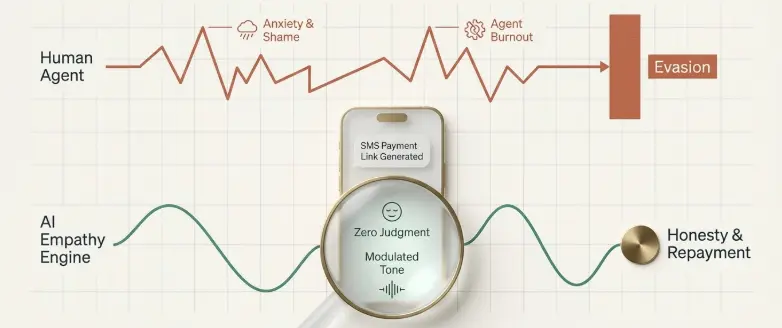
Collection is perhaps one of the most difficult and stressful tasks in the finance sector. Collection usually tends to be very adversarial. Collection agents experience high levels of burnout owing to the negative energy involved, and human biases can cause them to adopt illegal collection measures that may harm the company’s reputation.
Voice AI is revolutionizing the whole concept of collection through the so-called “Empathy Engine.”
For an AI system dealing with delinquencies at the earliest stage (Bucket 1), there is no room left for human discretion. For borrowers, the very thought of admitting their troubles to another person can cause them intense feelings of shame and embarrassment. Knowing they are talking to an AI system automatically washes away all stigma attached to the act.
Borrowers become more truthful with bots.
Another point of advantage of an AI system is that it never gets riled up. It always remains cool and composed and speaks in a modulated voice. It can extend the period of repayment according to preset conditions, revise the monthly installment scheme, and even send payment links through SMS or WhatsApp mid-conversation.
In this way, NBFCs have been able to experience drastic increases in recovery rates while preventing their employees from exhaustion through the automation of calls reminding customers who are one to thirty days late with their payments.
Deflecting Tier-1 Support Queries and Eliminating Wait Times
There is a direct correlation between customer satisfaction and the time they spend waiting. When a customer simply requires some information like getting an NOC, statement of account, or simply the amount outstanding, to make them wait for 15 minutes before speaking to an operator is not acceptable.
The Voice AI takes care of all these tier one queries instantaneously for up to 80%. The Voice AI is seamlessly integrated into the institution’s LMS and CRM. Therefore, it can validate the caller’s identity through an OTP or voice biometric and give accurate real-time information.
However, if the issue cannot be handled by the Voice AI, or the customer insists on speaking to a person, the system uses a warm transfer strategy. Under the warm transfer strategy, it passes all the details of the conversation, including the transcript, to a live operator.
Strict Compliance and the Perfect Audit Trail
In the tightly governed space of banking and NBFCs, adherence to regulations is critical. For instance, there are clear instructions about contact hours and processes when trying to reach out to customers, especially for collection purposes.
While trained, humans are prone to making errors such as going off-script, missing mandatory disclosures or even contacting customers at unauthorized times.
All of these risks are fully mitigated by using Voice AI. The AI is always on-script and follows the rules 100%.
In fact, the AI will only ever contact a customer outside approved hours if explicitly allowed to do so in the script. Most importantly, every interaction is always logged in the CRM.
The Verdict: Adapt or Become Obsolete
The adoption of Conversational Voice AI technology in the world of finance is no longer the stuff of tomorrow’s world; it is here and it is inevitable. What was once merely an efficient cost-saving solution has transformed into a revenue-generating tool that drives growth, helps retain customers, and ensures scalable business processes.
It is not a matter of whether, but rather how soon you can implement Voice AI technology before your competitor snatches away your market share. As a customer who seeks instant and personalized empathic customer experiences at all times, you have no other choice. The rise of Voice AI cannot be stopped.