
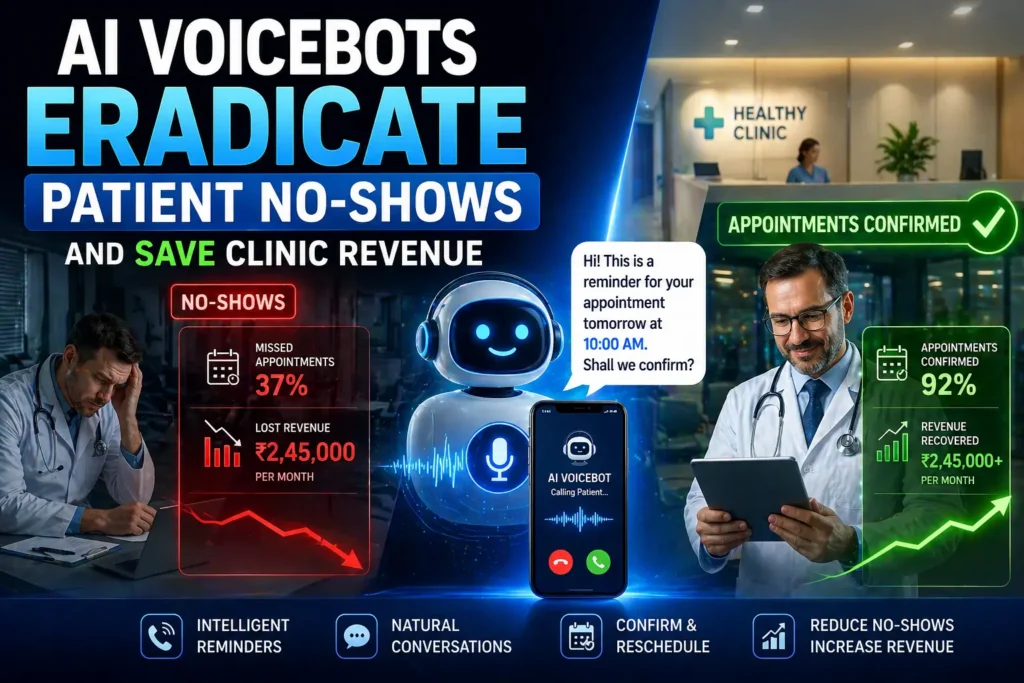
The Billion-Dollar Empty Chair: How AI Voicebots Eradicate Patient No-Shows and Save Clinic Revenue
Within the complex and delicate framework of hospital and clinic management, there are few things more aggravating—and more costly—than a no-show.
Consider the case of a specialized cardiologist, an orthopedic surgeon, or a very much in-demand dentist, who have their schedule filled up days, perhaps even weeks ahead of time. There is an appointment set for a vital 45-minute meeting at 10:00 AM.
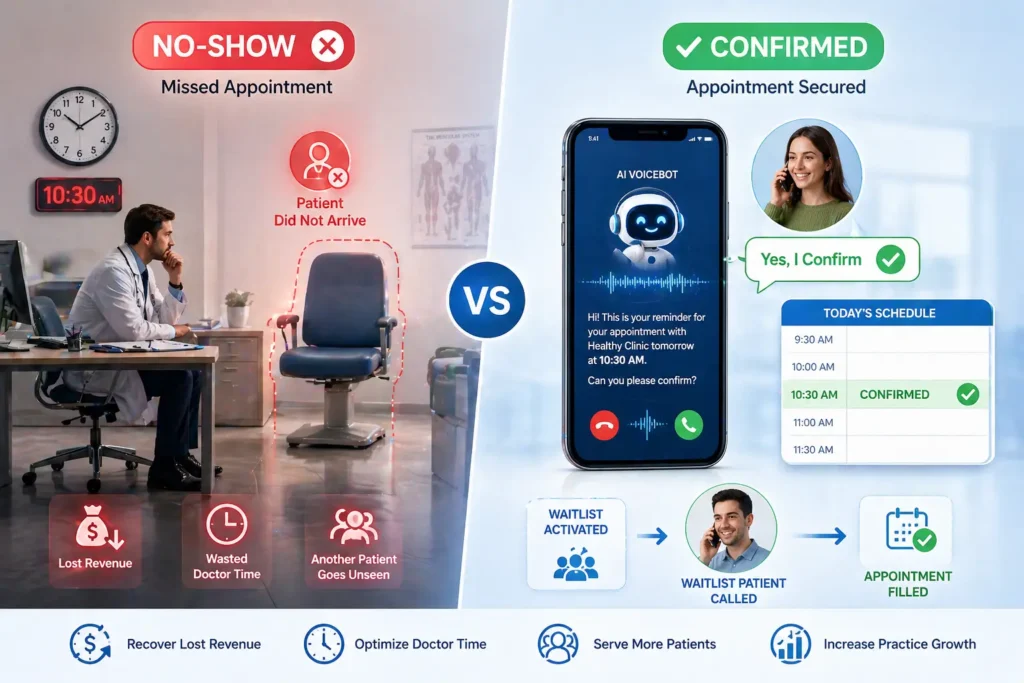
The room has been readied by the clinic staff, files and paperwork have been gathered, nurses are standing by and the doctor is ready to see his next patient. Except at 10:15 AM, 10:30 AM, the chair in the waiting area still stands empty because the patient never shows up and no call was ever received to cancel the appointment.
And this is only one chair.
First, the doctor’s extremely precious clinical time gets utterly wasted. Second, there is a critical patient who has suffered in extreme pain but could not be attended to because of the blocked spot, which is unfair to him or her. Third, the clinic experiences a net loss of revenue per hour spent, yet pays for overhead expenses, electricity, equipment depreciation, and salaries.
According to figures from the healthcare industry and economic reports, billions of dollars each year get lost in the world’s healthcare industry owing to the issue of patients’ no-shows. In the US, it is reported that $150 billion each year gets lost due to no-shows. This problem is particularly disruptive to the healthcare sector in developing countries like India where patient traffic is very high.
The question remains, what causes such no-shows so often? How can the modern health facilities use technology to prevent no-shows forever?
The Myth of Apathy: Why Patients Actually Miss Appointments
The first response to a no-show will usually be a rather cynical one that comes up with excuses such as the patient not valuing the time of the doctor or simply having found an alternative source of health care. Such scenarios do happen; however, the more objective statistics on the behavior of patients paint a picture of a more simple problem – forgetting.
A modern patient leads quite an unpredictable life with all the factors involved: the pressure from the corporate world, caring for the children, keeping up with finances and many other things. In the case of a patient scheduled for consultation several weeks ahead, there is a high possibility of the appointment being forgotten.
Moreover, a patient may run into obstacles that prevent them from attending the appointment, whether that is the impossibility of getting a ride to the hospital or being unable to arrange for some time off work. Instead of calling through the complicated hospital switchboard, most patients choose the path of least resistance and simply do not come to the appointment.
They do not skip their appointments from any malicious motives; they skip them because of a mere gap in memory or due to a lack of frictionless scheduling tools. If the basic issue at hand is forgetfulness on the part of humans and friction in logistics, then the answer to that is a reminder system, which is currently broken by most clinics.
Why SMS and Manual Calling Consistently Fail
There were only two approaches historically used by healthcare administrators to notify patients about their appointments, but they do not help much with addressing the issue.
1. Automated SMS and WhatsApp Notifications: Texting may be considered efficient because it is both cheap and easy to incorporate into practice. However, in today’s reality, it is utterly inefficient. On average, people receive dozens of messages every day – some of them are push notifications from applications, others are promotional messages, and the rest are spam emails. Such a generic message may get lost within dozens of notifications received every single day. What is more important, SMS do not carry any kind of urgency or emotional involvement necessary for making patients remember their appointment.
2. Manual Staff Dialing: Seeing that the texts aren’t being responded to, most of the clinics have their front desk receptionists and nurses calling the list of patients for the following day manually. This is absolutely impractical. The front desk staff members are already preoccupied with attending to real patients, processing payments, and answering incoming calls.
It takes ages for the person calling to get through just one patient on the list. They will be faced with busy signals, disconnected lines, and voice messages. Due to time limitations, staff members will barely manage to finish even half the list during their shifts. Moreover, using the services of a highly skilled medical administrator as a mere robot seems to be absolutely outrageous.
The AI Voicebot Revolution in Healthcare Scheduling
It is fortunate that the most astute healthcare administration experts and Chief Medical Officers (CMOs) are discarding all such old-fashioned and inefficient practices. They are now heading towards full-fledged operational automation with the help of Conversational AI Voicebots.
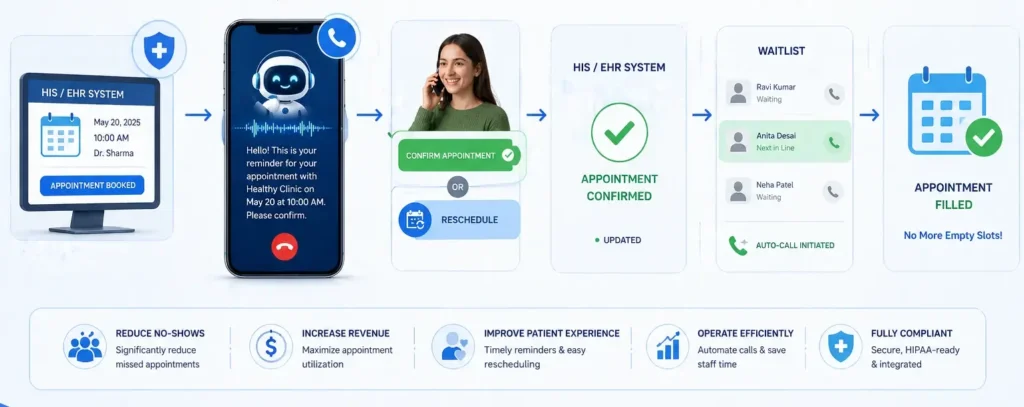
Instead of a mere text message or hurriedly made manual phone calls, AI Voicebots actually engage the patient in a very humanlike fashion. This fully integrated and secure technology works through API with your HIS/EHR software with absolute perfection and requires no human input whatsoever.
Below is how this advanced automation process works to ensure maximum attendance:
Pre-Screening Call (48 Hours Before Appointment):
Precisely 48 hours before the appointment time, the AI Voicebot makes an automatic call to the patient. This is far from the annoying IVR robot that asks you to choose from various options through digit punching. The AI Voicebot speaks in a perfectly human-like polite and empathic voice, which can even be configured according to the regional language of the patient.
“Hello Mr. Sharma, this is a courtesy call from City Hospital’s Cardiology Department. You have an appointment scheduled with Dr. Kapoor for tomorrow at 10:00 AM. Press 1 to confirm you will be attending, or press 2 if you need to reschedule.”
Interactive Engagement and Real-Time HIS Syncing
However, because human beings are conditioned to answer telephone calls and respond to voice prompts, the participation rate is significantly higher than with SMS. Nonetheless, it is when the patient has responded that the strength of the AI Voicebot really comes into play.
Immediate Confirmation: Upon pressing 1 or saying “yes,” the AI immediately updates the patient’s status to “Confirmed” on the HIS system. This ensures that there is definitive, data-backed information as to which patients will be attending appointments the following day.
Seamless Rescheduling: If the patient cannot attend and presses 2, it does not mean that the AI disconnects from the conversation. The AI is capable of sending a secure link for rescheduling by the patient or immediately transferring the call to a human receptionist.
Automated Wait List Activation: This represents the best way to guarantee revenue. In an instant, after the AI Voicebot receives information that the appointment by the patient has been cancelled, it releases that very hour slot from Dr. Kapoor’s schedule. At that exact time, the AI may be programmed to dial the first person on the wait list, saying: “Hello! Your chance has just arrived, a slot has become available at 10:00 AM with Dr. Kapoor for tomorrow. Do you want to grab that?”
The Measurable Clinical and Financial Impact
Using the Conversational AI Voicebot for scheduling and appointment reminders results in huge decreases in no-shows by a stunning margin of 30% to 40%.
The ROI figures are simply staggering. Taking into account that one specialist appointment will bring you $150, and if you prevent only 10 no-shows every week, the investment is more than paid back, and the system will bring you an additional $75,000+ worth of income annually.
More importantly, it significantly boosts patient care. Waitlisted patients will receive consultations much quicker, doctors will use all their time for consultations, and, at last, your exhausted receptionists who had to deal with the phone calls can focus on providing proper in-person care to patients.