
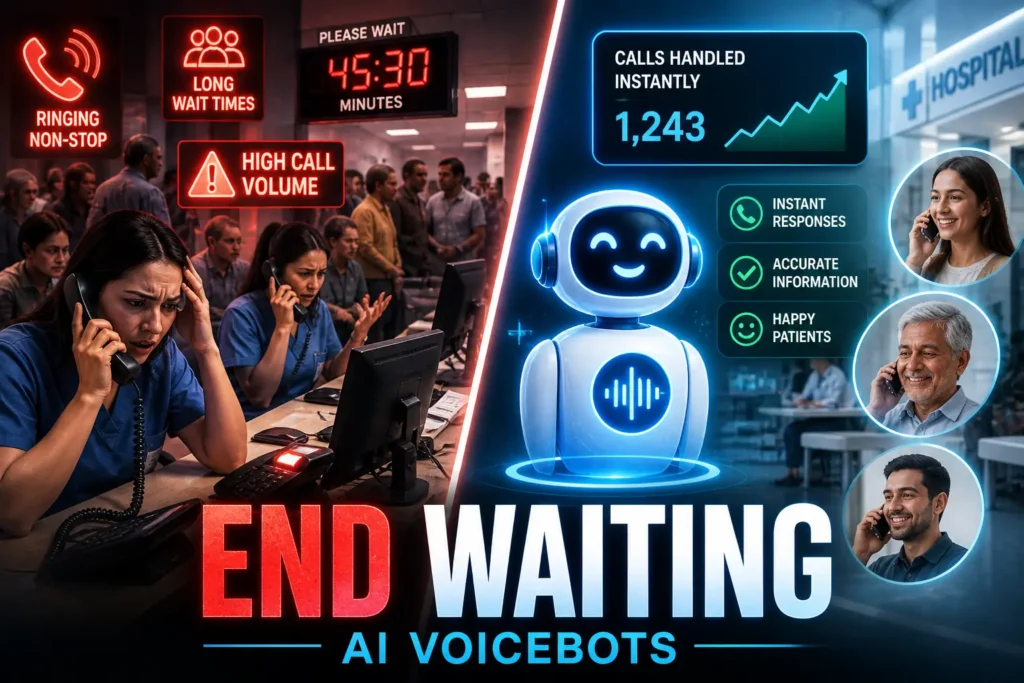
Curing the Waiting Room: Using AI Voicebots to Manage Peak Hospital Call Volumes with Zero Hold Time
During the flu season, in cases of localized viral outbreak, or even on a typical chaotic Monday morning, the communications system in place within a modern hospital or clinic could fail catastrophically under the stress.
Picture the switchboard in a 500-bed hospital during the busiest time of day. All the lines are constantly buzzing with calls, making an impressive display of red lights.
A mom is calling to schedule an emergency appointment for her son who has developed a very high fever.
An older person is calling inquiring about their complicated blood tests and whether they can be picked up already.
A relative is calling asking about the visiting hours of the intensive care unit.
A man suffering from heart pain is frantically trying to call to get through to the ER.
Because this is a limited number of human representatives, who work there, everyone gets into exactly the same line. The consequence is that the lines get clogged up. Thus, the mother of the child, the old patient, and the person with the heart attack all hear the very same message: “Your call is important to us.
All our executives are busy now. Your estimated waiting time is 18 minutes.” In a normal business environment like an online store or a SaaS company, keeping a client on hold for 15 minutes already means really poor customer support.
In medicine, however, keeping an ill, worried, or critically ill patient on hold for 15 minutes equals to a disaster because it makes the patient highly psychologically uncomfortable, ruins the image of the institution before they even enter it, and in some severe cases can even cost patients’ lives.
The Fallacy of Hiring More Receptionists
When the hospital administration reviews their monthly performance statistics and finds that the abandonment rate is rising to 30% or 40%, their natural inclination would be to address this problem using human resources. They would instruct HR to hire five more front-desk employees or to extend the existing contract with their outsourced call center BPO.
This is a highly inefficient and risky move. The volume of calls in the healthcare sector is extremely erratic. Hiring twenty more receptionists to cope with an unexpected increase in volumes due to an influenza epidemic or dengue fever is problematic once spring comes, and the call volume drops by 40%. You will be spending high premiums on wages, benefits, and infrastructure for idle people.
It is not possible to endlessly scale up the human factor to cater to unpredictable surges in demand. Moreover, humans get tired, require lunch breaks, and working with irate patients is stressful, which results in significant turnover at the receptionist’s position.
The Elastic Front Desk: AI as a Tier-1 Receptionist
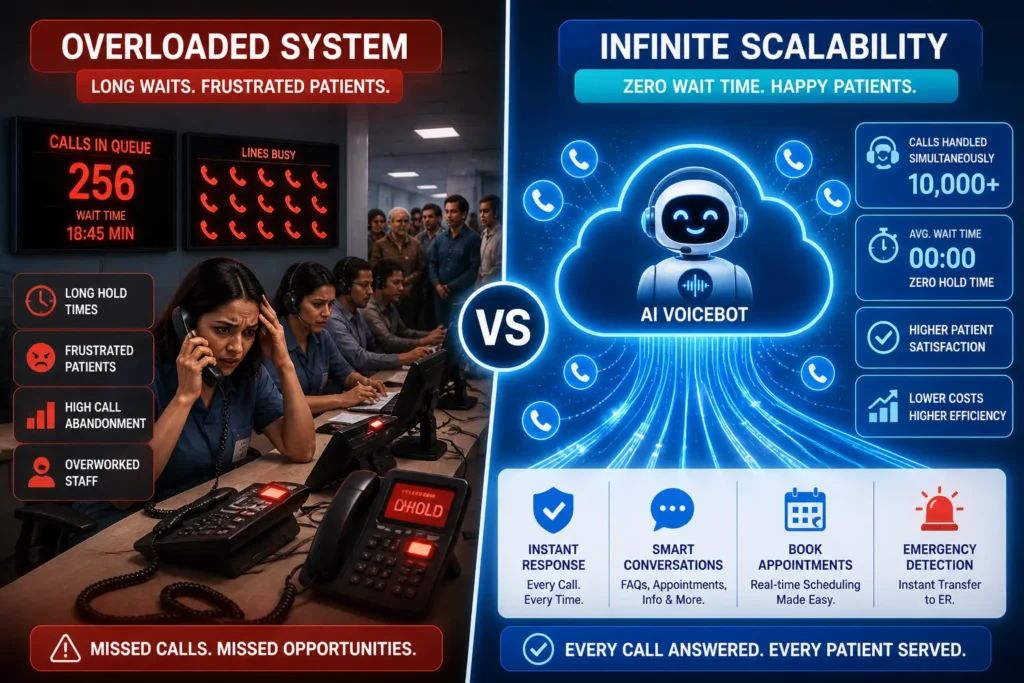
The best operational strategy for the current times would be to shift from the human bottleneck to an infinitely flexible digital solution. Conversational AI Voicebots will be increasingly used as Tier-1 Medical Receptionists in the coming days.
An AI Voicebot is hosted on the cloud platform and thus, has an advantage over the human team that no other human has – the superpowers of Infinite Elasticity & Concurrency. If you get 10 calls at 10:00 AM, or even 10,000 calls at 10:00 AM, your AI Voicebot picks up each one of them without fail, on the very first ring. There is absolutely no Hold Time in your hospital’s operations anymore.
How the AI Medical Receptionist Transforms the Patient Journey
Once a patient dials the hospital, they do not hear the elevator music anymore. They get instant access to a courteous and conversational AI assistant that can deal with complex medical procedures and processes.
1. Instant Verification & Standard FAQ Handling: More than 60 percent of all calls made to the hospital pertain to low-value routine questions and issues that could have been solved online.
The AI automatically verifies the caller by asking them for the details associated with their registered mobile number or patient ID number. It can instantly reply to queries such as “What are the OPD timings of Dr. Sharma today?” or “Is the in-house pharmacy open round the clock?” or “Are my MRI reports available now?”
2. Appointment Scheduling: The AI uses NLP to review the hospital calendar in real-time. If the patient says, “I want an appointment for dermatology tomorrow afternoon,” the AI will find an available slot, verify the availability, schedule the appointment right onto the doctor’s calendar, and send an SMS confirming the appointment details.
3. Emergency Detection and Immediate Transfer of Calls: This is the most important feature of the AI Receptionist. In addition to performing routine tasks like booking an appointment (which accounts for about 60% of the calls), the AI has been coded to recognize words associated with emergencies or panic, such as “chest pain” or “serious bleeding.” If such words appear, then all other tasks will stop and the live call will be transferred to the emergency department dispatcher or senior triage nurse.
The Operational Transformation
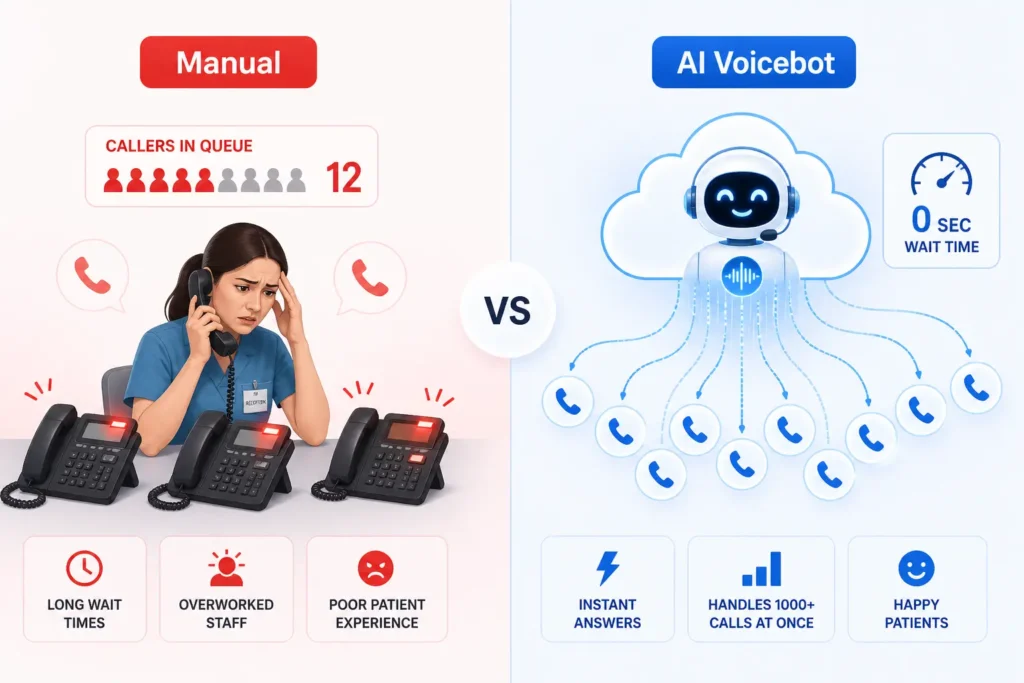
Because you will allow the AI Voicebot to function as an impenetrable line of defense, handling every inquiry, the change in the internal operation in the hospital will be drastic.
The burden of dealing with ringing red lights on the switchboard or with angry patients who were kept waiting for half an hour is now lifted off your human operators’ shoulders. The burden is also removed from your receptionists, and they will have the luxury of giving proper attention to those calls which require empathy.
As a result, your hospital becomes one with zero wait times, lower administrative costs and a superior patient experience right from the very first phone call.