

The "Moment of Truth": How to Process Insurance Claims Faster and Skyrocket Customer Satisfaction
In the insurance business, you are not selling a product, you are selling a promise, selling peace of mind. For years, a customer has been paying their premiums, month after month, year after year, in anticipation that in the unlikely event of a disaster, whether it be a car accident, medical emergency, or damage to property, you will be there to protect them.
However, in the unlikely event that a disaster does strike, and that customer finally files a claim, then that is when they experience what we call the “Moment of Truth.” This is the precise moment when the value of your insurance brand is being put to the ultimate test.
Unfortunately, for most insurance companies and brokerages, this “Moment of Truth” soon turns out to be a complete nightmare, and for one simple reason: while the front-end sales process has become lightning-fast and digital, the back-end claims process has been surprisingly slow and manual.
In this exhaustive guide, we will look to explore the reasons behind delayed insurance claims, how manual verification of documents is secretly causing an increase in your Operational Expenditure (OPEX), and how intelligent AI Automation is revolutionizing this industry by processing claims instantly!
The Core Problem: The Agony of the Waiting Game
The psychological condition of the customer at the time of filing the claim is extremely vulnerable. They are highly stressed, anxious, and financially vulnerable. They don’t want to fill out forms, nor do they want to wait weeks to resolve the claim. They want quick answers, updates, and immediate financial support.
Let’s take a peek behind the scenes at what really goes on behind the scenes at a typical insurance company when a claim is made.
If the insurance company has a manual process of handling the claim, it’s extremely laborious. An insurance adjuster has to:
Open the customer’s file, download the documents, bills, police reports, garage bills, etc.
Go through pages of unstructured data.
Manually verify the submitted documents against the lengthy, 50-page insurance policy document.
Manually type the approved data into the company’s CRM or claim management software.
Send the update to the customer.
A human being, despite how knowledgeable and experienced they are, is only capable of processing a certain number of claims per day. However, when hundreds and thousands of claims are received on a daily basis, huge bottlenecks are expected.
There are cases wherein the claims are left in a “pending” queue for a number of days. The people processing the claims are overwhelmed and fatigued, causing mistakes in the data entry process.
For the customer, this process is like an agonizing waiting game.
The Ripple Effect: How Slow Claims Destroy Profit Margins

The cost of a slow claims process is far greater than just an annoyed customer. It creates a devastating ripple effect, which actively works to destroy an insurance company’s profit margins and efficiency.
A. The Customer Support Flood
When a customer is made to wait 7 to 14 days for a response to their claim, their anxiety boils over into anger. What do they do? They call up your customer support and flood them with phone calls. They write angry emails, wanting to know the status of their claims.
Now, your highly trained and skilled customer support team is suddenly spending 80% of their time answering calls, acting as status checkers. Instead of being able to utilize their high skill levels, they’re spending all their time apologizing for the delay in the processing department. This causes you to need to hire larger support teams, driving your Operational Expenditure (OPEX) through the roof.
B. The Loss of Lifetime Loyalty
Trust is something that is created over years and destroyed in seconds. If the customer has had a horrible and stressful time trying to get their legitimate claims paid out, they will not renew their policy with your company. Moreover, they will ensure that no one else they know makes the same mistake and chooses your brand. In today’s competitive marketplace, the loss of a customer’s LTV because of your company’s slowness is a fatal error.
The Smartest Strategy: Implementing AI Automation
In order to scale, reduce costs, and capture the loyalty of the new consumer, insurance companies need to fundamentally change the way they do things. The old model of throwing more human bodies at a high-volume paperwork problem is no longer a financially viable solution.
The easiest, most cost-effective, and most powerful solution to speedily process claims is to leverage the power of Artificial Intelligence (AI) in the document verification process.
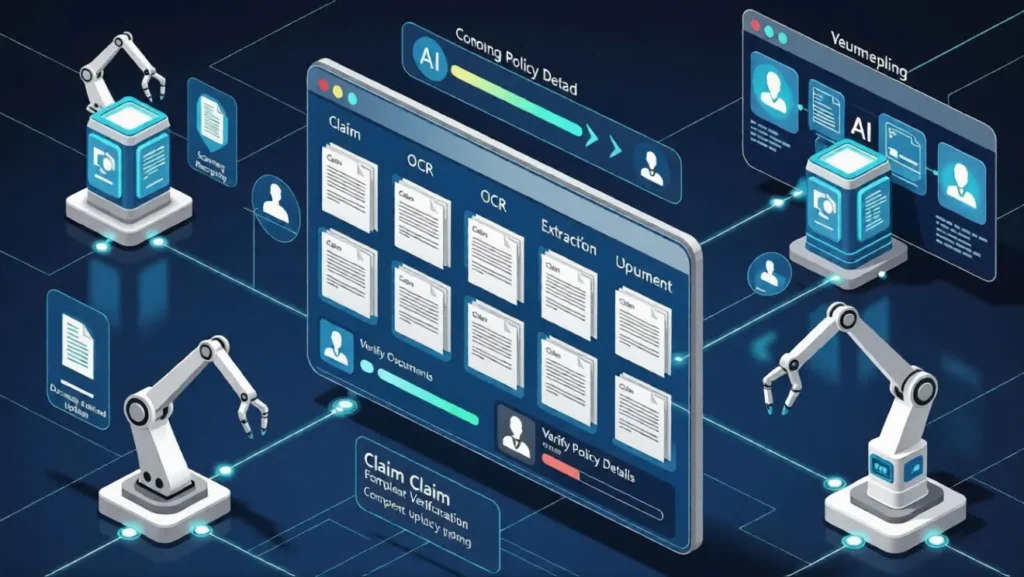
New-age Insurtech companies and forward-thinking insurance companies are bypassing the traditional document verification process and leveraging AI technology. Here’s exactly how the entire process changes from a slow trickle to an instant, flawless operation:
Step 1: Instant Reading and Data Extraction
The moment the customer clicks “Submit” on their claim, the AI kicks into gear. The AI reads and extracts all relevant information from the submitted documents using its powerful Optical Character Recognition (OCR) and Natural Language Processing (NLP) techniques. Whether it is a scanned hospital bill, a handwritten mechanic’s note, or a complex police report, the AI reads and extracts relevant information in fractions of a second. What would take a human ten minutes to read and understand takes the AI just fractions of a second to do the same job.
Step 2: Automated Policy Verification
Extracting relevant data is just half the battle for our AI. Where AI really excels is in understanding the context. The AI instantly cross-verifies the extracted data with the customer’s policy limits in our database. The AI accurately and securely verifies whether the incident is covered under the policy, whether deductibles are met, and whether there are any possible inconsistencies and fraud. If everything matches policy conditions, our AI instantly approves the claim for “Straight Through Processing” (STP) without any human intervention whatsoever.
Step 3: Real-Time, Proactive Updates
Since the AI processing is real-time, the system can automatically update the status of the claim with the customer. Within minutes of the claim being submitted, the customer would receive the following update: “Your documents have been successfully verified, and your claim is moving to the final approval stage.” In this way, you have completely eliminated the anxiety of the customer. They know exactly what the status of the claim is, and therefore, they have absolutely no reason to call your support helpline. This immediately solves the problem of the burden on your call center, thus reducing your OPEX.
The Power of Infinite Scalability
One of the most powerful untapped benefits of using AI to automate your claims process is Infinite Scalability.
The insurance business is, in many ways, a seasonal or event-driven business. What this means is that in the event of a massive hail storm or flood in a certain region, your company could suddenly experience a 500% increase in property and auto claims. This would completely overwhelm a traditional human-based claims processing team, causing them to be woefully behind for months and having thousands of angry customers to placate.
An AI-based automation system, on the other hand, does not care about scalability. Whether you are receiving 10 claims per day or 10,000 claims per hour, the AI system will process them all at once at the same rate and efficiency.
Elevating the Human Workforce
One of the biggest myths floating around is that AI in the insurance industry is meant to replace human employees. The opposite is true. AI is meant to enhance human employees. When you take the soul-crushing task of reading documents and verifying information away from your human claims adjusters, you allow them to focus on what they do best. Your team can focus 100% of their time and energy on investigating complex claims, dealing with severe fraud detection, and providing top-tier support to customers who have gone through a traumatic event. Let the machines handle the paperwork; let the humans handle the relationships.
Conclusion: Automate the Routine, Protect the Promise
In the current insurance industry, speed is not a luxury; rather, it has become a basic requirement for survival. It is a must-have. Moreover, the insurance industry demands fast updates, as well as businesses demanding reduced operational costs.
By integrating AI into your document verification process, your business attains the perfect balance: you process an infinite number of claims at the same time, reduce your OPEX costs, and enhance your efficiency. Most importantly, you are keeping the promise you made to your customer at the exact moment of need.
Customers trust businesses that resolve their queries quickly. In the insurance industry, trust is the only currency that matters.
Are you ready to revolutionize your insurance business’s claim process?
Dheeraj Mehta from Archiz Solutions has created a short, powerful video explaining the entire process of AI-based document verification, specifically for the insurance industry. If you are from the insurance industry, then this video is highly applicable to you, as you want your business to lead the industry.
🎥 Watch the entire operational process here: Automate Claims Processing & Reduce Delays
Get Free Demo: archizsolutions.com/contact | +91 9599570903 | info@archizsolutions.com