
How AI Voice Agents Enable Zero-Literacy Outreach for NGOs
The Literacy Barrier NGOs Rarely Talk About
Literacy is mentioned frequently in development literature in the context of measuring the outcomes of education. The term is less commonly referred to in the context of program implementation but is the underlying criterion that defines the boundaries between who can receive, and who cannot receive, most NGO services AI voice bots for zero-literacy outreach
Let’s take a case where a farmer receives an SMS regarding “pest management.” The SMS would look like this: “Apply neem spray at 20ml/liter concentration during the evening hours for 7 consecutive days.” The text message accepts that the farmer can read ‘neem spray,’ can understand numerical ratios, can comprehend information that requires timing, or can understand the quantification of ‘7 days.’ The text would likely completely confuse someone whose farming experience is merely demonstration-based, despite the information being desperately needed by the farmer.
This does not necessarily denote a lack of intelligence, capability, or motivation. Indeed, many highly intelligent and competent individuals have managed their complicated lives without possessing strong reading skills. They know landmarks, not signs. They memorize phone numbers, not through a phone address book, and they manage their finances through simple calculation and trust, not a checkbook register.
This means that when NGOs fall back on text-based communication, they inadvertently exclude these people—many of whom may already be the most marginalized and vulnerable anyways. The process happens without anyone really realizing it. There is no notice of a person being rejected and a reason given for how they might’ve felt the services offered were inaccessible. Instead, they simply drop off from the program and are defined by the NGO as uninterested.
Voice-based outreach completely shifts this dynamic by eliminating the need to consider literacy altogether
Why Voice Is the Most Inclusive Interface
Human beings evolved to communicate through speech tens of thousands of years before writing systems emerged. Speaking and listening develop naturally in children without formal instruction, while reading requires years of explicit teaching. This makes voice the most universally accessible interface that exists. Voice-based communication offers several inherent advantages for last-mile outreach:
Works without reading: A person unable to decode written appointment reminders may have no problem understanding “Your child’s vaccination is at 10 AM tomorrow at the village health center.” The same information becomes available if speech rather than text is used to convey it.
It feels both familiar and human because it replicates the nature of conversations. People have natural conversations with each other: information is exchanged, questions are asked, and confusion is clarified. They also don’t require learning new skills or adapting to an unfamiliar system. Elderly beneficiaries who may never have used smartphones in their lives can have easy interactions with a voice on the phone.
Allows for immediate clarification: If someone doesn’t understand written instructions, they’re stuck unless they can contact someone for help—which in itself often requires literacy to even formulate the question through text. Voice enables natural back-and-forth: “What does that mean?” “Can you repeat that?” “Which clinic is closest to me?” The system can detect confusion and adjust explanations in real time.
Facilitates emotional trust: Tone, warmth, and emotions are also present in “voice” and can never be directly conveyed through text. There are fundamental differences between hearing “Do not worry” and seeing “Do not worry” on a screen. In health advice, financial advice, crisis situations, etc., this emotional dimension can be crucial for creating the necessary emotional trust required to adhere to advice.
These advantages are not minor improvements, but rather fundamental differences in terms of categories of accessibility. Text-based outreach inherently excludes significant categories of people in the last mile population group. Voice-based outreach inherently and automatically includes all members of that group.
How AI Voice Agents Work in Low-Literacy Environments
AI voice agents bring the locational advantages of human phone conversations, and also add capabilities that no human team can match.
The User Experience The process is seamless and transparent from the end-user’s or the beneficiary’s perspective. Someone makes or receives a call to a helpline number. They receive a greeting in their language, or even the specific dialect they speak, and the machine or human asks how it can assist. They answer as they normally would in conversation, “I need to know the health clinic hours” or “I want to apply for the agriculture loan.”
The system transcribes their spoken words, interprets what they are really asking for (intent recognition), accesses the relevant information from the organization’s database, crafts a useful response to their query, and then speaks the response back to them—all within a second or two.
The conversation continues as the person poses their follow-up questions or requests clarification or discusses other topics as they would with a human operator. Several technological options allow this to be done in low literacy contexts:
Dialect and accent recognition: Advanced speech-to-text systems do not demand “proper” pronunciation and formal dialects. They recognize the way people commonly talk in villages, which can involve regional words, pronunciation variations, and language switching. They do this so that we do not have to face the frustration of systems that only work for those formally educated in cities.
Not necessary to navigate any menu: Typically, IVR technology has the user step through a system of “press 1 to do this, press 2 to do that.” This is because these systems have always been trained on open-ended questions, and the user has the option to simply state what they want.
Context retention across a conversation: For example, if a person asks whether they are eligible for a loan and then says “when do I need to repay,” the system understands who “I” refers to and what the question is asking based on the previously discussed loan.
Emotional intelligence: At a higher level of sophistication, systems can actually sense tension, confusion, or urgency conveyed through the tone of the user’s voice. This means that if the person sounds confused or asks the same question repeatedly, the system can react to simplify language, slow down the rate of speech, or bring a human operator to the conversation. This eliminates the frustration of having to repeat yourself to the system without actually being recognized as confused.
As far as the recipient is concerned, they don’t interact with technology at all—they interact with someone helpful who speaks their language and understands their questions and their answers, and this is exactly what AI-enabled voice agents allow to scale without limit
Real Impact of Zero-Literacy Voice Outreach
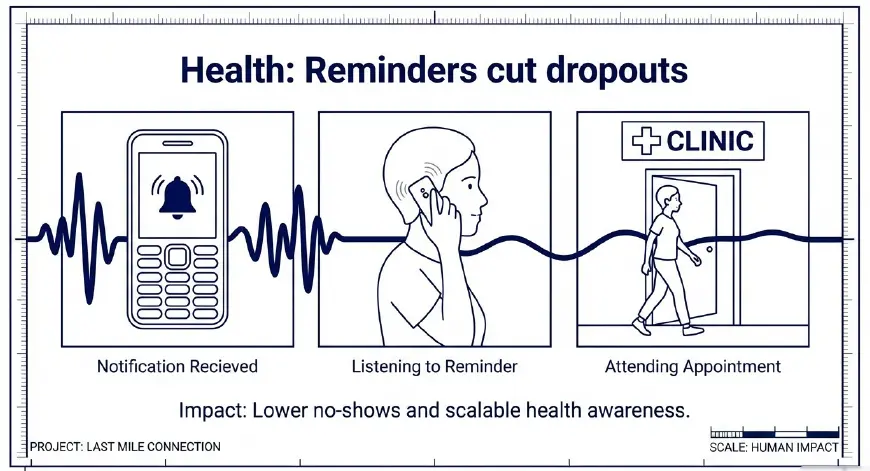
Organizations seeking to provide voice-based communications to low-literacy populations have seen a transformative difference in their program participation and effectiveness.
Higher participation rates: When an obstacle to access is removed, those who were unable to access it beforehand are now able to do so. Health programs see appointment-attending participants skyrocket after reminder texts turn into reminder calls. Smallholder farmers start receiving advisories for agriculture, or access financial literacy programs that were previously inaccessible.
Improved compliance with protocols: Know thy customers, know compliance. If customers know what is expected of them, such as taking medicine, applying fertilizer, or paying loans, they become much more likely to comply. In voice, you can describe what you want the user to do, and you can be as detailed and unique as the user needs you to be, immediately disambiguating any confusion.
Lower confusion and complaints: Much of the frustration beneficiaries experience stems from not knowing what to expect, when things will happen, or how to get help. Immediate answers through voice-based systems in understandable language dramatically reduce this confusion. Fewer complaints and higher satisfaction are reported by organizations, as people actually know what is happening rather than feel they are left in the dark.
Improved data quality: When the people can answer questions through natural interaction, response rates go up and accuracy goes up. Instead of skipping survey questions they aren’t sure of, they can ask what the question means. Instead of guessing on categories, they can describe in their own words what the situation is for the system to interpret. This yields richer information that is more accurate for use in program adaptation.
Greater equity in access: Most importantly, voice outreach runs counter to the normal diffusion pattern where better-educated, better-connected, and better-positioned populations get services first, and those on the margins get left behind. By not imposing literacy and digital requirements, voice explicitly allows the reaching of those left behind, such as elderly populations, less formally educated women, displaced communities, and rural residents far from urban centers.
This isn’t simply about automating existing processes more efficiently. It’s about making the previously impossible—inclusive outreach at scale—suddenly achievable. Organizations can maintain meaningful connection with thousands of beneficiaries regardless of literacy levels, creating truly universal access to information and services.