

Ethical AI Voice Agents for NGOs: Privacy, Trust, and Human Control
Why Ethics Matter More at the Last Mile
The NGDOs that target a given group usually find themselves in a state of powerlessness, which can be poverty, sickness, relocation, discrimination, as well as marginalization. It is evident that as a result of the power relationship between NGDOs and their stakeholders, it is seen that an imbalance exists, whereby individuals are obliged to receive the services but cannot turn them down (ai voice bots for ngos).
The technology used in these cases also raises some very important issues. In any business, if consumers do not like the technology used, they can choose to shop elsewhere. This is different from these consumers, since the services offered by these organizations are essential to their lives—otherwise, they would not be in these situations to begin with.
These consumers would not even be able to understand this kind of technology in any way that they would be able to give their full consent.
Ethical usage of AI voice agents is not just about compliance with laws but more about commitment to ethical principles in protecting vulnerable
populations: respect for human dignity, respect for privacy, transparency about their capabilities and their limitations, human direction for decision-making, and accountability for system failure.
Organizations who are using voice AI in a responsible manner understand this, and this means realizing the value of these technologies in serving society, not the reverse. And it also means not using the criteria of efficiency of a particular project and whether it helps them reduce costs, but rather whether it is actually creating a difference.
Privacy and Compliance in Voice AI
The voice conversations contain confidential information, such as health, financial, and familial details, and location information. Ensuring that such information is adequately protected from unauthorized access and misuse is not only
a legal requirement but also an ethical obligation.
The conversations are also secured through end-to-end encryption: It is crucial that conversations through voice AI technologies are encrypted. This implies that if someone intercepts the sent audio and transcription data, it should be encrypted and not accessible unless an authorized person views it. This is achieved through AES-256 encryption or better, and it should be enabled and not disabled.
The redaction of personally identifiable information in PII minimization reduces exposure: Often, information like names, phone numbers, and addresses can be identified and hidden to avoid any privacy issues or breaches. This helps in understanding the patterns of conversations better.
Regulatory Compliance Frameworks: Depending on their geography, voice-based systems have to adhere to GDPR regulations in Europe, data protection regulations individually, and HIPAA regulations pertaining to healthcare, among others. The correct vendors will actually design these systems such that regulatory compliances are integrated within the system itself.
Consent and transparency: Beneficiaries should understand they are dealing with AI and not humans, understand what information is being collected and for what purposes, should have access to human operators for their needs, and should also have access to their own information and the option to delete it. This helps promote autonomy because one knows they’re dealing with honesty.
Data minimization principles: Ethical approaches to data collection for service delivery obtain and store information for a certain time that is proportionate and minimizes the need for information collection and deletion
when no longer needed. Data accumulation that benefits organizational rather than beneficiary interests contributes to privacy risks, which can be averted by showing respect for information.
In last mile settings where there are issues concerning privacy protection, issues include a lack of understanding of the concepts of privacy or their rights, a choice of settings which lowers one’s expectations of confidentiality, and a lack of legal provisions or their enforcement. However, organizations should not use these issues as excuses for their conduct, but rather for enhanced levels of privacy protection where the beneficiaries are unable to do so.
Human-in-the-Loop Safeguards
Even with AI, regardless of how advanced it is, it is impossible for it to deal with all situations in an appropriate manner. There are some situations in which human judgment, sympathy, or authority is required, which cannot be fulfilled by AI. Ethical usage means understanding such limits and including human input in areas it matters.
Escalation of critical matters: There should also be an automatic escalation system for critical matters that get raised through voice AI, such as events of medical emergencies, mental conditions, abuse, severe money management problems, and so on. Here, it is better for an algorithm to err on the side of over-escalation rather than incorrect handling.
Opt-out to human operators: The option to talk to a human operator should always be available for the beneficiary. The voice agent should proactively ask the users if they would like to talk to a human operator: “Would you like me to connect you with a staff member?” The design of a system that causes the user to go through hoops with no opt-out option is a design of disrespect for the user.
Human review of critical decisions: In the event where AI has a significant impact on critical decisions like determining eligibility and risk assessments, humans should review and approve these decisions instead of relying on automated systems.
Providing staff training and empowerment: If humans are involved in resolving escalations, then training needs to be provided, and authorities must be given so that they can handle difficult situations. Organizations must not use AI technology to downsize their staff without providing training and support to existing staff members.
Feedback loops for improvement: The people working with escalated interactions experience system failure firsthand. The feedback they offer to the AI system should be systematically used to bring improvements to the system—enhance response templates, refine system escalations, and expand knowledge bases. This creates a process of continuous improvement instead of static systems.
The point of the exercise is not to replace human judgment with automation, but to use automation to free up humans’ attention to focus it where it’s needed most. Systems built on such a philosophy serve their beneficiaries best.
Preventing Misinformation and Bias
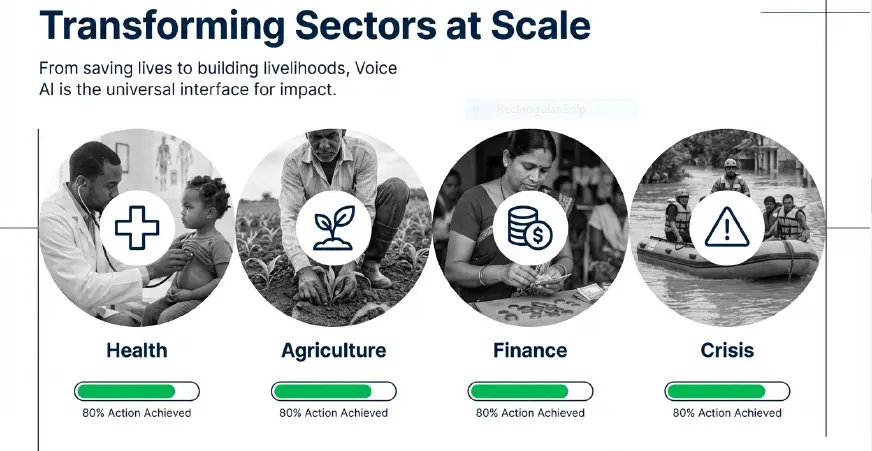
For example, AI systems may assert false information, represent biases in their respective datasets, and/or give culturally inappropriate advice. By their nature, in last mile situations where information recipients may not have alternate avenues to verify information given to them, this becomes a significant issue.
Knowledge-based question answering: Instead of letting AI systems arrive at answers based on general knowledge it has learned on its own during processes of training, it should be restricted to only respond based on information obtained from organization-approved knowledge bases. Using knowledge bases vetted for accuracy—medical information, program information—reduces the chances of hallucination and inaccurate information delivery for voice agents.
Explicit acknowledgement of uncertainty: There should be acknowledgement when systems are unsure. Speculating on answers is unconvincing. “I’m not sure about that, but let me connect you with someone who can assist you better” is more honest than speculating. Accepting uncertainty within AI systems eliminates the dangerous potential of overconfidence.
Cultural and linguistic appropriateness: Translation involves more than just linguistic correctness; there is also a cultural element to consider. What may sound appropriate in one culture may seem totally alien or offensive to others. The involvement of local speakers will ensure that the message or communication being expressed is respectful to all cultures.
Bias detection and mitigation: AI models may carry biases—gender biases, socioeconomic stereotypes, ethnic prejudices. Regular testing of these models with different groups of users is essential to detect biases. Biases must be corrected and more efficient training data, algorithms, and dialogue flows employed.
Version Control and Updating: Medical information, rules, and programs evolve or alter over time. An effective voice AI would include processes and systems for timely update of the information given, as changes may arise. There is always the potential for giving incorrect information if not updated.
Preventing misinformation is an ongoing rather than an occasional activity. Beneficiary feedback mechanisms and continuous improvement processes also help maintain accuracy as contexts change.
Trust as the Foundation of Scale
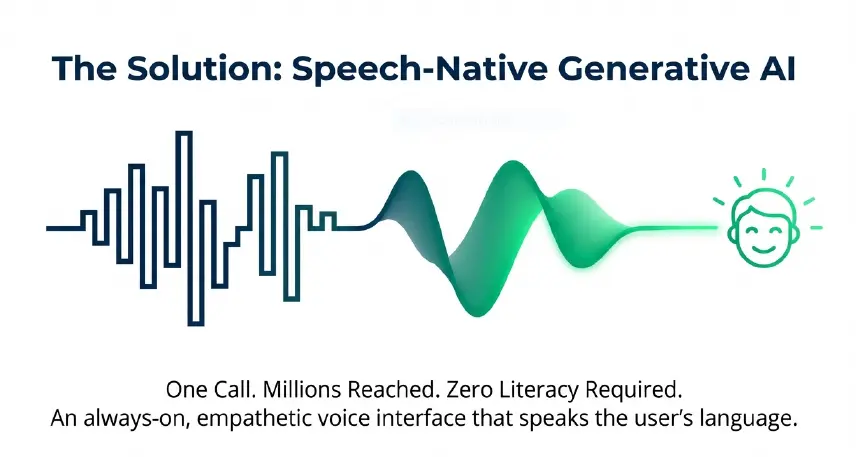
Thousands of calls can be processed, but no machine can instil trust—only human organizations can instil trust through ethical living.
For the last mile to be successfully implemented by artificial intelligence voice agents, the beneficiary must trust that their interests are represented, that their information is kept confidential, that information provided is reliable, that their dignity is upheld, and that they can reach an actual person if needed. This, however, is not automatically granted and must be backed by demonstrable commitment to ethical principles.
An organization that emphasizes ethics may be slower in deployment because it spends time gathering the people, implementing proper safeguards, training its users appropriately, and developing proper safeguards. While this may seem inefficient compared to fast deployment, it offers a sustainable deployment characterized by community embracing and not resistance.
On the flip side, organizations that prioritize speed over ethics may see backlash if there is privacy violation, misinformation, or when the beneficiaries are not treated with respect. This can cause problems to be delayed by years, which is far longer than it should have taken with an ethical approach.
The last mile operates on trust. While current AI-based voice agents hold significant promise in terms of reach and cost savings, this can only be realized by ensuring such solutions are implemented in a manner that enhances, rather than diminishes, existing trust between stakeholders and communities. Ethical use is not a barrier to, but rather a prerequisite for, impactful use.