
The Execution Gap: Why Highly Digitized NBFCs Are Still Leaking Revenue (And How AI Voicebots Fix It)
Key Takeaways Before You Dive In:
The Core Problem: Most NBFCs have invested in state-of-the-art CRMs and risk analytics solutions that cost millions, yet 70% of their customer communications remain laboriously manual.
The Human Limitation: Manually making thousands of EMI reminders via human agents is time-consuming and leads to inefficient customer communications and enormous costs.
The Smart Solution: By developing an automated infrastructure layer through Conversational AI Voicebots, NBFCs can now initiate thousands of calls in an instant from their CRM system, thus increasing customer connection rates 2 times.
Are you a Chief Technology Officer (CTO), Digital Head, or Collection Director at a Non-Banking Financial Company (NBFC) or any other financial lending business? Have you spent the last five years obsessing over Digital Transformation for your business?
You have managed to upgrade your legacy systems. You have managed to integrate state-of-the-art Customer Relationship Management (CRM) solutions. You have managed to implement sophisticated analytics and machine learning algorithms that can flawlessly analyze a borrower’s credit history and pinpoint those who are likely to default with uncanny accuracy. Your data is clean, and your dashboards look like something out of NASA. Your system knows who is likely to miss his/her Equated Monthly Installment (EMI) tomorrow.
So, with all of this world-class technology literally at your fingertips, why is your loan recovery process still moving at a glacial pace? Why are your timely collections dropping off, and why are your operations costs still skyrocketing through the roof?
The answer, of course, is the massive and previously unknown problem in your operations that Dheeraj Mehta, Founder of Archiz Solutions, has recently coined as “The Execution Gap.” In this guide, we will examine exactly what The Execution Gap is, why traditional manual calling operations are literally hurting your bottom line, and how modern financial institutions are using AI Voicebots not only as a solution but as an infrastructure unto themselves to fully automate their loan recoveries.
The Illusion of the Perfect Tech Stack
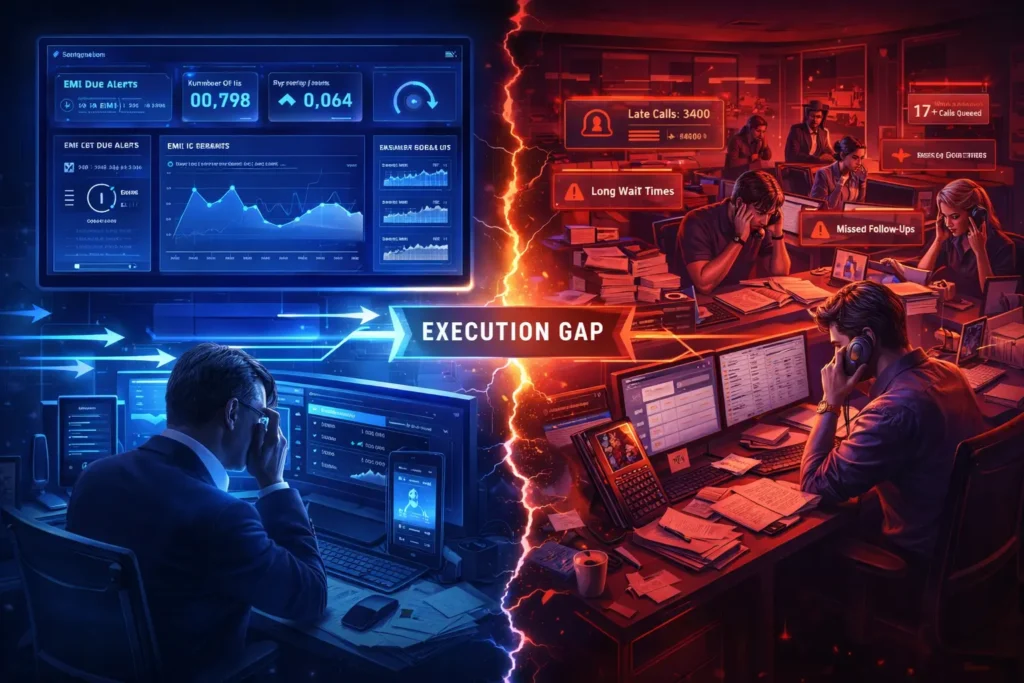
To grasp the problem, we need to recognize the point at which the digital process of most NBFCs comes to an abrupt end.
Financial institutions are extremely proficient in gathering, organizing, and evaluating data. Your CRM tool is highly advanced and can automatically generate a report every morning at 8:00 AM detailing the 10,000 customers who have EMIs due in exactly 48 hours.
But what happens at exactly 8:01 AM?
The data process comes to an abrupt halt and crashes into a massive brick wall. The digital report generated with such finesse and accuracy is passed on to the collections manager, who in turn sends it to the team of 100 calling agents. The agents have to get up from their chairs, put on their headsets, and start dialing the numbers one by one. Your data analysis skills are super-fast, but your execution speed is glacial. The Execution Gap is the gap between knowing what to do and actually doing it.
The Bottleneck of Manual Communication
While there has been a massive boom in technology in the fintech industry, industry data reveals that 70% of loan-related customer communications remain completely dependent on human bandwidth.
When you depend on human agents to execute your data, your business is handicapped by human limitations:
A. The Impossibility of Scale
A highly productive human collection agent might be able to make perhaps 100 to 150 calls in a single day. If your portfolio is growing, and suddenly you have 25,000 EMIs that are due next week, your team simply cannot make all of those calls in time. To scale up your calling efforts, you have to hire more collection agents, rent more offices, and conduct more compliance training. Your costs grow linearly with your customer base, which kills your profit margins.
B. The Tragedy of the Delayed Follow-Up
Due to the impossibility of scale, follow-ups are always delayed. A collection agent makes a call on Monday. The customer doesn’t answer. The collection agent then might not make a second call until Thursday because they have 300 other people to call. By Thursday, the EMI is already past due, in Bucket 1, and the NBFC is losing money.
C. Inconsistent Customer Experience
When agents are pressed for time, their tone of voice changes. They hurry up on the call, do not actively listen to the customer, and in some cases, get aggressive. This is a horrible customer experience that not only affects your brand reputation but also makes the customer defensive.
The Paradigm Shift: AI Voicebots as an Infrastructure Layer
If the bottleneck is the human bandwidth, how do you close the Execution Gap? The answer is to automate the action.
The most innovative NBFCs are changing their collection strategy entirely by implementing Conversational AI Voicebots. It is essential to grasp that modern AI Voicebots are not the clunky, frustrating IVR (Interactive Voice Response) systems of the past that forced customers to “Press 1 for English.”
Modern AI Voicebots, such as those offered by Archiz Solutions, are intelligent and conversational, using Natural Language Processing (NLP). More significantly, modern AI Voicebots are implemented as an Infrastructure Layer.
They do not exist in isolation in their own silo but are plugged in and connected to the very heartbeat of your CRM system. As soon as your CRM system begins to generate data, the AI Voicebot is the instant execution arm of the system.
Let’s take a look at the step-by-step execution of the automated collection process in real-world scenarios:
Step 1: The Instant Digital Trigger
Let’s consider a real-life example. An EMI is due in 2 days. At 9:00 AM the next morning, the CRM system captures this event. However, instead of exporting the list to the human team, the CRM system sends the instant API trigger to the AI Voicebot.
Step 2: Infinite, Simultaneous Outreach
The AI Voicebot is not dialing one customer at a time. It is capable of instantly and simultaneously dialing 10,000 customers the exact second the trigger is received. There are no coffee breaks, no breaks at all.
Step 3: Dynamic, Natural Conversations
The AI Voicebot greets the customer naturally in their preferred regional language when the customer picks up the call.
“Hello Mr. Sharma, this is a polite reminder from NBFC Name. Your loan EMI of ₹5,500 is due on the 5th of this month. Are you planning to make the payment online today?”
Step 4: Real-Time Objection Handling
If the customer gives an objection, e.g., “I do not have my salary yet; I will pay later this week,” the AI understands the customer’s intention perfectly. It does not argue with the customer. It could say, “I understand. Would you like me to send a payment link for Friday?” It gets the customer’s intention, “Promise to Pay” (PTP), very accurately.
Step 5: Automated CRM Updating
The moment the call is terminated, the AI Voicebot immediately updates the CRM system with the outcome of the call that just took place. Your CRM system is now “living” and “breathing.”
The Measurable Business Impact

When an NBFC moves from random, manual, inconsistent calling with humans to intelligent, automated AI communication, the impact on the balance sheet is massive.
Businesses that have implemented AI in the financial sector have reported astonishing operational improvements. Some of these improvements include:
Up to 40% Reduction in Calling Costs: Companies have reported that they drastically reduce their calling costs by automating the massive number of routine EMI reminders. You can scale your communication output without having to scale your payroll costs.
2x Increase in Customer Connection Rates: The AI is able to retry all unanswered numbers at optimal times without getting tired. Therefore, the customer connection rate is doubled.
Reach 5x More Customers Daily: An NBFC that implemented this AI architecture was able to reach five times more customers on a daily basis in just a matter of weeks. The number of customers that they were able to reach was massive.
Empowering Your Human Workforce: Once the AI takes care of routine reminders, your human collections team is able to do what they do best. Your team is able to focus 100% of their time on complex restructuring, high-value defaults, and severe delinquencies that require deep human empathy.
Conclusion: The Future is AI-Driven Communication
In the highly competitive lending industry, having the best data is no longer a competitive advantage; it is the bare minimum requirement. The true competitive advantage belongs to the institution that can act on that data the fastest.
If your NBFC’s loan management system still depends on a human team to make manual calls, you are not just being inefficient—you are actively losing revenue every single day. Your highly digitized business is suffering because your execution layer is stuck in the past.
The future of NBFC operations is not just digital; it is AI-driven communication. It is time to close the Execution Gap, automate your collections, and build a recovery pipeline that scales infinitely.