
How NGOs Reduce Costs by 30–95% Using AI Voice Agents
The True Cost of Manual Outreach
Costs associated with NGO communication are not limited to direct expenditure items such as phone and personnel costs. In order to understand the overall cost associated with manual communications, it is pertinent to discuss associated direct and indirect costs. Reduce NGO Outreach Costs
Direct labor costs rise quickly: Every call requires staff time, not just to talk to the person, but also to locate them, to document conversations, to schedule subsequent interactions, and to maintain call lists. If organizations have dedicated calling teams, salaries and associated benefits are considerable line items. If staff are incorporating this into their existing duties, the time involved translates into considerable expense.
Continuous Training and Onboarding: Staff turnover in call center settings for NGOs is usually between 30% to 50% annually because of high repetitiveness, emotional strain, and low compensation. Where each staff member leaves an organization as a walking encyclopedia, there is a need to constantly train new personnel. It takes these fresh recruits weeks just to learn about an organization, adopt suitable interaction strategies, and become effective.
Infrastructure costs multiply: Manual calling requires physical workspace, phone systems, management oversight, quality monitoring, and performance evaluation infrastructure. Even in normal periods when utilization is low, organizations have to keep call capacity for peak periods, thus sustaining extra capacity costs.
Opportunity costs can be a limitation to scale: Most importantly, resources invested in routine communication cannot be used for program delivery. Every dollar funding appointment reminder calls is a dollar not being used for clinical services, agricultural extension, financial counseling, or educational programming. Every hour staff are dedicating to routine questions is an hour that is taken away from complex cases requiring human expertise.
When NGOs use manual calculations to determine the actual cost per beneficiary interaction in terms of salary, overhead costs, training costs, etc., the costs per beneficiary interaction are normally in the range of $2 to $8 per meaningful contact. When NGOs aim to address thousands of such beneficiaries within meager budgets, the figures do inherently affect them.
Why AI Voice Is Economically Different
Artificial intelligence voice agents are unique in that they modify the cost structure, not incrementally, but fundamentally, by virtue of breaking the linkage between the quantity of communications and resource demand.
Marginal costs approach zero: Once deployed, one call or ten thousand calls can be made using the AI voice system, with no increase in costs. There is no need to buy extra personnel, rent extra space, or build extra infrastructure because of increased calls. The system’s costs increase elastically with calls. In addition to minimal cloud computing costs, they are far lower than labor costs.
No hiring & training delays: Organizations can scale immediately instead of waiting three months for the hiring/training pipeline. When a new program rollout needs urgent attention, or a disaster situation requires an immediate surge in communications, voice AI scales in a matter of hours versus weeks/months for humans.
No overtime for 24/7: Manual teams work for limited hours and need to be paid for overtime hours. Voice agents work 24/7 free of cost, allowing people to access information and services at any time: even if they call on weeknights, weekends, or holidays, or at the crack of dawn due to emergencies.
Automate documentation and analytics: Each interaction automatically results in structured data without requiring any time for documentation; similarly, analytics can be done on runtime without any extra work and data entry. It transforms reporting from resource-intensive periodic exercises into continuous insight that supports adaptive program management.
These economic characteristics don’t just cut costs-they fundamentally change what’s possible. Outreach that was economically infeasible with manual methods becomes possible, indeed sustainable.
Real Cost Reductions NGOs See
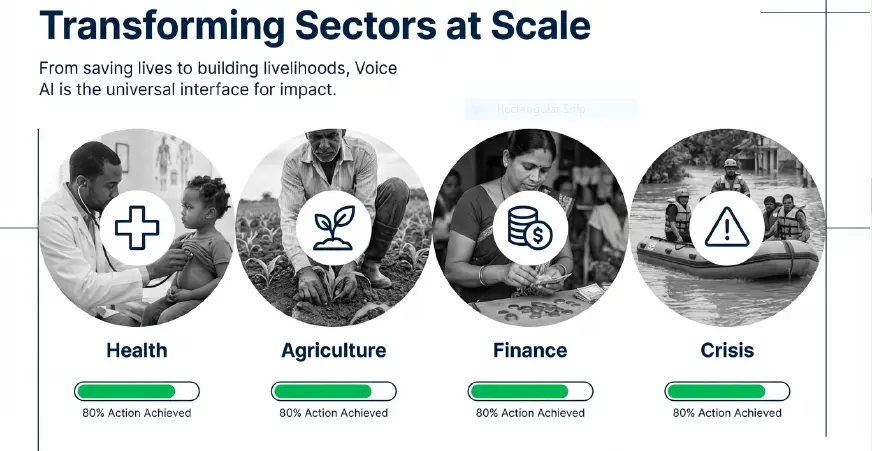
70-80% communication automation: Routine communications, reminders, FAQs, status updates, information queries handled previously, and many communications requiring little response complexity are handled entirely through automated voice agents. It does not suggest a 70-80% reduction in staff; instead, it suggests a relocation of their time from these efforts to focusing more time on the complex, nuanced calls that truly require the nuance of humanity. However, organizations can avoid hiring additional staff levels as programs grow.
30-50% total operational savings: Where labor savings, overtime, training, infrastructure, and efficiencies are factored in, NGOs can expect total operational savings of 30-50%. To an organization that has an annual budget of $500K for communications programs, this equates to an extra $150-250K for program growth.
The savings can be as high as 95% per interaction. The most dramatic savings come through in cost-per-contact metrics. Where calling might cost $3-8 per meaningful interaction when including all overhead, automated voice agents reduce this to $0.15-0.40 per interaction. It’s this cost reduction of 90-95% that finally allows organizations to maintain far more frequent contact with beneficiaries—daily medication reminders instead of weekly, multiple follow-ups instead of single touchpoints—without budget increases.
Improved budget predictability: Manual communications costs vary unpredictably with staff turnover, overtime during surges, and variability of recruitment timing. Voice AI creates predictable monthly costs that scale smoothly with usage, making it easier to budget and financially plan more precisely. Predictability benefits grant-funded organizations the most as they must commit to specific deliverables with fixed budgets.
Redirected savings amplify impact: The most important savings aren’t financial but in mission impact. When $200K previously spent on routine calling becomes available for program expansion, organizations can serve more beneficiaries, improve the quality of service, expand their geographic reach, or enhance monitoring and evaluation. Voice AI doesn’t just reduce costs; it removes the economic constraint that put a cap on organizational reach.
Why Donors Care About Voice ROI
Now, funders also want to ensure that grants are most effective per dollar spent. Voice AI enhances effectiveness and justification of cost-effectiveness in ways that capture donors’ attention and needs.
Better reporting with less effort: Data from voice interactions provides detailed reports about how well you’re reaching your beneficiaries, what they’re asking, and program results—without requiring weeks of staff time to put reports together. You can now use dashboards to demonstrate to funders exactly how you’re using your funds, including the number of people you’re serving, how frequently, and with what results.
Quantifiable efficiency gains achieved: Donors prefer quantifiable results, e.g., “Now we reach 5,000 beneficiaries weekly as opposed to 1,200 with the same budget”. “Cost per successful vaccination reminder is cut from $4.50 to $0.30.” Voice AI is all about delivering quantifiable results.
Scalability evidence for future funding: Organizations seeking larger budgets will show evidence of scalability so that increased investments can be made without proportionate increases in cost. VOICE AI shows evidence of scalability by proving the model can scale 10 or 100 fold.
Social return on investment clarity: where organizations can demonstrate that $100K invested in voice infrastructure generated a total of $300K in avoided costs, improved outcomes worth $500K in avoided emergency interventions, and enabled program expansion serving 15,000 additional beneficiaries-the value proposition becomes quite compelling. Voice AI provides the data and efficiency that make high SROI achievable and demonstrable.
Alignment with the principles of effective altruism: Funders moved by the approaches of Effective Altruism favor interventions with measurable impact and good cost-effectiveness profiles. This places Voice AI very strongly in this framework because of its drastically lower costs and measurably better reach.
The ROI conversation isn’t just about saving money; it’s about proving that the choices made regarding organizational infrastructure actually maximize mission delivery per donor dollar. Only Voice AI provides the reality and evidence of cost-effectiveness in ways which manual systems simply cannot match.