
The 80% Rule: Why Your Hospital Is Losing Its Reputation to "Silent Patients" (And How AI Voice Calls Fix It)
Main Points You Need to Know Before Reading This Post:
Silent Epidemic: Based on industry statistics, there is an ugly truth that most healthcare facilities need to know: Up to 80% of patients will never leave their feedback to the hospital’s staff before being discharged.
The Megaphone Effect: Those who keep quiet in the wards don’t stay quiet when they get home. Their dissatisfaction becomes viral within seconds, in the form of devastating 1-star reviews online and on Google.
Intelligent Solution to a Common Problem: The top-notch medical institutions are moving away from outdated paper-based patient feedback and using advanced AI solutions to make sure patients share their opinions right after discharge via Voicebots.
Imagine yourself as an administrator of a respected multi-specialty hospital facility. Your Monday morning starts at 9 AM in the hospital’s administrative office. You sit down at your desk, have a cup of coffee and open your dashboard.
At first glance, all seems well. The healthcare professionals are well-trained, the hospital is immaculate, and the most up-to-date standards of care are being implemented. However, then, the CXO looks through Google reviews.
In front of him/her lies an extremely negative 1-star review posted only the night before. This particular patient is upset at having had to spend three hours resolving a billing issue and feels like there was a lack of understanding coming from the floor nurse who was in a rush.
But the CXO is shocked. Immediately, he/she checks out the patient’s discharge paperwork. As per the documents, when the patient was asked about their experience during the check-out process, he/she answered with a smile and nod, saying, “Everything was fine.” He/She did not complete the feedback form lying on their bedside table, nor complained to the floor manager.
But what was the reason for not voicing out during his stay in the hospital? Why did he have to wait until he got home to vent his frustrations on social media?
In this detailed manual, you will learn the psychology behind the “silent patient,” the reasons why manual-based feedback mechanisms do not work, and how innovative healthcare organizations can use AI Voice Calls to capture patient sentiment before it’s too late and defend their reputation from negative publicity online.
The Psychology of the Silent Patient
For an administrator attempting to solve this problem, the key step is putting themselves in the patient’s position. Admitting oneself into the hospital is a frightening ordeal. The experience itself is riddled with fear, pain, and costs.
Once a patient receives confirmation of their release, the only thing occupying their mind is going back home.
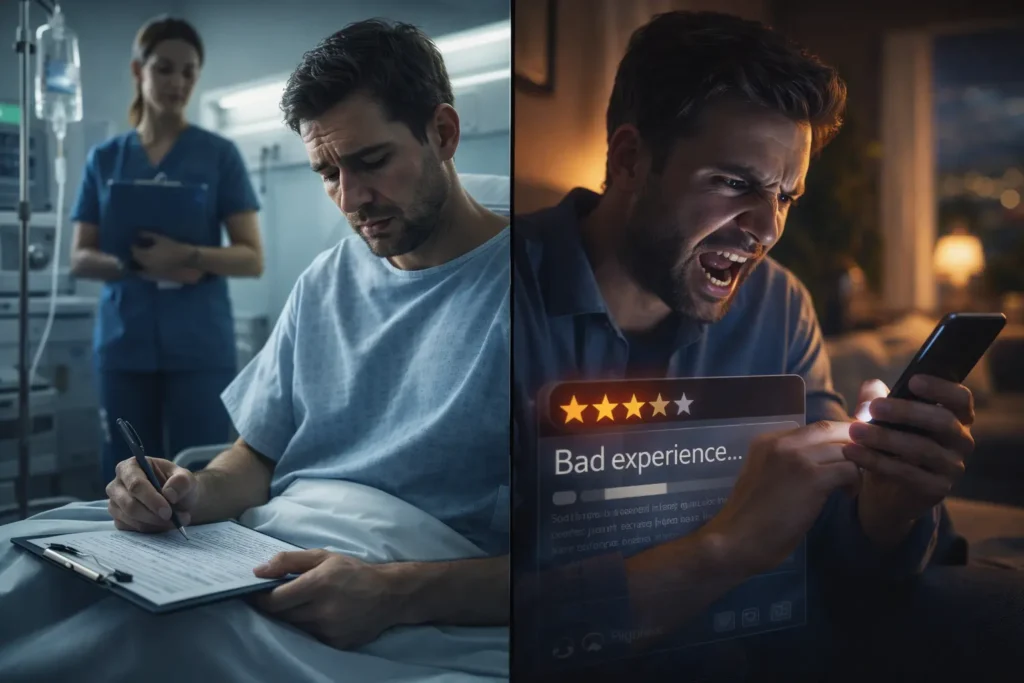
During that fleeting moment of joy, if a nurse who’s already running behind hands them a two-page feedback form on a clipboard, what will happen?
Intimidation: Patients may feel scared when asked to complete the form in the hospital setting. They don’t want to cause a disturbance at such a sensitive time, especially since they are still within the walls of the facility.
Apathy: Some patients are too exhausted to take up the task of filling out a form using a cheap pen.
The “Rush” Factor: The discharge process takes some time. Patients wait for billing and pharmacy clearances before being able to leave.
Due to the above mentioned very human qualities, 80% of patients depart without saying anything at all.
But this silence is far from being a measure of satisfaction. The minute they return home, their adrenaline rush wears off, and the frustration about waiting for so long during the billing process, or getting bad food, hits them hard. They take out their smartphones and post their complaints on social media platforms such as Google, Facebook, or medical websites.
Once the hospital administration realizes what’s happening, the situation is beyond repair. The trust is irrevocably lost, and the prospective patients are already scared off by the negative reviews on the Internet.
The Flaw in Manual Post-Discharge Calls
Knowing that the paper form has become obsolete, most of the hospitals try to solve this issue by adopting an inefficient manual process of contacting patients after discharge. In this process, hospitals usually train their administrative employees, junior nurses, or even the BPO department to make a call to every individual patient within 24 to 48 hours after his or her discharge from hospital.
Although this idea sounds good, its implementation is highly defective and very ineffective as well:
A. The Pressure on Already Overworked Nurses
The nurses of your hospital must remain dedicated to caring for and healing your patients. Making them sit behind the desk and spend countless minutes calling people simply to ask, “How was your stay?” does not make any sense at all.
B. Inconsistent Follow-up Calls
Given the busy schedules of human representatives, follow-up calls are either postponed or even forgotten altogether. When a representative makes it possible to call just 30% of patients who have recently left the hospital, your hospital will continue to overlook 70% of data relating to the quality of care you offer.
C. A Week-long Delay in Data Analysis
Even when a human representative manages to contact an angry patient on Wednesday, information from this call will be recorded in a spreadsheet, gathered into a report, and discussed with management on Monday. Getting to know about an angry patient one week after their discharge is absolutely useless, since they probably left you a bad review online already.
The Paradigm Shift: Intelligent AI Voice Calls
In the absence of paper-based surveys and manual calling groups, which prove to be too costly and ineffective, what is the means of attaining 100 percent insight into patient satisfaction levels in hospitals?
The solution to such challenges comes from eliminating human intervention in the data-gathering process. Some of the most forward-thinking healthcare institutions have turned their patient experience upside down with the implementation of conversational voice-based AI chatbots.
According to Dheeraj Mehta, founder of Archiz Solutions, such technologies have brought a complete change in reputation management practices in hospitals. Such solutions are definitely different from those pesky and robotic IVR solutions where patients need to press buttons to reach someone.
Let’s dive into an overview of the working process behind the automated zero-latency feedback workflow:
Step 1: The Trigger
At the very instant that the hospital records the discharge of the patient on its system, an automatic trigger is fired. In no time, a phone call with the patient is scheduled and the AI-powered Voicebot starts a conversation with the patient in a few hours since he has arrived home.
Step 2: Natural Conversation
As soon as the patient picks up the phone, the AI will greet him. “Hello Mr. Sharma, this is a courtesy call from the Patient Care team at [Hospital Name]. We hope you are recuperating well at home. Can you spare two minutes and tell us about your experience in our care? ” The tone used by the AI is natural, empathic and conversational. The patient responds in his own voice. No button pressing or form filling is required.
Step 3: Real-time Sentiment Analysis
While the patient is speaking, the software analyzes their words using advanced Natural Language Processing (NLP) methods. Not only does the system transcribe the patient’s voice, but it analyzes the sentiments expressed within it and detects whether the emotions are positive, neutral, or negative at once.
Step 4: Instant Notification of a Potential Grievance
And here comes the fun part! If the AI system determines that the patient is not satisfied with the services provided due to misdiagnosis, rudeness, or fraud by the clinic, it immediately notifies the Patient Relations Manager or the Grievance Officer with an alert saying that there may be a potential problem.
A phone call from the medical office will prevent the company from getting a bad review on Google.
The Measurable Business Impact: Transforming Your Brand

The effects of the transition from an ineffective and laborious feedback mechanism to a powerful and smart AI Voicebot platform are tremendous.
Proactive Reputation Management: Because you are now able to instantly intercept complaints, your response strategy changes from being reactive to proactive. You immediately eliminate the negative experience before it leads to a 1-star review online.
Magnified 5-Star Reviews: It is not only bad but also good feedback that the AI detects. In case a patient enjoyed the treatment process to the full extent, your system may automatically send them a message with the direct URL to your Google My Business listing, inviting them to leave a 5-star review. Your ratings will skyrocket accordingly.
100% Outreach Rate Without Additional Work: The medical institution is now able to reach out to every one of its discharged patients, getting an accurate insight into the functioning of the organization without any involvement of its employees.
Freed-up Nurses & Administration: With all the paperwork taken off your hands by the AI, your nurses and administrative staff can fully dedicate themselves to providing top-notch patient care.
Conclusion: Take Control of Your Narrative
In today’s healthcare environment, simply delivering superior care isn’t sufficient to ensure profitability for your business. Perception is reality. When your patients perceive their treatment negatively and shout it to the world via the Internet, you’ll feel it in your bottom line.
You can’t allow 80% of your patients to leave your facility without saying anything. You can’t rely solely on neglected paper surveys or tired teams making manual phone calls.
Data and sentiment analysis is the role of a computer. Deeply listening, practicing medicine, and resolving grievances is the work of a human.
With just one phone call using an AI Voice Calls solution, you eliminate the problem of the “Silent Patient.” You provide your patients with a powerful voice, you free up time for your employees to take care of patients, and you zealously guard the reputation you’ve worked so hard to establish.