
The Student "Memory" Gap: How to Stop Late Fee Payments and Automate University Collections
If you are in charge of the operations, finance, or administration of a university, college, or a big educational institution, you are most likely very familiar with the most stressful time of the year in the academic calendar: Fee Collection Season AI Voicebots.
Even though they are the best in the world in terms of the quality of education and facilities, educational institutions are often faced with the frustrating and utterly predictable problem of thousands of students failing to pay their semester fees in time. As the due date approaches and then passes, the cash flow of the university becomes extremely unstable, and a sense of panic grips the minds of the people in the finance department.
What is the traditional solution to this problem? The university administration immediately goes into crisis management mode and mobilizes their staff. The best and most highly educated academic counselors and administrative executives are suddenly taken away from their actual work and forced to become glorified debt collectors, spending weeks poring over huge Excel spreadsheets and dialing thousands of phone numbers, saying the same thing over and over and over: “Hello, this is a reminder that your semester fee was due yesterday.”
But what if this entire chaotic and manual process is based on a false premise about your students? What if there is a way to significantly improve on-time fee payments without your staff making a single phone call?
In this comprehensive guide, we’ll discuss the actual psychology behind student payments, the hidden costs of manual administrative follow-ups, and how forward-thinking universities are using AI Voicebots to automate their fee payment processes.
The Great Myth: Why Do Students Actually Pay Late ?
When a semester fee deadline is missed, the university management makes a swift judgment. The judgment is that the student or their parents deliberately choose not to make the payment, owing to a sudden scarcity of funds.
It should be understood, though, that there indeed are situations of financial need. However, after analyzing all the available data on the university sector, there is a much more unexpected and mundane reality. The overwhelming majority of missed payments occur owing to a ‘Memory Gap.’
Consider the life of a contemporary university student. The student is living in an extremely stressful world. The student is balancing an extremely busy class schedule, preparing for mid-term exams, working on complex group projects, and attending extracurricular activities. In addition, the student is probably working part-time jobs. The student’s cognitive abilities are completely exhausted.
When a student fails to meet a deadline, it is not because of malice or a lack of intent to make the payment. The student simply fails to remember the exact date, owing to the hectic university lifestyle. The student may remember that fees need to be paid ‘sometime in November,’ but fails to remember the exact date of November 15th.
If the fundamental issue is simply the forgetfulness of humans, then the answer is extremely simple: A timely, yet polite reminder. Of course, the implementation of such a basic solution across the vast student base is where the traditional university system completely fails.
The Hidden Cost: Treating Admin Staff Like Auto-Dialers
In order to address the problem of forgetfulness, universities use their administrative staff to make reminder calls. Although this may be feasible for a small private tutoring center with 50 students, this is an absolute operational nightmare for a university with 5,000 to 20,000 enrolled students.
The reliance on manual human dialing causes severe operational issues, and this hurts the university in the following ways:
A. The Burnout of Brilliant Minds
Your university administration team was hired to provide a smooth academic environment, provide counseling services, coordinate logistical activities, and enhance the student academic experience. However, if you require them to spend 6 to 8 hours a day acting as a call center agent, dialing numbers and reaching voicemail after voicemail, you are destroying their morale.
B. Inconsistent and Slow Outreach
A human can make a limited number of phone calls within an eight-hour period. If the need to remind 10,000 students that their fee is due in three days is a task for your university, it is impossible for a human to make the necessary calls. This process is slow and will result in hundreds of students not receiving the reminder. They will miss the due date, and the cash flow will be negatively impacted.
C. The “Harassment” Perception
When a human is rushed and stressed, the tone of the phone call changes. A human phone call can be perceived as aggressive and demanding. This relationship between the student and the academic institution is a service industry that requires mentorship and trust. It is a service industry that is directly impacted if the relationship between the student and the academic institution is aggressive.
The Smart Solution: The Shift to AI Voicebots

If manual calling is too slow, too expensive, and too damaging to staff morale, then what is the alternative? The most innovative leaders in the education industry are now moving from manual labor to smart automation with the help of Conversational AI Voicebots.
In a recent article, Dheeraj Mehta, the Founder of Archiz Solutions, has pointed out the way this technology is completely revolutionizing university operations. An AI Voicebot is not a frustrating, robotic, “Press 1 for English” IVR system. It is a smart, conversational system that connects directly with your university’s ERP (Enterprise Resource Planning) software or student database.
Here is exactly how the automated process of AI fee collection works:
Step 1: Proactive, Automated Outreach
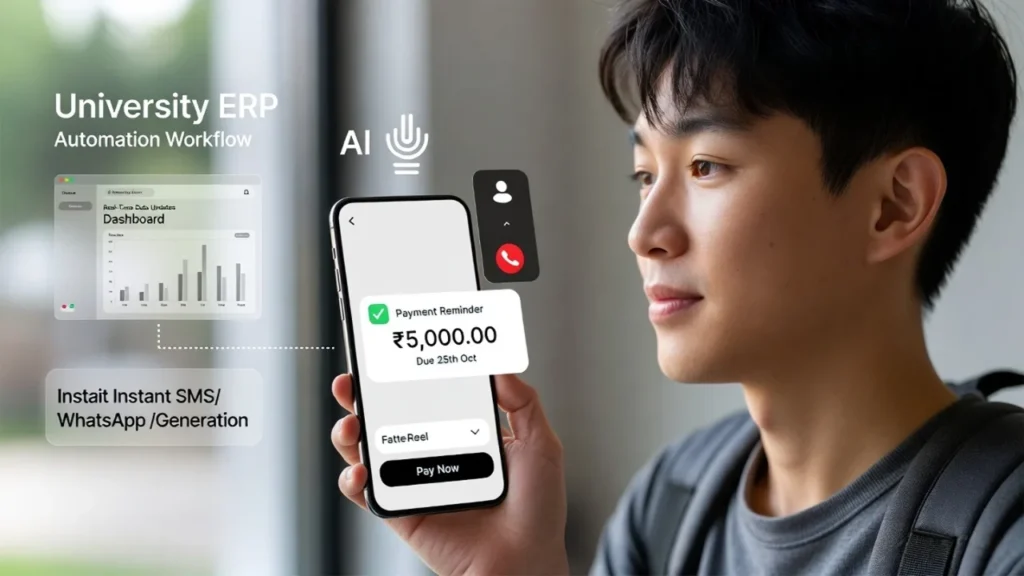
No longer must you wait until the deadline passes. Three to five days prior to the fee payment deadline, the AI system makes proactive outreach. The AI Voicebot automatically makes phone calls to all students with outstanding balances. Whether you have 500 students or 50,000 students, the AI makes all of these phone calls at the same time.
Step 2: Natural, Polite Conversation
When the student receives the phone call, the AI responds. “Hello Student Name, this is a polite reminder from the university administration. Your semester fee of Amount is due on Date. Are you planning to make the payment online?” The tone of the conversation is consistently helpful, polite, and completely devoid of human frustration.
Step 3: Instant Information Sharing
When the student asks, “Can you send me the link to pay?” the AI understands the intent and instantly triggers a secure payment link via SMS or WhatsApp while on the call. The AI can also answer basic Frequently Asked Questions (FAQs) related to the payment process.
Step 4: Real-Time ERP Updates
As soon as the call is completed, the AI logs the student’s response, for example, “Will pay tomorrow,” “Requested extension,” directly into the university’s database. No human data entry is required.
The ROI of Automation: Why Universities Must Adapt
The impact this has on the business is almost instant and extremely quantifiable. For instance, for universities that switch to this AI Voicebot system, there is:
Massive Jump in On-Time Collections: With the AI system promising 100% consistency in reminders, no student will ever miss a due date again! The efficiency in bridging this memory gap will result in drastic reductions in late payments, creating a highly stable cash flow for the institution.
Thousands of Hours Saved: The robotic process automation involved in dialing out to students will be highly efficient for the institution, freeing up thousands of hours for administrative staff.
Empowered Human Staff: With this system, your administrative staff can now focus 100% of their time and energy into solving complex problems for students who genuinely have grievances, require scholarship counseling, or even special academic support.
Conclusion: Automate Your Campus Operations Today
The future of higher education management will be based on operational efficiency. You cannot scale a modern educational institution with old, inefficient back-office operations.
If you are a university that is wasting time and resources printing out huge excel sheets and expecting your administrative staff to manually dial students to collect fees, then you are losing money and killing the efficiency of your staff. Machines should be doing repetitive reminders. Student welfare and guidance are for humans.
It’s time to let the machines do the hard work while your human staff focus on shaping the future of your students.
Are you ready to automate your fee collection processes? Dheeraj Mehta of Archiz Solutions has created a vedio but potent video explaining the process of how this AI technology works for educational institutions.