
The Waiting Room Crisis: How AI Symptom Checkers Are Revolutionizing Patient Triage and Faster Care
Key Takeaways Before You Dive In:
The Core Problem: Long waiting times in clinics are seldom the result of a shortage of doctors but rather the extremely slow process of collecting the initial information about the patients’ symptoms.
The Danger of Manual Queues: Using the “first-come, first-served” principle means that patients with severe and urgent conditions end up waiting behind patients with minor conditions.
The Smart Solution: Using the AI Pre-Screening Assistant solves the problem of long waiting times in clinics by instantly triaging patients and preparing the doctor before the patient even walks into the consultation room.
If you walk into almost any busy medical clinic, urgent care center, or Hospital Outpatient Department (OPD) anywhere in the world today, you are likely to be greeted by a painfully familiar sight: the Overflowing Waiting Room.
You are likely to see rows of chairs filled with sick, nervous, and frustrated patients. You are likely to see a receptionist who is completely overwhelmed with phone calls and paperwork. And behind closed doors, you are likely to see highly trained and brilliant doctors who are burning out fast with the unrelenting pace of their daily workloads.
In the age of instant digital gratification, in which a person may be able to order a meal or book a flight in a matter of seconds, the traditional healthcare experience is shockingly slow. When a patient is not feeling well, making them wait two hours for a five-minute consultation not only makes them angry but also hurts their ability to trust your healthcare facility.
What causes the delay in the clinic?
Most healthcare clinic management believe that the solution to the problem of delay in the clinic is to hire more doctors or build a larger waiting room. However, the actual reason behind the delay in the clinic has to do with a much deeper problem in the way in which healthcare clinics manage the patient intake process.
In the following guide, we will examine the underlying reason behind the delay in the clinic, the unknown danger of the manual triage of patients, and the innovative solution that forward-thinking healthcare providers are utilizing to completely automate the patient pre-screening process by utilizing AI Symptom Checkers.
The Bottleneck: The Flaw of "Starting from Zero"
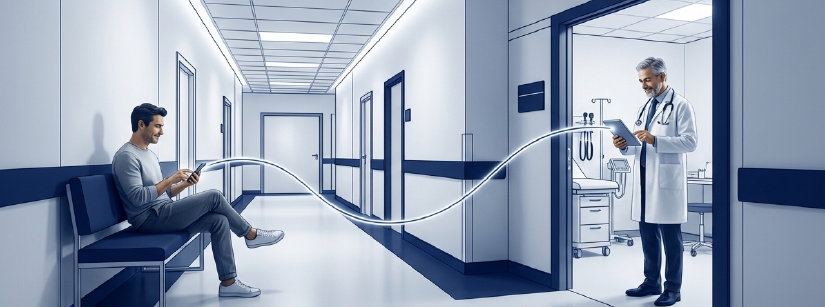
To understand why your clinic is experiencing massive delays, we need to look at the workflow inside the room.
What actually happens when the patient’s name is finally called and he/she sits down in front of the doctor? The doctor smiles, looks at the patient, and has to start from zero.
The doctor has no idea why the patient is there. The doctor has no data, no information. The doctor has to spend the first 4 to 8 minutes of the entire consultation acting like a human data entry clerk. The doctor has to ask very basic, very repetitive, and very uninteresting questions such as:
- “What brings you in today?”
- “When did your symptoms start?”
- “Do you have a fever? Have you taken any medication for it?
- “Do you have any pre-existing medical conditions?”
While these questions are absolutely crucial in the proper medical diagnosis of the patient, it is an extremely inefficient way to utilize a doctor’s valuable time.
If a doctor has 40 patients a day, and it takes 5 minutes per patient just to take the patient’s history and enter it into the Electronic Medical Record (EMR) system, that’s more than 3 hours a day spent just doing basic data collection. That’s the real problem. When a doctor has to spend so much time just gathering information, the appointment takes longer and longer, the day behind the doctor grows longer and longer, and the people in the waiting room continue to increase in number by the minute.
The Smart Fix: Deploying AI Pre-Screening Assistants
If it is too slow and too dangerous to require physicians to start from ground zero and manually triage patients at the front desk, then what is the solution? How do modern clinics scale their operations without compromising the safety of patients?
The most innovative leaders in healthcare management are bridging the gap between the old and the new by using Conversational AI Symptom Checkers.
Industry experts are revealing the specifics of how this HealthTech automation is changing the way clinics run. This is not a diagnostic tool or a replacement for physicians. This is the ultimate clinical assistant, doing the “heavy lifting” of collecting the information needed in the beginning stages.
Here is the step-by-step blueprint of the process of how the AI Triage works:
Step 1: The Digital Check-In
Before the patient even arrives at the clinic (via a WhatsApp link sent when they book an appointment) or immediately upon walking through the door (via a tablet or QR code at the front desk), they begin the process of speaking with the AI Assistant.
Step 2: Conversational Symptom Gathering
The AI system starts a natural and conversational dialogue with the patient. The AI system essentially asks the patient the same basic questions that the doctor would have asked. “What are your main symptoms today? How long have you been feeling this way? Could you rate your pain on a scale of 1 to 10?” Since the AI system processes information instantaneously, this entire dialogue takes less than 2 minutes.
Step 3: Smart Algorithmic Triage
As the patient gives his/her response to each of these questions, the AI system instantly processes this information against various algorithms to assess the severity of the symptoms. In case it detects “Red Flag” keywords in the symptoms, it instantly sends an emergency alert to the nurse/doctors on duty. The AI system sends an instant alert to ensure that such patients are immediately taken into a room.
Step 4: The Flawless Doctor Handoff
For normal patients, the AI system takes the response from each of these questions and creates a clean and structured medical summary. The AI system sends this summary directly to the doctor’s screen before the patient even enters the room.
The Measurable ROI: Empowering the Medical Staf
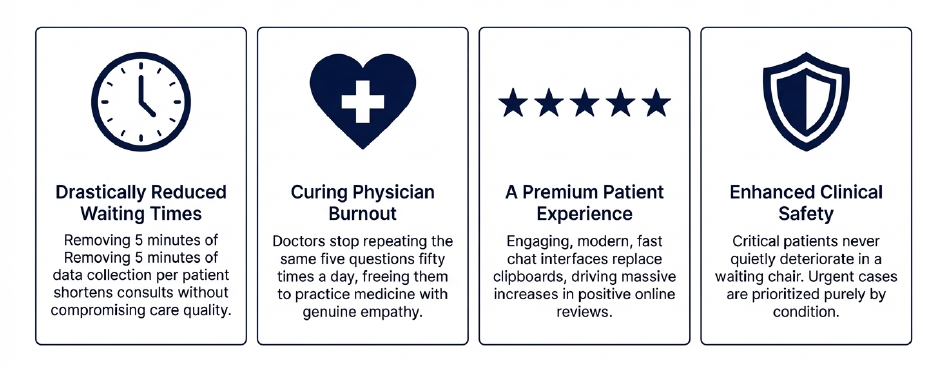
The impact of moving from a manual waiting room to an AI-powered waiting room is immediate and staggering.
Drastically Reduced Waiting Times: By not having to spend 5 minutes collecting basic patient information, a consultation is significantly shorter without any compromise in quality of care.
Curing Physician Burnout: It’s mentally exhausting asking the same five questions fifty times a day. By using an AI-powered waiting room, a doctor can walk into a consultation fully prepared. They can spend their valuable time doing what they were trained to do – examine a patient, explain a treatment plan, and practice the art of medicine with genuine empathy.
A Premium Patient Experience: Nobody wants to be sick and fill out a bunch of information on a clipboard. A chat-based AI experience is engaging, modern, and fast. By also reducing waiting times significantly, a patient feels cared for and understood – a huge increase in positive online reviews.
Enhanced Clinical Safety: By using a smart waiting room, the chances of a critical patient quietly waiting their turn and deteriorating are virtually eliminated. Urgent patients are automatically prioritized based on their condition, not their waiting time.
Conclusion: Leave Data to the Machines, Leave Healing to the Humans
The pressure on the healthcare industry to achieve more for less is intense. Patients expect rapid service, and doctors are fighting unprecedented burnout.
You cannot solve 21st-century healthcare challenges using 20th-century paper clipboards and queues.
If your high-paid, best-trained doctors are wasting half their time being data entry clerks, then your medical clinic is at a tremendous disadvantage. The time has come to draw a clear line between administration and medical care. Gathering basic symptoms and managing queues is a machine task. Diagnosing, soothing, and healing the patient is a human task.
By using the AI-powered Symptom Checker, the waiting room dilemma is immediately solved. Your doctors are saved from burnout, patient safety is ensured, and a smooth, frictionless healthcare experience is provided to the community, which will thank you for it.