
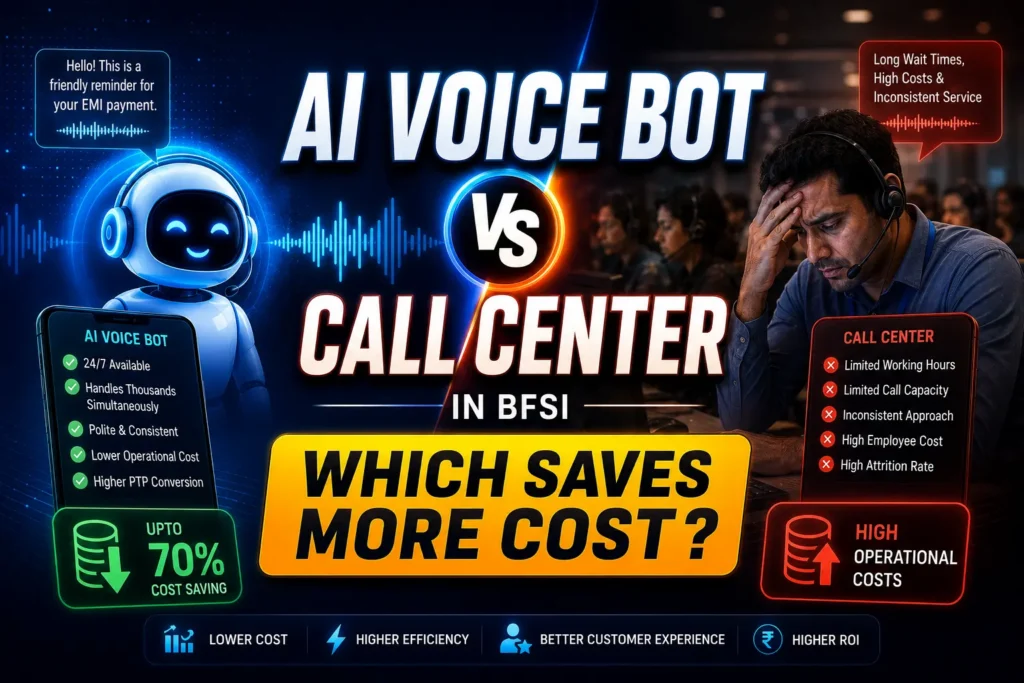
AI Voice Bot vs Call Center in BFSI: Which Actually Saves More Cost? A Deep Dive Analysis
Main Points to Consider before Reading Ahead:
Linear Scaling Problem: Legacy human contact centers demand linear growth, which means that the same number of HR expenses, overheads, and training hours will be needed as loan volumes increase by a certain factor.
High Agent Turnover Rates: BFSI contact centers have an average agent turnover rate of over 40%, resulting in a vicious cycle of recruitment and training for replacements.
Economic Model of AI: AI-based conversational voicebots provide limitless scaling at minimal cost. They need no office space, do not require any training period, and work round-the-clock.
Communication forms the backbone of BFSI. The validation of KYC information of new customers, making welcome calls, reminding clients about their EMIs, and recovering defaulters – all of this is done via phone calls.
For the past three decades, the solution to handling this huge amount of communication has been very straightforward – make the call center bigger. Banks have spent billions of dollars on huge BPO deals, rented thousands of square feet of office space, and hired thousands of telephonists. But as we get further along in the digital era of 2026, the cracks are starting to show in this huge structure.
The question on everybody’s mind in the boardroom meetings of these fast-growing NBFCs is, “Do we need more people in our call center or do we install AI Voicebots?”
The True "Fully Loaded" Cost of a Human Call Center
For the Chief Financial Officer who is considering investing in a call center facility, the most prominent cost will be the salary of a trainee representative (for instance, ₹20,000/month). Nevertheless, using only a base salary to assess the price of human labor is one of the biggest financial misinterpretations.
To arrive at the true “Fully Loaded Cost” of human labor, a financial organization will need to include the following expenses into their analysis:
Real Estate & Utilities: Desk space, office lease, round-the-clock cooling system, electricity, and internet connectivity costs.
Hardware & Software Licensing: Computer hardware, business-grade headset, and costly monthly licensing of CRM and autodialer software.
Excess Middle Management Layers: TLs overseeing groups of 15 reps each, QA specialists who are listening in on the calls, and HR staff.
Adding all these elements, that ₹20,000 agent is actually going to cost your NBFC around ₹60,000 plus per month. Additionally, churn ratios for call centers often range from 35% to 45%. You have to keep on spending on recruitment and training in a never-ending cycle.
The Economic Model of the AI Voicebot
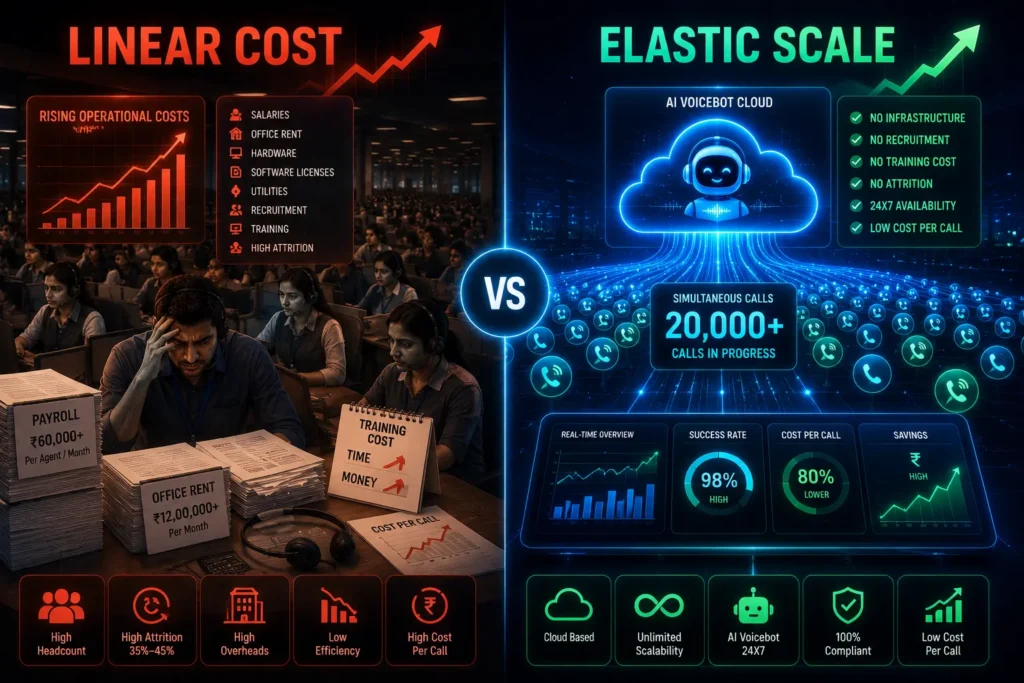
However, we can now compare this against the financial model of using a cutting-edge, Conversational AI Voicebot solution provided by enterprise companies such as Archiz Solutions. The economics behind AI are based on a totally different approach known as Elastic Scalability.
No Cost for Infrastructure: The AI Voicebot resides in the cloud. It doesn’t need a table, a cool office, a PC, or a headset to be used effectively.
No Learning Curve: An AI solution does not require any 4-week training course to learn about RBI regulatory norms or your unique lending offerings. All you have to do is simply upload the script and integrate the APIs, and it’s ready for the floor within a few hours.
No Employee Turnover: An AI Voicebot doesn’t tire easily, doesn’t argue back with difficult clients, doesn’t ask for pay raises, and never leaves to work for your competition.
The Power of Infinite Concurrency
The greatest financial benefit that can be derived from artificial intelligence technology is concurrency. Human beings can make one telephone call at a time. On the other hand, an AI Voicebot can make 10 telephone calls or even 20,000 telephone calls simultaneously. In case you encounter a surge in the number of telephone calls you need to make, particularly during seasonable times like month-end collections, your AI Voicebot will scale up instantly to cope with the increased demand and then scale down afterwards.
The Quality and Compliance Factor
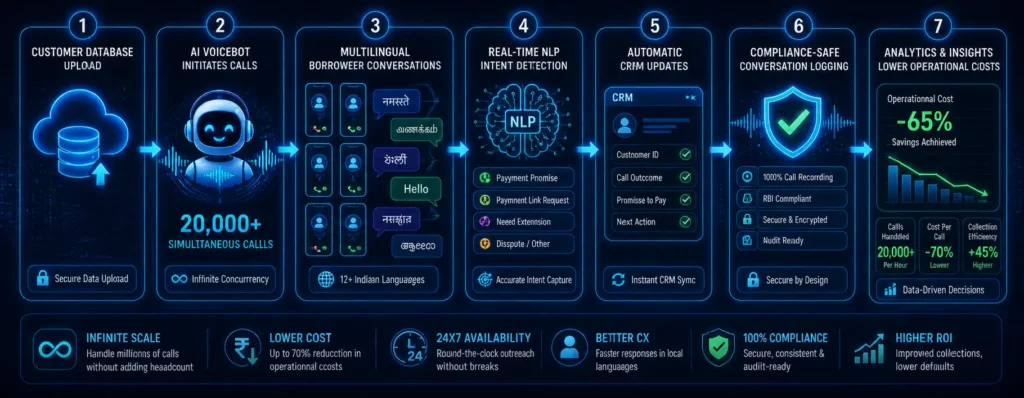
Cost does not matter if the quality is compromised. Traditional bankers feel that an AI voicebot might irritate borrowers with a typical “Press 1” IVR tone. Modern conversational AI leverages deep natural language processing (NLP). This bot speaks effortlessly in more than 12 regional Indian languages and captures the intent of the borrower in real-time with API webhooks to update the CRM.
Besides, human agents are a big regulatory headache. An AI voicebot never gets irritated, unlike the borrower. The bot keeps its 100% compliant tone through each call.
Conclusion: Scale Your Output, Not Your Payroll
If your NBFC needs to recruit 50 human agents each time your loan book grows by 10%, then you are caught in a straightjacket of growth that will ultimately ruin your bottom line. The future is reserved for those organizations which can operate through “Agentless Operations.”