
For years, businesses running voice-based customer interactions have faced the same operational gap: the call happens in one system, and the CRM update happens somewhere else entirely — often manually, sometimes hours later, and almost always inconsistently. This disconnect is exactly what AI voice agent CRM automation is now solving, and it’s reshaping how sales, support, and service teams handle every inbound and outbound call.
The Problem with Disconnected Call Systems
Traditionally, connecting a calling system to a CRM or helpdesk meant building a workaround. Teams relied on tools like Zapier, Make, or custom scripts to shuttle data between the phone system and the CRM after a call ended. These middleware layers were never designed for the split-second timing a live conversation demands, so businesses ended up maintaining fragile integrations that broke, lagged, or required a developer every time something changed.
The result: agents walked into calls with zero context about the caller’s history, and after the call ended, someone had to manually log notes, update deal stages, or close support tickets. This is precisely the gap that native AI voice agent CRM automation removes.
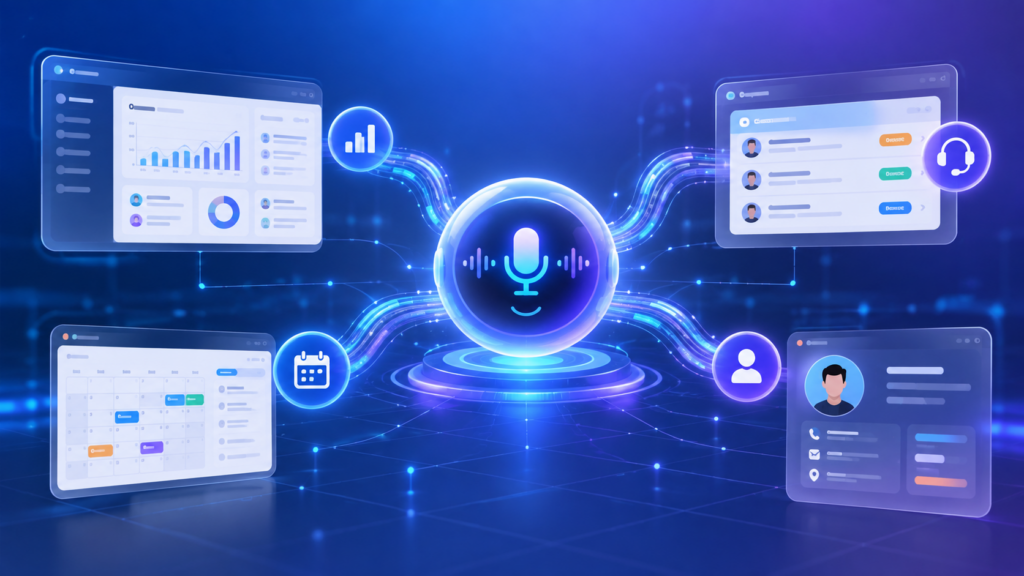
What Native CRM and Helpdesk Automation Actually Means
Instead of bolting a CRM connection onto a calling tool after the fact, native automation builds the CRM and helpdesk connection directly into the call lifecycle itself. That means three things happen automatically, without any external plumbing:
- Before the call — the system pulls the caller’s existing CRM record, open support ticket, or upcoming appointment, and hands that context to the agent before a single word is spoken.
- During the call — the agent can look up account details, check order status, or pull pricing information in real time, directly from connected business systems.
- After the call ends — the outcome is written back automatically: a CRM field updates, a ticket closes, a follow-up task gets created, or a summary lands in the right channel.
This is the essence of modern AI voice agent CRM automation: the call and the record-keeping are no longer two separate workflows stitched together — they’re one continuous process.
Why This Matters for Growing Businesses
For sales teams, this means no more lost context between calls. A rep — or an AI voice agent — always knows what stage a deal is in, what was discussed last time, and what needs to happen next. For support teams, it means tickets get updated the moment a call ends, not whenever someone remembers to log it.
Industries like real estate, healthcare, NBFC, and logistics benefit especially well from this shift, since these sectors depend heavily on fast, accurate follow-up. A real estate CRM that automatically logs a buyer’s property preferences straight from a call, for example, saves agents from re-entering data and reduces the risk of a lead falling through the cracks. The same logic applies to a clinic confirming appointments or a logistics team updating shipment status after a customer call.
Where Archiz Solutions Fits In
At Archiz Solutions, this is the direction our AI Agents and AI Voice Bot offerings are built around. Rather than treating your calling system and CRM as separate tools that need manual syncing, our approach connects them natively — so every call, whether handled by a human rep or an AI voice agent, feeds directly into your CRM and support workflows without extra integration work on your end.
This kind of AI voice agent CRM automation isn’t just a convenience feature — it’s becoming a baseline expectation. Businesses that still rely on manual logging or fragile third-party connectors are losing time on every single call, time that compounds across hundreds or thousands of interactions a month.
The Bigger Shift: From Bolted-On Tools to Built-In Systems
The broader trend here is a move away from stacking specialized point tools — a dialer, a CRM, a helpdesk, a Zapier layer holding it all together — toward unified systems where the call itself is CRM-aware from the first ring. This shift reduces maintenance overhead, cuts down on data entry errors, and lets sales and support teams focus on the conversation instead of the admin work around it.
As more businesses adopt AI voice agent CRM automation, the competitive gap will widen between companies still manually reconciling call notes and those where every call automatically updates the system of record. For businesses evaluating their next CRM or AI voice solution, this native integration should be a non-negotiable checkbox, not an afterthought.
Final Thoughts
Native CRM and helpdesk automation built into every call is no longer a “nice to have” — it’s fast becoming the standard for how modern businesses handle customer conversations at scale. If your current setup still depends on manual updates or third-party middleware to keep your CRM in sync with your calls, it may be time to explore a more integrated approach.