

Why Car Dealerships May Shut Down in 2026 | 3 Mistakes Dealers Must Fix
The automotive retail landscape is undergoing tremendous changes at an unprecedented rate. The industry is currently being disrupted by a startling prediction that is sending shockwaves throughout the industry. The prediction is that many traditional automotive dealerships could be out of business by the year 2026. Recently, in a comprehensive breakdown of the automotive industry, Dheeraj Mehta, founder of
Archiz Solutions
presented a wake-up call to all automotive dealerships around the globe. The prediction of a series of automotive dealership closures is not due to a lack of sales, as automotive sales continue to be strong. The problem is being caused by diminishing profit margins and outdated manual operational systems that cannot keep up with today’s fast-paced, technology-driven buyers.
If your automotive sales staff and Business Development Center (BDC) is currently running the same way it was five years ago, you are in trouble. The following is a breakdown of the real operational problems that are eating away at your bottom line, the changing automotive buyer, and the three mistakes you must fix with Artificial Intelligence (AI) to ensure survival in 2026 and beyond.
The Changing Consumer and The Real Problem
To grasp the reason behind the struggle of the traditional dealerships, we first need to understand the evolution of the modern consumer. The modern consumer is shaped by what I call the “Amazon Effect.” The modern consumer expects instant gratification, immediate results, and seamless integration between the digital and physical worlds. If the consumer makes an inquiry at 11:00 PM on Tuesday night, the consumer expects that the dealership will acknowledge that inquiry. If the consumer calls the dealership on Saturday afternoon, the consumer does not expect to wait ten minutes on hold.
Dealerships spend hundreds of thousands of dollars each year on digital advertising, SEO, third-party lead generators, and social media marketing. The problem is that the modern consumer has no idea that the first step in the sales funnel is simply the generation of the lead. The real problem, the real pain point, and the real revenue leak is the operational system that is handling these leads.
Most dealerships are using entirely human operational systems to handle these leads. The reason that the traditional, human-only approach is breaking down and destroying the profit margins of the dealerships is:
Missed Opportunities During Peak Hours
Go to any successful car dealership on a Saturday afternoon, and you will find a chaotic scene. You will find salespeople walking the lot with customers, finance people buried under a mountain of paperwork, and a reception desk that has people waiting. Because of these chaotic sales floors, incoming calls from hot, ready-to-buy customers are often going to voicemail, or customers will be put on an agonizingly long hold. Every time a customer goes to voicemail, the chances of them calling a competitor increase by 80%.
The Failure of "Speed to Lead"
In the automotive industry, there is a well-known statistic referred to as ‘Speed to Lead.’ If a lead comes in via an online form, calling that lead back within the first 5 minutes of receipt of that form will significantly increase the likelihood of converting that lead into a foot traffic customer. The reality is, when sales teams use traditional workflows, relying on looking at their CRM when in their cars, it takes hours or even days to call someone back. In 2026, customers won’t wait; they’ll go to the competitor down the street who answered their call first.
Wasted Advertising Spend and Rising CPA
The Cost Per Acquisition (CPA) for the auto industry is increasing steadily. You are literally paying a premium for each and every single lead that your marketing team is generating for you. The more these expensive leads become stale due to your sluggish responses or follow-ups, the more your ad spend is being totally flushed down the drain. Your top-line revenues may be doing okay, but your profit margins are quietly being bled out from the bottom.
The industry is already reacting to the pending crisis. Recent figures have shown that an astounding 76% of forward-thinking dealerships are already spending more on AI voice budgets for the coming years. Dealership owners have realized the harsh fact that more and more human speed will not be enough to protect their profit margins.
The Solution: 3 Dealership Mistakes You Must Automate Using AI
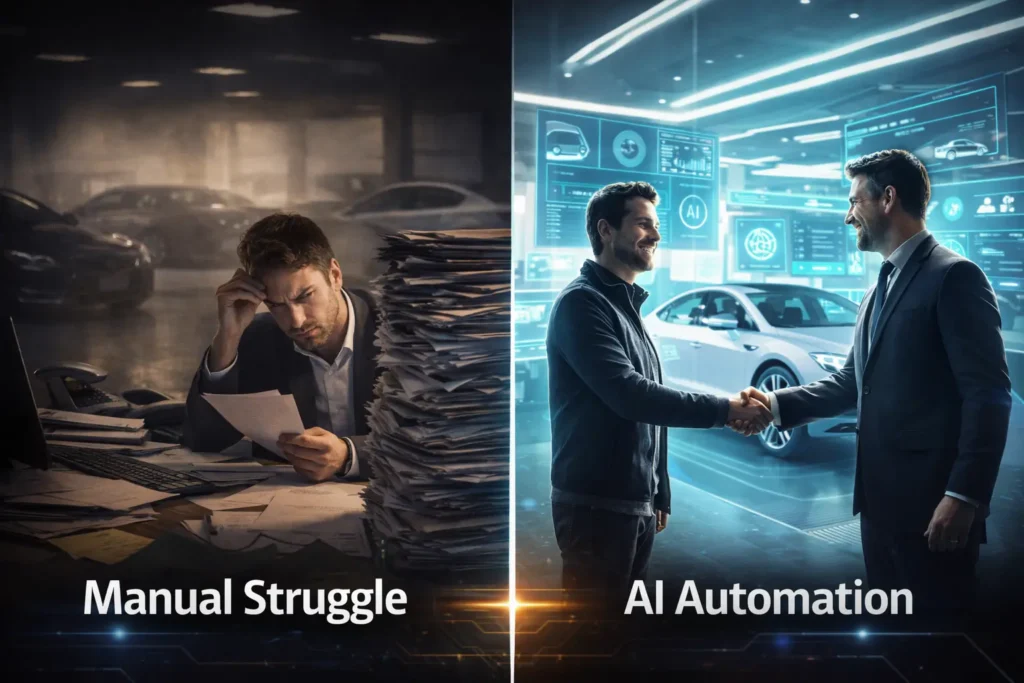
In order to protect your profit margins, lower your CPA, and grow your dealership’s sales seamlessly, you need to remove these inefficiencies. Humans are incredibly good at building relationships and closing deals face-to-face, but they’re not very good at repetitive, high-volume tracking and dialing.
You need to implement intelligent AI VoiceBots in these three critical areas:
Mistake 1: Relying on a Manual BDC for Initial Call Handling
In the automobile business, every missed call is equivalent to a missed sale. While human receptionists and BDC agents are extremely valuable assets to the business, there are just so many of them to go around. They get busy, they have lunch, they call in sick, and they go home at night. However, your potential buyers are not going home at night. They are going to keep researching cars until they find the right one.
The Fix: The solution is to implement an AI VoiceBot that functions as a digital receptionist and BDC agent. Today’s advanced AI VoiceBots, such as those developed by Archiz Solutions, answer every single call instantly and every single time. They use Natural Language Processing to have a natural conversation with the caller. They can answer frequently asked questions about your inventory, provide specific details about cars, qualify the buyer’s intent, and even book test drives into your CRM system. With an AI VoiceBot, not a single call is ever missed, and not a single opportunity is ever missed, regardless of the time of day.
Mistake 2: Dropping the Ball on Long-Term Lead Follow-Ups
The second-largest purchase decision that most consumers make is the purchase of a car. It is an important decision, and the customer needs to be nurtured and reminded with utmost care and precision. However, expecting humans to keep track and remind thousands of leads over a period of time, say 30 to 90 days, is mathematically impossible. As such, sales representatives would “cherry-pick” the easy leads and completely ignore the rest of the pipeline.
The Fix: Automate the follow-up and nurture sequences. An AI VoiceBot could automatically make outbound calls and send perfectly timed voice and SMS reminders to the buyers. If the customer had shown interest in an SUV three weeks ago but didn’t convert into a sale, the AI could proactively call the customer and inform them about the launch of a financing offer. Additionally, the AI could send automated reminders to the customer 24 hours and 2 hours prior to the scheduled test drive. This automated nurture would result in a significant reduction in “no-shows,” and more buyers would walk into the showroom. The more buyers walking into the showroom would directly translate into an increased overall sales closing rate.
Mistake 3: Operating on "Gut Feelings" Instead of Hard Data
Many dealership owners and GMs still operate their sales floors based on intuition, tradition, and gut feelings rather than hard facts and figures. They don’t know the exact number of calls that are being missed over the weekend. They don’t know what the exact objections are that are causing customers to hang up on the phone. They don’t know what the exact advertising campaign was that produced the highest quality phone calls versus the lowest quality web leads.
The Fix: Take full advantage of the analytics and conversational intelligence that the modern AI system has to offer. Modern AI platforms provide you with exact, real-time data on your entire communication pipeline. Every call that is made and received through an AI VoiceBot is transcribed, analyzed, and recorded into your CRM system. You’ll know exactly what phone calls are converting into scheduled appointments and what advertising campaigns are resulting in a positive Return on Investment (ROI). The key principle for the auto retail industry for the future is quite simple: Stop guessing; start measuring.
The Ultimate Synergy: AI and Human Sales Staff
A common misconception in the automotive industry is that AI is coming in to replace the car salesperson. This is further from the truth. People still buy from people. Trust, empathy, negotiation, and the experience of the test drive are all human experiences that an AI system would not be able to replicate.
The objective of incorporating AI into your automotive dealership is to create the ultimate synergy. This is achieved by allowing your AI VoiceBots to handle the grueling, time-consuming, administrative tasks like answering 500 initial inquiry calls a day, leaving voicemails, and sending appointment reminders. This would free your sales force to do what they do best. Your sales force would not be exhausted from making initial calls. Instead, your sales force would be able to focus 100% of their time greeting warm leads that are pre-qualified, standing in your showroom, ready to buy. This would prevent employee burnout, reduce turnover, and create a very profitable sales force.
Conclusion: Automate or Struggle
Countdown to 2026: The countdown to 2026 has already started. In the coming years, the rate of market competition will be extremely high, inventory will vary erratically, and the profit margin will be the lowest it’s ever been.
Automating your front-end business with AI will result in a gain in the market share, a decrease in CPA, and exponential growth for the auto dealership. On the other hand, auto dealerships that do not adopt the front-end business will experience a squeezed margin to the breaking point.
The market, along with the modern car buyer, will not wait for you to catch up. It’s time for the auto dealership to adopt a smart AI communication system instead of waiting for financial losses to implement it.
Want to future-proof your auto dealership and protect your profit margin? Watch the video from Dheeraj Mehta on the same topic: