
The Silent Margin Killer: How AI Voicebots are Saving E-commerce Brands from Massive RTO Losses
Key Takeaways Before You Dive In:
The Real Cost of RTO: A returned Cash on Delivery (COD) order is not just a lost sale. It means you are paying double shipping costs, wasting resources, and holding up precious inventory.
The Flaw with Manual Confirmation: Using human customer service representatives to manually call and confirm COD orders slows down your dispatch cycle by 24 to 48 hours. This is frustrating for real customers and increases the risk of cancellations.
The Smart AI Solution: By using an AI Voicebot to immediately call the customer within 5 seconds of the checkout process, D2C brands can now filter out fake and impulse orders before they leave the warehouse, thus saving their profit margins.
Are you a Direct-to-Consumer (D2C) brand or an e-commerce company operating in emerging markets like India? You already know the golden rule of e-commerce: You cannot survive without offering Cash on Delivery (COD) to your customers. For millions of customers out there, COD is the ultimate trust factor. It removes their fear of online fraud. They get to open and inspect the package before handing over their hard-earned money. Offering COD to their customers increases their website conversion rate by a whopping 30% to 40%.
On the surface, your Shopify or WooCommerce control panel looks amazing. Your marketing team’s Facebook Ads strategy has paid off, and the orders are coming in. Your hundreds of orders a day via Cash on Delivery (COD) are being processed every day.
However, when the end of the month arrives and the Chief Financial Officer (CFO) actually runs the Profit & Loss (P&L) statement, the horrifying truth emerges. A staggering percentage of those orders never actually generated revenue. They were rejected at the door, the customer didn’t wish to pay, or the address was totally false.
This process has been named RTO (Return to Origin), and it’s the silent but deadly killer of e-commerce profit margins.
In the following comprehensive guide, we will explore the actual cost of RTO, why the traditional method of using a calling team to solve the problem isn’t working, and how the fastest-growing brands in the industry are using AI Voicebots to immediately validate orders and totally eliminate the problem of fake orders.
The Anatomy of an RTO: Why Your Business is Bleeding Cash
When you examine your analytics, this returned order may simply be reflected as a zero-dollar transaction. However, the truth remains that an RTO is a very negative transaction. Each time you ship an order and it gets returned, your business actually loses money in four different areas:
A. The Double Shipping Penalty
You cannot get logistics services for free. When you ship an order to the customer, you incur a shipping cost. When the customer returns the product at their doorstep, your logistics partner incurs the cost of shipping the product back to your warehouse. You’ve just incurred double the cost of shipping for absolutely zero returns.
B. Wasted Packaging and Labor
Your team has already wasted resources picking and packing the order. The custom corrugated box, the bubble wrap, the tape, and the invoice were all wasted. When the product returns to your warehouse, the packaging materials are usually in disrepair. Your team has to waste even more resources unboxing the product.
C. The Nightmare of Blocked Inventory
This is probably the most critical, yet most overlooked, cost of RTO. If an item is sent to a customer and then returned, it is literally stuck in transit for 10 to 15 days. In other words, it is blocked. You cannot sell it to an actual, paying customer because it is stuck in the back of a delivery truck. If you’re an apparel company or an electronics company, blocked inventory is literally impacting your revenue potential.
D. The Impulse Buying Factor
What causes RTOs to begin with? The most common reason is, surprisingly, social media marketing. A customer is scrolling through Instagram at 11:30 PM. They see an ad for your product, highly optimized for maximum effect. In an act of sheer impulse, they click on it, ordering your product on cash on delivery because, let’s face it, there’s literally no financial risk to them. They don’t even need to give away their credit card information. However, when the delivery guy turns up three days later, the impulse has passed, and “buyer’s remorse” has set in.
The Flaw of Manual Order Confirmation

Realizing that blindly shipping every single COD order is financial suicide, the majority of e-commerce brands have a defense mechanism in place: The Manual Confirmation Call.
They hire a team of customer support agents. Every morning, these agents are handed a spreadsheet containing the previous day’s COD orders. Their job is to call up every single one of these customers and say, “Hello, did you place an order for [Product] on our website? Can I confirm this for dispatch?”
The idea behind the Manual Confirmation Call is good; however, the execution is flawed in three big ways:
The Speed Bottleneck: A human can only call so many customers per hour. They have to answer the ringing phones, busy tones, and voicemails.
The “Unknown Number” Problem: The customer is unlikely to answer calls from unknown numbers during the day. The customer support agent will need to call the customer three or four times over two days to simply get a “Yes” or “No” response.
Delayed Dispatch: It takes 24 to 48 hours for the manual team to successfully confirm the order. In the meantime, the order is sitting stagnant in your warehouse. In today’s Amazon Prime culture, customers expect fast delivery. If you delay dispatching the order for two days just to verify the order, even legitimate customers will get annoyed and cancel.
You are in a terrible position – either dispatch in blind faith and risk RTO losses, or verify manually and slow down your entire supply chain.
The Paradigm Shift: Instant AI Voicebot Verification
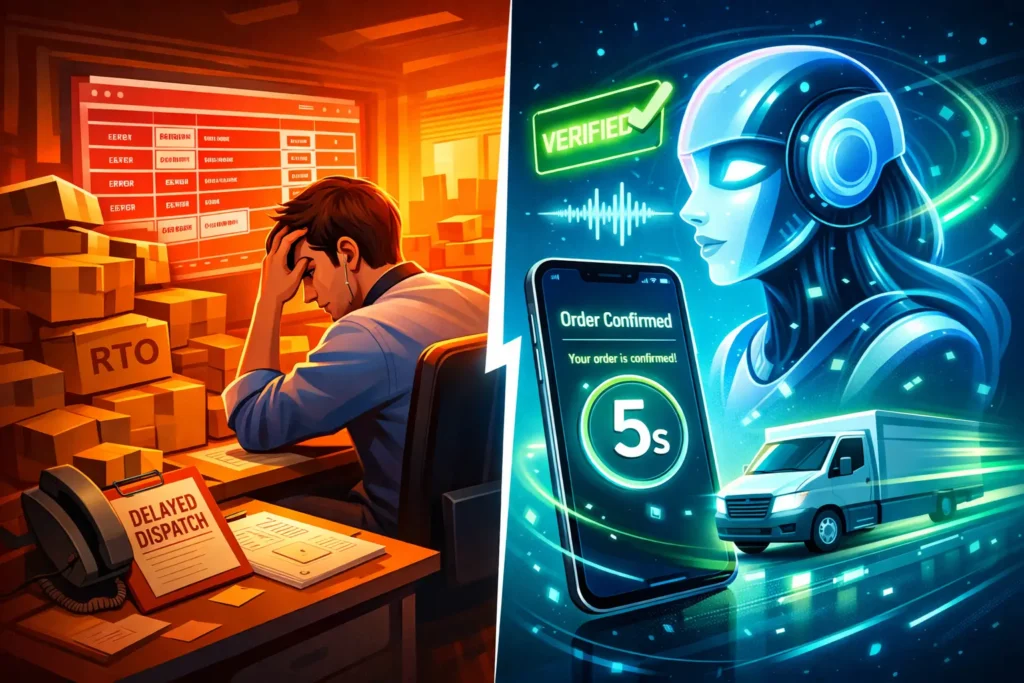
To ensure this, the e-commerce industry demands a solution that is instantaneous, scalable, and automated to ensure the profit margins and lightning-fast dispatch speeds are not compromised.
And this is where Conversational AI Voicebots enter the scene to revolutionize the logistics pipeline. Dheeraj Mehta, Founder of Archiz Solutions, recently showed how this solution can be implemented to entirely eliminate the RTO crisis for D2C brands by replacing the traditional process of manual calling with an intelligent AI infrastructure.
Here is a step-by-step overview of how the automated COD confirmation process works:
Step 1: The 5-Second Trigger
The moment the customer clicks the “Complete Order” button and clicks on the option to pay through Cash On Delivery on their Shopify, WooCommerce, or custom website through a webhook, the AI system is triggered.
In just 5 seconds, while the customer is still staring at the “Thank You for Your Order” page on their smartphone screen, their phone starts ringing.
Step 2: Intelligent, Immediate Interaction
Once the customer responds, AI Voicebot speaks back in a clear, natural, and highly professional tone.
“Hello! Thank you for shopping with [Your Brand Name]. We have received your Cash on Delivery order for ₹1,499. To confirm your order and begin dispatch, please press 1. If you wish to cancel this order, please press 2.”
Step 3: Filtering the Junk in Real-Time
Since the call is immediate, the customer’s buying intent is at its absolute peak.
If the customer is a genuine buyer, then they will press 1.
If the customer is a prank caller, or a kid playing with a phone, or someone who immediately changes his or her mind after placing the order, then they will press 2 to cancel.
Step 4: Automated Backend Updates
As soon as the customer types in the key press, the AI Voicebot immediately sends back a response to your online store’s dashboard. It automatically marks the order as “Verified – Ready to Ship” or “Cancelled by User.”
You don’t need your warehouse team to wait around for the spreadsheet sent over by the support team. They can simply look at their screen, filter the “Verified” tags, and start shipping the boxes.
The Measurable Business Impact
Change in P&L for E-commerce Companies: When you go from manual and delayed calling to instant AI Voicebot verification, there is no denying the impact on your P&L.
Huge Savings in Return to Origin: By requiring instant verification, you are weeding out all those fake orders, pranksters, and low-intent impulse buyers before you ever have to ship out a single item from your warehouse. You are avoiding all those double shipping costs for these types of orders entirely.
Lightning-Fast Shipping: With verification happening within just 5 seconds of ordering, you can actually ship out your item on the very same day. Faster shipping results in a happier customer and a greater overall acceptance rate for those orders at your doorstep.
Saving Support Team Bandwidth: Your customer support staff will not be required to be like robots or auto-dialers. They will be free to handle real customer problems, process refunds, and create customer loyalty.
Protected Profit Margins: Each fake order that is prevented is like pure profit. A brand that sends out 1,000 COD orders per day can save millions of rupees in reverse logistics and tied up inventories with a mere 10% reduction in their RTO rates.
Conclusion: Stop Shipping Blindly
In the hyper-competitive world of e-commerce and D2C retail, top-line growth is a meaningless vanity number. All that really matters is your bottom-line profit.
If you have a logistics model where you ship unverified COD orders and just hope that the guy opens the package and pays up, then you are playing a very dangerous game of roulette with your profit margins. On the other hand, if you are holding up dispatch by 48 hours to manually verify every single order, then you are annoying your real customers.
The ultimate competitive advantage is speed and intelligence. By using an AI Voicebot as an automated gatekeeper to your checkout process, you can be assured that every single box that leaves your warehouse is going to a verified buyer.