
The 24/7 Supply Chain Paradox: How to Provide Round-the-Clock Support Without Bankrupting Your Payroll
Let’s consider this scenario: It’s 2:00 AM on a Tuesday morning. A critical B2B freight shipment, carrying vital parts and pieces for a manufacturing client, is currently in transit. Or, it could be a high-end B2C package, and the anxious customer is eagerly awaiting its arrival for an important event.
But, something unexpected happens. The customer opens their tracking app, and something’s amiss. Anxiety strikes! What does the customer do? What’s their natural response? The customer reaches for their phone and dials your company’s customer support hotline.
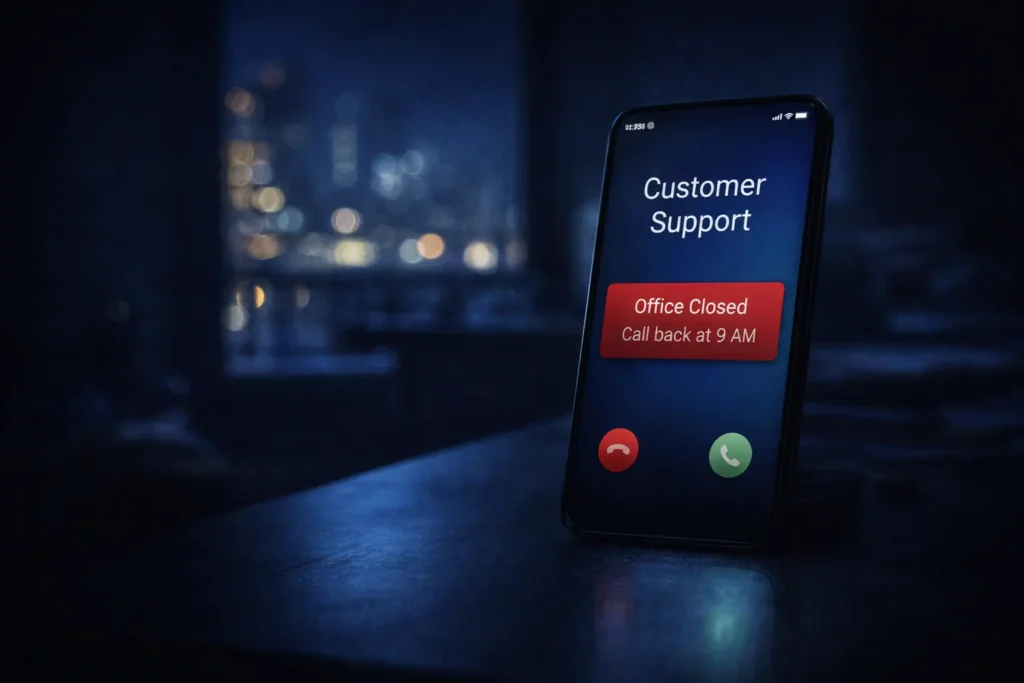
But, instead of reaching a live person, who can provide a timely, live update, the customer is greeted with this cold, impersonal voicemail: “Thank you for calling. Our office hours are 9:00 AM to 5:00 PM. Please leave a message, and we will get back to you during the next business day.”
In this exact moment, customer trust disappears. The anxiety becomes anger. And by the time your morning shift team arrives at 9:00 AM, they’re immediately overwhelmed with a huge backlog of furious voicemails and angry emails.
This, in a nutshell, is the paradox of the modern supply chain. Logistics, by its very nature, is a 24/7 industry. Trucks drive at night, planes fly across the ocean at dawn, and warehouses operate around the clock. So why does the customer support operation of so many logistics companies operate from 9 to 5?
In this definitive guide, we’ll look at why the traditional 9 to 5 support model is failing the modern supply chain, the hidden financial risks of hiring a night shift call center, and how industry leaders are finally solving this problem with 24/7 AI Voicebots.
The Core Problem: The Unrelenting "WISMO" Wave
In order to understand the operational bottleneck, we need to consider the data behind the reasons why customers contact logistics companies in the first place.
In the courier and freight industry, up to 80% of all customer inquiries fall under a single category: WISMO, or Where Is My Order?
Customers, regardless of whether they’re an enterprise customer waiting on a pallet of goods or a regular joe waiting on a pair of shoes, need visibility. When a customer is waiting on a package, and the package is in transit, the information is just as valuable as the end product. If the information is behind a ‘Closed’ sign, then the customer experience fails.
But answering WISMO calls is an incredibly inefficient process. A human being must answer the phone, ask for a 12-digit tracking number, type the tracking number into a database, read the result on their computer screen, and then tell the customer the exact same result over the phone.
Doing this during the day is a huge productivity killer for your team. But doing this at night becomes a huge financial killer for business owners.
The Margin Killer: The Cost of the Night Shift
When logistics founders realize that their brand reputation is being damaged due to their lack of attention to after-hour calls, their immediate reaction is to fix the problem the traditional way: “Let’s hire a night shift.”
While hiring a 24/7 call center may be the logical answer for a growing supply chain company, it is a margin-destroying nightmare in most cases. The following are the reasons why hiring a night shift is a financially unsustainable idea for most logistics companies:
A. Premium Wage Requirements
No one wants to work at 3:00 AM. To attract experienced customer support representatives to work the night shift, companies are forced to pay premium wages and night shift bonuses and benefits.
B. High Turnover and Training Expenses
Working the night shift in a call center is notoriously known to have the highest employee turnover rate of any industry. The long hours cause extreme burnout. If a worker quits after three months, thousands of dollars are spent recruiting and training a new employee, only to repeat the process.
C. Low ROI on Human CapitalWhat is the night shift team really doing? They are not working out logistics deals or resolving intricate supply chain arguments. They are merely reading off a computer screen a series of tracking numbers to concerned customers. Paying a human being a premium, overnight wage just to act as a manual database reader is a terrible return on investment (ROI).
Your business costs skyrocket, yet your business efficiency remains stagnant.
The Smart Fix: Deploying 24/7 AI Voicebots
If ignoring the customer is bad for business, and hiring a night shift is bad for your profit margins, what is the alternative?
The smartest, most aggressive logistics companies are bridging this gap by completely removing the human element from routine tracking queries. They are employing Conversational AI Voicebots to be their tireless, flawless, 24/7 frontline support agents.
Dheeraj Mehta, Founder of Archiz Solutions, recently explained exactly how this technology is revolutionizing the logistics industry. These are not the frustrating, old-school IVR systems whereby a customer must press a dozen buttons just to hear a robot speak. These new AI Voicebots utilize Natural Language Processing (NLP) to converse seamlessly and cleverly.
This is exactly how the automated 24/7 workflow works:
Step 1: Instant, Round-the-Clock Answering
When a customer calls at 2:00 PM or 2:00 AM, the AI Voicebot answers the phone on the very first ring. There are absolutely no hold times, no queues, and no “office closed” voicemails.
Step 2: Seamless Authentication
The AI speaks to the customer and requests their tracking ID or registered mobile number. The customer can simply read their tracking number aloud to the AI because it understands natural human language.
Step 3: Real-Time Database Integration
The AI Voicebot is connected through API to your logistics firm’s internal customer relationship management system (CRM), Warehouse Management System (WMS), or tracking system. In a matter of fractions of a second, the AI Voicebot is able to retrieve the exact location of the package and the estimated time of arrival (ETA).
Step 4: Accurate Delivery Updates
The AI Voicebot communicates the exact information to the customer: “Hello! Your shipment from Mumbai to Delhi is currently in transit and has recently crossed Jaipur. It is scheduled for delivery tomorrow before 4:00 PM.”
If the customer is satisfied with the information, the call is terminated. The entire interaction took less than 60 seconds. The customer got exactly what they needed. No human employee had to lift a finger.
The Measurable Business Impact of AI Automation

The moment you switch from manual night shift tracking using humans to the intelligent AI Voicebot, the benefits to your logistics business are immediate, quantifiable, and extremely profitable.
Zero Night Shift Payroll: The first advantage of using the AI Voicebot system is the significant reduction in operational expenses (OPEX). With the AI handling 100% of the night shift calls, you no longer need to hire, train, or pay night shift employees.
Elimination of the Morning Backlog Because your customers are serviced during the night, they don’t leave angry voicemails. So, when your morning shift employees come in at 9:00 AM, they don’t have to spend the first three hours of the day clearing the backlog of tracking-related voicemails. They can immediately start the day doing something productive.
Infinite Scalability During Peak Seasons: During the holiday season, Diwali sales, or other major e-commerce sales, the delivery volumes go through the roof. At the same time, the customer calls also increase. A human call center operation would literally crash if this many customers called. The AI Voicebot can handle 10 calls or 10,000 calls at once without dropping a single call.
Massive Boost in Customer Trust: Information is key in logistics. A customer knows they can call your company at any hour of the day and night and get an instant update on their high-value delivery.
Conclusion: Let the Machines Handle the Tracking
The supply chain industry is a very operational business. Your focus should be on moving the shipment as quickly as possible, improving your routing, and winning bigger freight contracts. You shouldn’t be concerned with the huge administrative burden of running a 24/7 call center.
Your human support agents are incredibly valuable assets. Their ability to understand and problem-solve should be reserved for the rare and critical exceptions like damaged freight, lost packages, and other logistical issues.
Reading a tracking number to a customer at midnight is a machine’s job.
With the help of an AI Voicebot, you can instantly solve the 24/7 support paradox. You can provide your customers with the speed and information they need instantly, while defending your profit margins against the cost of bloated staffing.