
How to Reduce Missed Calls in Healthcare: Complete Guide 2026
Each day, thousands of patient calls are missed by healthcare facilities across the nation. These are not just statistics on a report; rather, each missed call means a dissatisfied patient, a missed appointment, and lost revenue walking out the door. The challenge of reducing missed calls in the healthcare industry has become an urgent one due to the increasing demand for instant accessibility by patients.
A mid-sized hospital misses 30-40% of calls received during peak hours. This means that if your healthcare facility receives 500 calls on a daily basis, 150-200 patients will not be able to reach you when they need assistance. The effects of missed calls on healthcare facilities go beyond being a mere nuisance. The effects of missed calls in healthcare facilities impact patient outcomes, satisfaction rates, and your bottom line.
This complete resource will outline why reducing missed calls in healthcare is an urgent challenge, the reasons behind these communication breakdowns, and effective ways to eliminate 95% of missed calls without adding more staff.
Why Missed Calls Are a Critical Problem in Healthcare
Missed calls in healthcare represent more than operational inefficiency—they create cascading problems affecting every aspect of your facility
The Patient Experience Impact
When patients call a healthcare facility, they are usually experiencing feelings of worry, confusion, or seeking reassurance about their health. An unanswered or voicemailed phone call is a source of increased anxiety. Patients remember these instances of neglect much longer than they remember instances of excellence.
Studies have shown that a large percentage of patients who are unable to contact a healthcare facility on the first call will contact a competitor. In today’s healthcare market, where acquiring a patient requires a substantial investment, every unanswered call is a source of lost revenue.
The Reputation Damage
Problems in call management in the healthcare sector directly affect online reviews. The words “impossible to reach,” “always on hold,” or “never answer the phone” are common in one-star reviews of healthcare organizations. Online reviews impact your reputation, search engine optimization, and conversion rates for years to come.
Patients looking for healthcare services search online before making contact. If they read complaints about accessibility in online reviews, they never make the first call. Your expertise is irrelevant if patients cannot reach you.
The Revenue Impact
The missed calls that healthcare facilities receive give rise to three different revenue challenges:
Lost Appointment Scheduling: New patients calling to schedule appointments will not be able to do so if the calls are not answered. Missing just a few new patient calls per week results in massive revenue loss on a yearly basis based on your specialty and average patient lifetime value.
Higher No-Shows: Patients who are unable to reach your facility to reschedule appointments simply do not show up. The revenue loss due to no-shows is massive on a yearly basis for the average healthcare facility. Better healthcare call management practices can lower no-shows by 30-40%.
Wasted Marketing Dollars: You spend money on advertising, SEO, and patient acquisition marketing campaigns. When prospects calling from these campaigns reach voicemail, you are essentially wasting marketing dollars. The average healthcare facility wastes a massive amount of marketing dollars due to poor call accessibility.
The Staff Burnout Factor
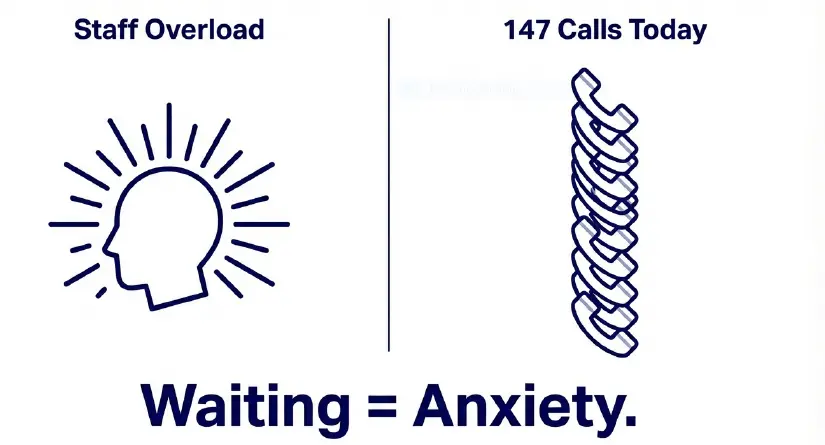
The call center staff is expected to do the impossible. During peak times (usually 8-10 AM), the volume of calls exceeds the ability of the staff to answer them. The staff is under constant stress, dealing with complaints from patients, and prioritizing which calls to take first. This is a major factor in the high turnover rate of 20-25% in the healthcare sector for administrative staff.
The attempt to lower the number of unanswered calls in healthcare by working overtime is merely a recipe for burning out staff without addressing the capacity issue. The staff cannot work endlessly to keep up with demand.
The True Cost of Missed Calls in Healthcare Facilities
Understanding the complete financial impact of missed calls healthcare operations experience helps justify investment in solutions.
Direct Revenue Loss
Each missed call may mean lost business in the following areas:
Unscheduled appointments with new patients
Loyal patients choosing more accessible competitors
Follow-ups and procedures not scheduled
Prescription refills causing patient dissatisfaction
Even conservative estimates for smaller practices indicate a significant annual loss due to missed calls in healthcare settings. Larger hospitals and multi-location practices are affected proportionally.
Indirect Costs
Patient Acquisition Waste: Marketing campaigns generate calls. Unanswered calls translate to wasted marketing dollars. A major component of marketing spend results in nothing when unanswered calls are the consequence of ad spend.
Reputation Management Costs: Negative reviews due to accessibility issues necessitate ongoing reputation management spend and investment in review management strategies.
Staff Overtime: Extended hours to mitigate missed calls in the healthcare industry result in increased staff costs without addressing scalability issues. Healthcare facilities annually spend a lot on staff overtime related to call management.
Compliance and Quality Risks
Missed calls experienced by healthcare facilities result in a lack of documentation. When patients leave voicemails about their symptoms or concerns, call management and response timeliness translate to a compliance issue. Delayed responses to urgent calls pose a risk of quality of care.
What Causes Missed Calls in Healthcare?
Before implementing solutions to reduce missed calls in healthcare, understand root causes.
Insufficient Capacity
The basic issue is mathematical. The number of calls exceeds the staff’s ability to respond. A three-member front desk handling routine calls cannot answer eight calls at the same time. Some calls will not be answered, no matter how hard the staff tries.
The traditional healthcare call management system has fixed capacity. The number of calls varies greatly from one time of the day to another.
Multi-Tasking Conflicts
The reception staff do not work exclusively with phones. They handle the following simultaneously:
Patient registration
Insurance verification
Scheduling in the system
Processing payments
Communication with the clinical staff
When assisting an in-person patient, the reception staff cannot answer the phones. All the activities present the possibility of missed calls in healthcare settings.
After-Hours Call Volume
Analysis reveals that 25-35% of healthcare calls are made outside of business hours. Patients who work call back in the evening. Patients who are anxious call back on the weekend. All calls go to voicemail with traditional systems, and callbacks are made the next day, only to reach voicemail again.
The lack of 24/7 accessibility is a direct cause of missed calls that healthcare operations face.
Complex Call Routing
Complexity is introduced by large healthcare systems that have multiple departments, providers, and locations, making routing more complex. Patients call the main number, go through menu options, are transferred, hold, and sometimes disconnect or reach voicemail. Every transfer point is a potential point for dropped calls.
Complex healthcare call management systems, which are intended to route calls effectively, often cause more problems than they solve
Seasonal and Situational Spikes
Flu season, post-holiday times, and local health events cause dramatic spikes in call volumes. A call volume handling facility designed for average daily volumes is overwhelmed during spikes. Missed calls in the healthcare industry skyrocket during these times with no scalable solutions.
Why Traditional Solutions Don't Reduce Missed Calls in Healthcare
Many healthcare facilities attempt to reduce missed calls in healthcare using conventional approaches that provide limited improvement.
Hiring More Staff
Hiring more staff at the front desk will increase fixed expenses without addressing scalability. When it is not peak, the extra staff will be idle. When it is peak, the extra staff will still be swamped. This linear model of staffing will not be able to keep up with the exponential variation of demand.
Hiring more staff at the front desk will be a large expense every year. For a facility that needs to be staffed through all business hours, multiple employees will need to be hired without necessarily improving the missed calls healthcare metrics.
Voicemail Systems
Voicemail records messages but does not decrease the number of missed calls in healthcare—it only records them. Patients are still affected by the failure of accessibility. Voicemail generates callback workload, which increases response time. Research indicates that a large percentage of healthcare voicemails do not receive callback responses.
Voicemail systems are not a solution to the call management problem in healthcare; they only record the problem.
Call Forwarding to Mobile Phones
Some practices include the forwarding of after-hours calls to the staff’s mobile phones. This leads to a number of issues:
Staff members are interrupted during their personal time
There is no access to scheduling systems
There is inconsistent documentation
There is increased burnout
There is a violation of professional boundaries
Call forwarding does not solve the issue of capacity limitations that lead to missed calls in the healthcare industry.
Traditional Answering Services
After-hours answering services use message-takers as operators. The services cannot:
Enter your appointment system to schedule patients
Respond to medical inquiries
Offer information about a specific facility
Manage complex scheduling needs
Monthly fees for basic answering services are an expense that does not improve the effectiveness of call management in the healthcare industry. Message-takers can record messages but cannot address patient needs, and patients will still have to wait.
Proven Strategies to Reduce Missed Calls in Healthcare
Effective solutions to reduce missed calls in healthcare require technology that scales with demand while maintaining quality.
Implement AI Voice Automation
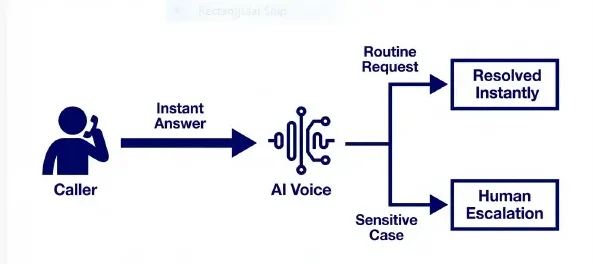
AI voice in the healthcare sector offers the best possible solution to minimize missed calls in healthcare settings. AI voice systems respond to every call immediately, 24/7, without any limitations on capacity.
How it works: When patients make calls, the healthcare AI voice system responds to every call in the first ring. The system participates in a normal conversation, interprets the caller’s intention, offers information, schedules appointments, or refers the caller to human representatives as needed. Unlike conventional IVR systems, which require callers to press buttons, AI voice systems interpret callers’ verbal requests naturally.
Effect on missed calls: Healthcare settings that adopt AI voice in their healthcare operations minimize missed calls by 90-95% right from the start. The system can manage an unlimited number of calls simultaneously without compromising call quality. Peak hour congestion becomes a thing of the past since the AI voice system automatically adjusts to meet the surge in demand.
Cost-effectiveness: The healthcare AI voice system investment usually pays off with high ROI in a few months, thanks to minimized missed calls and optimized appointment capture, offsetting the cost of overtime, answering services, and minimizing the need to hire more personnel.
Optimize Call Routing Intelligence
Intelligent call routing decreases the number of missed calls that healthcare facilities face by connecting callers to the right resource right away without the need for transfers.
Healthcare voice AI recognizes the caller’s intention based on the conversation: “I’d like to schedule an appointment,” “I have a billing question,” or “I’d like to speak with a nurse.” The AI directs the call accordingly without the need for human transfer, which is prone to drop-off.
The traditional call management system in healthcare forces the caller to go through menus, make educated guesses about the right choice, and wait for transfers. Intelligent call routing in healthcare using AI voice removes these barriers.
Outcomes: Healthcare facilities that use intelligent call routing experience a 40-60% reduction in call transfers, a 35% reduction in call abandonment, and a substantial improvement in first-call resolution.
Enable 24/7 Call Availability
After-hours calls account for 25-35% of the total number of calls. The ability to be truly 24/7 solves the problem of missed calls in the healthcare sector immediately.
Healthcare voice AI runs 24/7 without any breaks. Patients calling at 2 AM, on weekends, or on holidays get the same instant response and level of service as they would during business hours. The system schedules appointments, answers queries, handles prescription refills, and handles emergencies accordingly, irrespective of the time.
This functionality turns the healthcare call center from a business-hours-only operation to a 24/7 always-available service, in line with the patient expectations shaped by other service sectors providing 24/7 digital access.
**Impact:**
Healthcare facilities using 24/7 healthcare voice AI see an additional 30-40% of appointment bookings from after-hours calls that would otherwise go to voicemail. Patient satisfaction ratings improve 25-35% specifically on accessibility metrics.
Automate Routine Call Types
Analysis shows 70-80% of healthcare calls involve routine, repeatable requests:
- Appointment scheduling and rescheduling
- Confirming appointment times
- Getting directions and parking information
- Asking about clinic hours
- Prescription refill requests
- Insurance and billing questions
Routine calls of this type are fully automated by healthcare voice AI. Patients get immediate and correct answers without the need for human intervention. This significantly alleviates the burden of call volume on the front desk staff, enabling them to concentrate on complex calls that require human input.
Results: Automating routine calls using AI voice in the healthcare sector cuts the front desk call volume by 65-75%. Employee burnout is minimized, and their performance on complex calls is improved.
Implement Real-Time Call Analytics
Understanding call patterns enables strategic decisions to reduce missed calls in healthcare. Real-time analytics show:
- Call volume by hour, day, week
- Peak demand periods
- Most common call types
- Missed call rates and patterns
- Average wait times
- First-call resolution rates
The AI voice in healthcare systems offers complete dashboards of these metrics in real-time. This allows leaders to see problems immediately and monitor progress over time.
Application: When data analysis reveals that missed calls increase on Tuesday mornings, you can explore the reason. Maybe physician schedules are published Monday evenings, which causes the Tuesday morning appointment surge. Knowing the reasons allows you to solve the problem ahead of time.
Healthcare facilities that apply analytics to inform healthcare call management decisions can lower missed calls by 20-30% beyond what technology alone can achieve.
Measuring Success: Tracking Missed Call Reduction
Effective healthcare call management requires measuring performance continuously.
Key Performance Indicators
Missed Call Rate: Target below 5%. Formula: (unanswered calls / total incoming calls) × 100. AI voice in healthcare systems results in 1-3% missed call rates compared to 25-40% in traditional systems.
Average Answer Speed: Target below 10 seconds. Traditional systems take several minutes in peak hours. Healthcare voice AI responds in seconds.
First Call Resolution: Target above 70%. Percentage of calls resolved without callbacks, transfers, or escalations. AI voice in healthcare systems results in 75-85% first-call resolution for facilities.
After-Hours Call Capture: Target 100% of after-hours calls answered. Traditional voicemail captures few calls effectively. Healthcare voice AI captures 100% calls with full service availability.
Patient Satisfaction – Accessibility: Monitor specific scores for “ease of reaching facility” and “phone responsiveness.” Facilities using AI voice in healthcare systems report 30-50% improvement in these specific scores.
ROI Calculation
Measure the financial impact of the efforts made to lower missed calls in the healthcare industry:
Revenue Growth: Measure the number of appointments scheduled during the time periods that previously experienced missed calls. Value can be calculated based on average revenue per appointment and patient lifetime value.
Marketing ROI: Measure the conversion rate of calls to appointments. Improving call management in the healthcare industry has a profound impact on marketing ROI.
Staff Productivity: Calculate the time saved on routine calls. Value can be quantified by considering the impact of reallocating staff to more valuable tasks that require human empathy and expertise.
Reputation Enhancement: Measure the change in online review ratings and volume associated with accessibility-related topics. Accessibility is directly linked to improved ratings.
Overall ROI analysis will indicate a strong positive return on investment for efforts made in AI voice in the healthcare industry related to lowering missed calls.
Case Study: Regional Hospital Reduces Missed Calls by 94%
The regional hospital was facing the issue of missed calls in healthcare operations during peak hours. The front desk staff received hundreds of calls in a day and were also dealing with patients physically, resulting in bottlenecks.
The Problem: 35% of calls were unanswered during morning peak hours
Thousands of after-hours calls were going to voicemail every month
Patient satisfaction scores were impacted by accessibility issues
Staff were experiencing burnout due to unrealistic workload expectations
The Solution: Hospital adopted AI voice in the healthcare system to minimize missed calls in healthcare operations. The AI voice in the healthcare system answered all calls instantly, attended to all routine calls automatically, and escalated complex calls to human representatives.
The Results (Within 90 Days): Missed call rate reduced from 35% to less than 2%
24/7 availability captured previously lost after-hours calls
Patient satisfaction scores improved dramatically
Staff morale improved as the phone burden decreased
Appointment booking rates improved significantly
Success Factors: The success of the hospital in its mission to minimize missed calls in healthcare operations was achieved through a holistic approach that included technology implementation, workflow optimization, staff training on AI escalation of calls, and monitoring of call analytics to fine-tune the system.
Common Mistakes When Trying to Reduce Missed Calls
Healthcare facilities often make these errors when attempting to reduce missed calls in healthcare
Treating It As Staffing Problem Only
Adding staff without addressing scalability creates expensive solution that doesn’t work during volume spikes. Healthcare call management requires systems that scale automatically with demand.
Implementing Complex Phone Trees
Multi-level IVR menus frustrate patients and increase call abandonment. Attempting to reduce missed calls in healthcare by adding more menu options usually makes the problem worse.
Relying on Voicemail as Solution
Voicemail documents missed calls but doesn’t prevent them. Patients still experience failure to connect. Effective healthcare voice AI answers calls in real-time, eliminating voicemail need for most calls.
Ignoring After-Hours Volume
Focusing only on business hours misses 25-35% of total call volume. Comprehensive approach to reduce missed calls in healthcare must include 24/7 strategy.
No Performance Measurement
Without tracking missed call rates, answer times, and resolution rates, you cannot verify improvement. Effective healthcare call management requires continuous monitoring and optimization.
The Future of Healthcare Call Management
The demand for immediate accessibility will only continue to grow. Missed calls in healthcare operations must be minimized if healthcare organizations are to remain competitive. AI voice in the healthcare industry is the most scalable and cost-effective solution currently available.
Traditional methods of addressing the issue—hiring more staff, operating longer hours, and using voicemail systems—cannot possibly keep up with the demand for always-open and immediate communication response from patients. Healthcare voice AI can address these demands while lowering healthcare operational costs and improving employee morale.
Healthcare organizations that adopt AI voice in healthcare technology early on will have a competitive edge over others due to better patient experience, improved online reputation, and more efficient operations.
Getting Started: Reduce Missed Calls Today
If your facility experiences missed calls healthcare operations struggle with, the path forward is clear
Step 1: Audit Current Performance Measure current missed call rate, average answer time, after-hours call volume, and patient satisfaction with accessibility. Set up baselines.
Step 2: Calculate Impact Calculate financial impact of missed calls on your facility. Consider lost appointments, wasted marketing dollars, no-show rates, and reputation damage.
Step 3: Research AI Voice Solutions Investigate healthcare voice AI solutions to minimize missed calls in healthcare. Ask for product demos illustrating actual call handling examples.
Step 4: Pilot Program Begin pilot project to handle particular types of calls or times. Analyze before fully integrating AI voice solutions into the healthcare system.
Step 5: Monitor and Optimize Continuously monitor performance data. Analyze data from the healthcare call management system to optimize further.
The solution to minimize missed calls in healthcare by 90-95% is available today. The issue is no longer whether to deploy the solution but how quickly you can implement to realize the benefits of better accessibility, patient satisfaction, and operational efficiency.
Schedule a demo to see AI voice in healthcare handle actual patient call examples and discover how your healthcare facility can end missed calls.
Frequently Asked Questions (Faqs)
1: Why is it important to reduce missed calls in healthcare?
Reducing missed calls in healthcare is essential because unanswered calls lead to lost appointments, dissatisfied patients, increased no-shows, and revenue loss. Patients expect instant access, and facilities that fail to meet this expectation risk losing patients to more accessible competitors.
2: What causes missed calls in healthcare facilities?
Missed calls healthcare organizations face are primarily caused by insufficient staffing capacity, multitasking front-desk staff, after-hours call volume, complex call routing, and seasonal demand spikes. Traditional healthcare call management systems are not designed to scale with fluctuating demand.
3: How does AI voice in healthcare reduce missed calls?
AI voice in healthcare answers every call instantly, 24/7, without capacity limits. It understands natural speech, automates routine requests, intelligently routes calls, and escalates complex issues to human staff—reducing missed calls by up to 95%.
4: Can healthcare voice AI replace front-desk staff?
No. Healthcare voice AI complements staff rather than replaces them. It handles repetitive, high-volume calls so staff can focus on complex patient needs, in-person care coordination, and empathetic communication—improving both efficiency and job satisfaction.
5: Is AI voice in healthcare compliant and safe?
Yes. Modern healthcare voice AI platforms are designed with compliance, security, and auditability in mind. They support proper documentation, controlled escalation, and secure handling of patient interactions, helping reduce compliance risks associated with missed or delayed calls.