
Voice AI for Education: 24/7 Student Support Made Simple
What Is Voice AI for Education?
Voice AI is a smart phone assistant that is specifically designed for colleges and universities. It is like Siri or Alexa, but it is trained to assist students with everything from enrollment to exam schedules. When students call their college, the AI answers right away and has a natural conversation with them. There are no more “press 1 for admissions” options or waiting 20 minutes on hold.
The AI can look at student schedules, answer frequently asked questions, schedule appointments, send messages by text or email, and even communicate in over 100 languages. If it can’t resolve an issue, it will transfer the student to a human representative with all the information already gathered.
Why Students Need 24/7 Help
Today’s students operate on a different clock than their parents. They are up at midnight studying, turning in homework at 3 AM, and coming from different time zones around the globe. Students also work part-time jobs during the day, so they can only contact the college office in the evening. International students may need assistance during the daytime in their country but the middle of the night at the college.
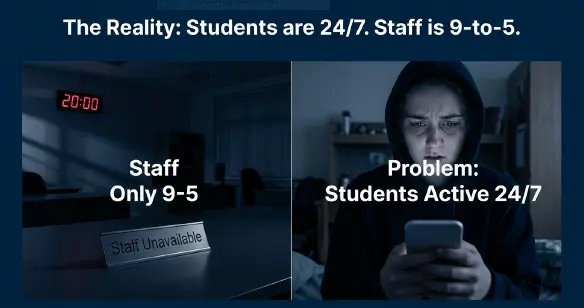
The issue is that most college offices are still closed at 5 PM. If a student has a pressing question at 8 PM regarding financial aid, a deadline, or how to log into their account, they have nowhere to turn. They send an email and wait two days for a response, or they just give up altogether. Studies have shown that 40% of student inquiries occur after business hours, and students who cannot receive assistance in a timely manner are more likely to leave school or attend a different college.
Problems with Current College Support
Long Wait Times
When students try to contact college offices, they usually have to wait 10-15 minutes on hold, be transferred several times, and sometimes have to explain their issue to three different people. This is frustrating and a waste of time for everyone involved. Many students just give up and hang up the phone without getting assistance.
After-Hours Black Hole
If offices close at 5 PM, all calls in the evening and on weekends go to voicemail. Emails sent at night will not receive a response until the next business day or possibly longer if it is the weekend. This results in students missing deadlines, making incorrect decisions, or losing faith in their college.
Exhausted Staff
The questions that college support staff answer hundreds of times a day are the same ones that need to be answered: “What’s the WiFi password?” “How do I reset my login?” “When is the drop deadline?” This is what causes burnout. Research has shown that 71% of college administrative staff are overwhelmed, and good staff leave after only 2-3 years because the work is exhausting.
Language Barriers
Foreign students and non-English-speaking families have difficulty getting assistance. Most colleges have staff members who speak English only, making it difficult for the 20% of students who speak a different language at home. Students who speak a different language at home drop out of college twice as often as English-speaking students, mainly because they cannot get assistance when they need it.
Lost Revenue from Dropouts
When students feel like they are not supported and cannot get help, many will quit. The average first-year dropout rate is 20-25%, meaning that 1 in 5 students will never come back for their second year. When each student is worth $40,000 to $60,000 over four years, this dropout issue costs colleges millions of dollars a year.
How Voice AI Solves These Problems
Instant Answers, Anytime
Voice AI responds to calls in less than 2 seconds, 24/7. Whether the student calls at 11 PM or at noon, they will receive the same quick and helpful response. They won’t have to wait on hold, leave a message, or be told to call back during business hours. The student asks their question, and they receive an immediate answer, whether it’s about library hours, exam times, or payment deadlines.
Handles Repetitive Questions Automatically
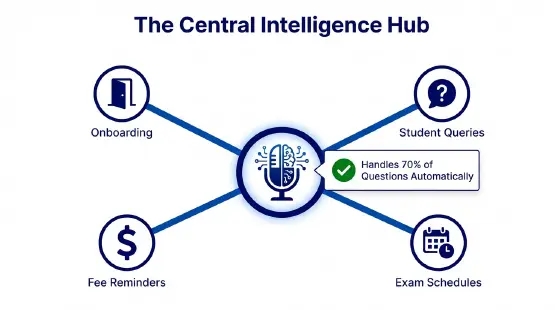
The AI handles all the simple, repetitive questions that are taking up staff time—password reset, locations of buildings, deadline information, office hours, and simple policy questions. This allows the human staff to concentrate on the difficult questions that require a human’s judgment, empathy, and expertise. The staff can then focus on academic advising, mental health counseling, and assisting students in unusual circumstances
Speaks Every Student's Language
Voice AI is capable of carrying out an entire conversation in Spanish, Mandarin, Hindi, Arabic, French, Korean, Vietnamese, and over 100 other languages. When a parent from Mexico calls about financial aid, the AI speaks to them in fluent Spanish, sends them documents in Spanish, and even connects them with a bilingual staff member if necessary.
Catches Problems Before Students Quit
The AI system tracks the patterns of engagement of the students and automatically contacts them if it notices any red flags. If a student has not accessed the learning platform for five days, has missed three consecutive classes, or has not paid a fee, the AI system calls the student to assist them before the situation deteriorates. This has led to a 30-40% decrease in the dropout rate of first-year students at institutions that use proactive AI contact
Smart Handoffs to Humans
Voice AI is aware of its own limitations. If a student is dealing with a difficult problem, is showing signs of emotional distress, or requires special accommodations, the AI will automatically switch them over to a human representative. However, the trick is that it provides the human representative with a complete recap of the conversation so that the student doesn’t have to tell their story twice.
Real-Life Examples of Voice AI in Action
International Student Gets Visa Help at 2 AM
Raj is a Chinese student who requires assistance with document preparation for his student visa. It is 2 AM in the United States, but it is 2 PM in China, which is his daytime. He dials the number for the international office at his university. The Voice AI responds in Mandarin, which is his native language. Wei describes his visa problem in Mandarin, and the AI responds effortlessly, asking him questions to clarify whether he is applying for an F-1 visa or an J-1 visa. The AI also emails him a list of all the visa documents he needs in Chinese and records the entire conversation in the university’s system. Wei receives the assistance he needs right away.
Preventing a Student from Dropping Out
Sarah is a first-year student who is having trouble with Chemistry. She has been absent from three classes in two weeks and is feeling overwhelmed. The learning management system at the university picks up on her pattern of absence, and Voice AI automatically calls Sarah. The AI says, “Hi Sarah, I noticed you missed Chemistry class this week. Is everything okay?” Sarah confesses that she is stressed and feels like she can’t handle college. The AI reassures her: “Many students feel this way during their first year. You’re not alone. Would it help if I connected you with a chemistry tutor and your academic advisor?” Sarah agrees. The AI automatically schedules a tutoring session for the next day, alerts Sarah’s advisor with a full description of Sarah’s difficulties, and follows up with a text message reminder. Because of this intervention, Sarah receives help before she decides to quit college.
Instant Onboarding for New Students
Ramesh is a freshman at State University. The day after he pays the enrollment deposit, he gets a call from Voice AI inviting him to campus. The AI doesn’t simply congratulate Ramesh—it takes him through the next steps. “Have you set up your student account yet?” Ramesh replies no. The AI walks him through the process of setting up the account over the phone, verifies that he can log in, assists him in downloading the campus mobile app, shows him how to view his class schedule, and asks if he wants to schedule his orientation session. After just one 8-minute call, Ramesh has accomplished all the things that new students usually find difficult.
Handling Enrollment Rush Without Chaos
It is the first week of the semester. Thousands of students are calling simultaneously with inquiries about enrolling in classes, parking decals, textbook purchases, and housing assignments. In the past, this week was pure chaos—five members of staff trying to answer 800 calls, with students waiting 45 minutes on hold and many of them hanging up in frustration. This year, Voice AI is answering all 800 calls at the same time. Easy questions are answered immediately. Tough questions are directed to human staff members with all the information already gathered. The effect: no frustrated students and happy staff members who can concentrate on problem-solving.
Multilingual Parent Support
Maria’s mother receives a call from Guatemala. She only speaks Spanish and wants to learn about financial aid for her daughter. Voice AI responds to the call in Spanish and holds a full conversation, discussing FAFSA, institutional financial aid, and payment plans in simple Spanish. Voice AI emails her a financial aid guide in Spanish and sets up a callback with a bilingual financial aid counselor. Maria’s mother feels valued, informed, and assured that her daughter is going to a college that cares about her family.
Benefits for Students
No More Waiting on Hold
The students receive their answers in seconds rather than waiting for 15-20 minutes while listening to music. If they have a quick question between classes or before an exam, they can call, receive an answer in 90 seconds, and go about their day.
Help Anytime, Day or Night
Whether students are studying at midnight, have a question on Sunday morning, or need assistance during holiday break, Voice AI is always there. They never have to hear “Sorry, we’re closed” or wait until Monday to get a response.
Speak Your Native Language
International students and those who do not speak English can also receive assistance in their native language. The AI system is conversant in Spanish, Chinese, Hindi, Arabic, French, Korean, and over 100 languages. This makes all students feel welcome, no matter which part of the world they hail from.
Never Repeat Yourself
The AI has memory of past conversations. If a student contacted the system yesterday about a change of major and again today with a follow-up question, the system is already aware of the context. Students do not have to repeat their situation every time they seek assistance.
Get Help Before You Fall Behind
If the students begin to struggle—miss classes, fail to complete assignments, or appear to be disengaged—the AI will reach out to them to provide tutoring, counseling, or other assistance. Students will not have to reach rock bottom before receiving help.
Less Stress, More Support
The fact that help is always only a phone call away reduces anxiety in students. They can concentrate on their studies without worrying about whether they will be able to reach someone when they need help.
Benefits for Colleges and Universities
Save Significant Money Every Year
A typical mid-sized university with 15,000 students would spend around $600,000 a year on support staff to handle phone calls and basic inquiries. By having Voice AI automatically handle 70% of these calls, the university can cut this cost to $250,000, a savings of $350,000. This amount can be used to fund scholarships, faculty, or facilities
Reduce Student Dropout and Increase Revenue
When students are better supported, fewer of them leave school. When Voice AI cuts the dropout rate from 20% to 14% (a 30% reduction), it means that 300 more students will remain in a school of 5,000 freshmen. This translates to $15 million in retained tuition revenue at $50,000 per student over four years. This alone will pay for the implementation of Voice AI 100 times over.
Make Staff Happier and More Productive
When AI is used to answer repetitive questions, employees are able to engage in more meaningful work such as problem-solving, advising, counseling, and mental health support. This results in increased job satisfaction and reduced turnover rates, as well as the optimal use of highly trained employees. Employees feel less burned out and more satisfied with their work when they are engaged in tasks that require their expertise and empathy.
Handle Peak Periods Without Hiring
When it’s enrollment time, exam week, or the beginning of the semester, the number of calls can increase 10X. Historically, colleges had to hire temporary help or just accept that many calls would not be answered. Voice AI can handle an unlimited number of calls simultaneously, meaning every student gets assistance even during peak times.
Attract and Retain International Students
International students pay full tuition and bring diversity to the campus. However, many students choose colleges based on how well they feel supported throughout the application process. If international students and their families know they can get support in their own language at any time, they will be more likely to choose your college and not drop out.
Gather Valuable Data and Insights
Each conversation on Voice AI is recorded and analyzed (with privacy considerations). Colleges can see patterns: What are the most common questions asked? Where are students getting confused? What problems are emerging? This information can be used to improve processes, update policies, and resource allocation
How Voice AI Actually Works
Voice AI isn’t magic—it’s smart technology working behind the scenes. Here’s what happens when a student calls:
The Call Connects
When a student dials the college phone number, the call goes to the Voice AI system instead of a traditional phone queue. The AI responds in under 2 seconds
Natural Language Understanding
The student asks the question in a normal way: “I need to know when my math exam is.” The AI doesn’t search for keywords—it knows what the student means using the same technology that powers Siri, Alexa, and Google Assistant.
Information Retrieval
The AI instantly connects to the college’s systems—the student information database, learning management system (like Canvas or Blackboard), calendar system, and knowledge base. In milliseconds, it finds the answer: “Your Math 101 exam is Friday, March 15th at 2 PM in Room 304.
Intelligent Response
The AI responds in a natural, conversational way and offers additional help: “Would you like me to send you a text reminder the night before?” If the student says yes, the AI schedules that automatically.
Taking Action
Depending on what’s needed, the AI can send texts, emails, book appointments, update records, process simple requests, or transfer to a human staff member. Everything happens in real-time during the conversation.
Learning and Improving
After each call, the AI logs what happened and learns from it. If a student asked a question the AI couldn’t answer, that gets flagged for review. Over time, the AI gets smarter and handles more situations successfully.
Frequently Asked Questions (Faqs)
Q1: Which AI is used in education?
Automated lead qualification uses AI voice technology to answer incoming calls, ask qualifying questions, and determine if a lead is ready to buy or sell. The system asks about budget, timeline, location preferences, and financing status. Based on responses, it assigns a lead score and either books an appointment with qualified prospects or adds them to nurture sequences. All information gets automatically entered into your CRM without any manual work.
Q2: What are the benefits of Voice AI?
The five essential lead qualification questions are: (1) Are you looking to buy, sell, or rent? (2) What’s your budget range? (3) What’s your timeline for moving forward? (4) Are you pre-approved for financing or paying cash? (5) Which locations interest you? These questions help determine if someone is ready, willing, and able to complete a transaction. Your automated system should ask these questions in a natural, conversational way during every call.
Q3: Can Voice AI be used for online education and distance learning?
Most AI voice systems for real estate lead qualification cost between $300 and $600 per month, depending on call volume and features. This is significantly less expensive than hiring a virtual assistant ($800-$1,500 monthly) and provides 24/7 coverage instead of limited hours. The typical agent recoups this investment by converting just one additional lead per month. Most see positive ROI within 30 to 60 days after implementation.
Q4: Will Voice AI replace our college staff members?
Yes, modern AI voice platforms integrate with all major real estate CRM systems including Salesforce, HubSpot, Follow Up Boss, kvCORE, BoomTown, and LionDesk. Integration typically takes less than 15 minutes through API connections. The system automatically writes lead information, conversation transcripts, qualification scores, and appointments directly into your existing CRM. For less common systems, integration tools like Zapier provide connectivity.
Final Thoughts: The Future of Student Support Is Here
The face of education has undergone a radical change in the last ten years. Students can now view lectures remotely, turn in homework at 3 AM, and access educational materials on their mobile phones. However, when they need assistance, they are still plagued by long wait times, restricted office hours, and language barriers. This paradox is confusing to students and is also costing colleges millions of dollars in lost tuition due to dropout rates.
Voice AI is the long-overdue solution that finally brings student support into the 21st century. Voice AI provides students immediate answers 24/7 in their native language without having to wait on hold. It identifies struggling students early and assists them before they leave. It also allows college staff to focus on tasks that require human intelligence and compassion.
The colleges that implement Voice AI first will have a clear advantage. They will attract more students, retain more students, be more efficient, and gain a reputation as institutions that care about their students. Colleges that wait will be left in the dust as the expectations of students continue to rise.
Voice AI is not about replacing the human element in education; it is about amplifying it.