
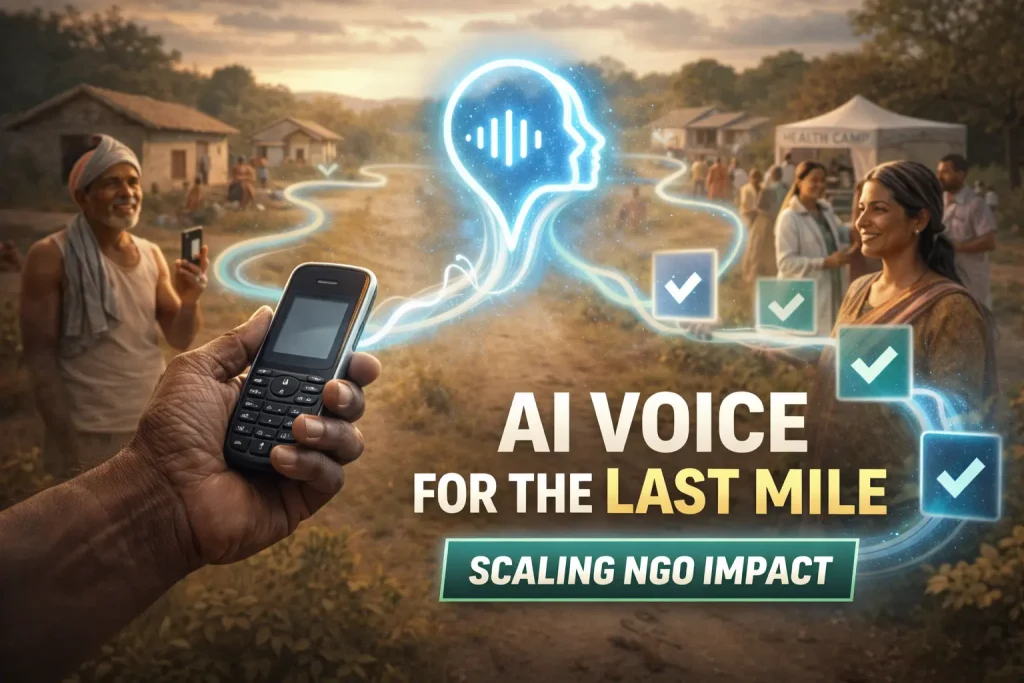
Scaling Impact with AI Voice Agents for the Last Mile
Until now, the real challenge of the social impact domain has always remained the last mile. Here, at the intersection of aspiration and pragmatism, even the most wonderful interventions and programs encounter the complexities of geographical inaccessibility, linguistic inhomogeneity, and the lack of infrastructure. This paradox, which challenges all NGOs in domains as disparate as healthcare, agriculture, education, finance, and emergency response, says the same across all sectors: the farther one reaches out, the farther they are from those who need the outreach most. Yet, in recent years, AI Voice Agents for the Last Mile have arrived as game-changers in resolving one of the most enduring and intractable of the social impact domain paradoxes. While mobile apps, SMS, and human calling teams are either unavailable or unduly burdensome in the last mile, AI-based voice agents are available on even the lowest feature phones, in local languages, and require no literacy of users at all. This article will discuss the Last Mile Communication Break, its solution, and its prospects in the context of the social impact domain.
Understanding the Last Mile Challenge in Social Impact
“Last mile” generally represents the final reach, i.e., the extension at which programs have to reach the actual beneficiaries. Although this distance might not be very long, this is often the longest distance. The major problem, or rather the biggest challenge, faced by almost every NGO at the last mile is not related to a lack of resources but rather communications.
The Literacy and Access Gap
Last mile populace using feature phones is a good number. Smartphone adoption is also growing, albeit selectively. Levels of literacy are also diverse. Many of these direct beneficiaries are in no position to peruse long messages and operate applications. Mobile-based text modes are based on assumptions about the reading ability and internet connectivity of users. There is no consideration given to the less Internet-connected populace. The strongest human interface is voice. Anyone who is in a position to receive and respond to a call, in any condition, is eligible for information and services. It is one of the most inclusive technologies available.
Capacity Bottlenecks and Human Limitations
- NGOs depend mostly on either field staff, call centers, or volunteers to reach out to beneficiaries. While these are effective models at a small scale, they tend to collapse under pressure. Common issues include:
- Limited working hours: Human teams work within the constraints of standard business hours; therefore, when needs arise unexpectedly during evenings, weekends, or holidays, beneficiaries are in immediate need of further support. It produces some discontinuities in service delivery, particularly in rural communities where time zones or daily routines fall out of synchronization with urban schedules, delaying responses and reducing the effectiveness of welfare programs.
- Staff burnout at the time of peak campaigns: During high-demand periods, such as seasonal drives or times of awareness campaigns, staff face overwhelming call volumes that lead to staff burnout, mistakes, and high turnover. This has consequences not only for morale but also for the quality of the interactions themselves, as fatigued workers may give inconsistent information or miss critical details that, in turn, hurt the mission of the NGO.
- Inability to scale: In the case of crises such as a disaster or pandemic, the volume of calls increases disproportionately, yet there is an inability to scale and respond because human resources cannot adequately be increased immediately, leading to an increased effect of the disaster on the affected communities.
High Cost per Call: Manual calling involves labor cost escalation quickly. Such an approach is not feasible for NGOs, which have limited budgets to spare. Each calling process requires personal dedication, diverting funds that could be utilized to reach more people than are attainable under manual calling systems, such as automated ones. (55 words)
During vaccination campaigns, loan repayment cycles, weather emergencies, or enrollment periods, these calls can increase overnight. Human forces just cannot increase at the speed needed. Voice AI for social impact scales instantly, serving thousands of calls at any time without fatigue, overtime, or hiring.
The Feedback and Data Blind Spot
Many NGOs run with delayed or incomplete field data. Data from surveys is collected manually, delayed, or even not collected at all. Beneficiary feedback reaches the decision-makers weeks after the problems arise. The voice agent collects structured data from utterances, thereby creating a timely feedback loop with the community.
Why Traditional Outreach Models Fail at Scale
Before understanding why AI voice agents are effective, it is important to understand why existing methods fail.
SMS and App-Based Outreach
In such systems, which prove to be cost-effective in the long term, there are minimal engagement levels observed in regions with low literacy levels. In such regions, there is a tendency to ignore or not understand the messages sent via the apps or via SMS. These systems also lack two-way interaction, emotional cues, and instant clarification.
Manual Calling Teams
Human callers offer empathy, but this comes at a great operational cost. Scaling requires hiring, training, and managing large teams—often quite impossible for NGOs. The issues that result from manual calling include the following:
Inconsistent quality: Variations in the training, mood, or experience of staff result in erratic delivery, whereby some beneficiaries correctly receive empathetic support and others experience errors or hurried interactions. This leads to the erosion of trust and program credibility, given that such discrepancies could very well equate to misinformation or unresolved issues in key areas like health advice.
Follow-up missed: Manual tracking usually makes human teams miss calls for follow-up or progress checks, creating gaps in continuous support, like medication adherence or enrollment processes. This lowers the general impact because beneficiaries might drop out of the programs due to perceived neglect, therefore worsening outcomes for the vulnerable groups.
Staff turnover: Environments characterized by high stress, repetitive tasks, and irregular hours are more likely to lead to staff turnover. This requires continuous rounds of recruitment and training, further depleting the resources of the implementing agency. Stability is compromised as continuity of care and institutional memory suffer; NGOs face greater challenges in sustaining outreach over time.
Legacy IVR Systems
Traditional IVR systems, such as “Press 1, Press 2,” are also very frustrating for customers since they do not understand the speech, regional accent, and context. Beneficiaries even drop out before reaching the required information.
AI Voice Agents for The Last Mile The last mile voice agents are advanced entities that take interactions a step further compared to IVR systems.
What Are AI Voice Agents for the Last Mile?
AI voice agents are speech-native, conversational AI that can have natural phone conversations, comprehend intent, and act in real-time. If you are new to the concept, the idea of an AI voice agent is a human-like phone assistant that understands local languages, has memory, and is available 24/7. AI voice agents are built primarily as voice-first solutions, and that makes them conducive for use in last-mile outreach.
How AI Voice Agents Work
A beneficiary calls or receives an automated call
This starts the interaction process smoothly, and it works on even the most basic of phones, without the use of apps or internet, offering instantaneous access even in hard-to-reach locations where the level of digital literacy among the population is very low.
Speech is transcribed instantly
Advanced ASR technology converts spoken words to text in real-time, handling dialects and accents accurately, ensuring no loss of meaning even in noisy environments or with varying speech patterns common in diverse communities. (50 words)
An AI model understands intent and context
Through LLMs, the system can understand the intention, emotions, and past interactions based on the knowledge base, which can allow for a personalized response and build trust and context for a conversation on health, financial issues, or emergency situations.
The system responds naturally in the same language
TTS produces human-like voices that have low latency, under 600 ms, and change tone and phrasing according to cultural differences, making conversations feel sympathetic and intuitive to the uneducated and untutored technophobes. (50 words)
Actions are triggered—reminders, bookings, data capture, or escalation
The AI can perform activities such as scheduling and/or surveying, while at the same time detecting levels of urgency, thus streamlining operations and making timely interventions without overwhelming the NGO personnel. (50 words)
This happens in less time than a second, resulting in a smooth human interface.
Core Capabilities of AI Voice Agents for NGOs
AI voice agents for the last mile act as force multipliers, enabling small teams to manage large populations.
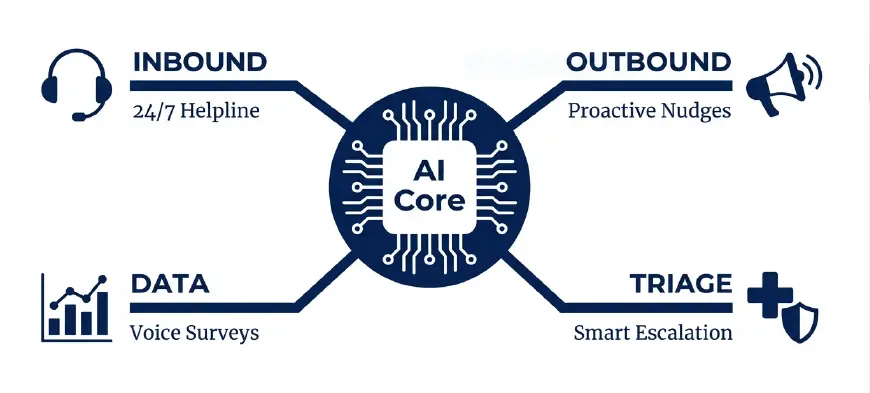
24/7 Inbound Helplines
Voice AI can handle inbound queries around the clock—scheme eligibility, health guidance, appointment details—without wait times or missed calls. This ensures beneficiaries are never left without answers
Proactive Outbound Voice Campaigns
AI voice agents can initiate calls for medication reminders, loan repayment nudges, weather alerts, and program awareness. Calls are consistent, personalized, and timely.
Voice-Based Surveys and Data Collection
Voice surveys significantly improve response rates. Beneficiaries speak naturally, and the AI converts responses into structured data. This closes the feedback loop efficiently.
Smart Triage and Human Escalation
AI voice agents can detect urgency—medical symptoms, financial distress, crisis situations—and escalate calls to human staff immediately. This ensures safety and ethical deployment
Sector-Wise Impact of AI Voice Agents
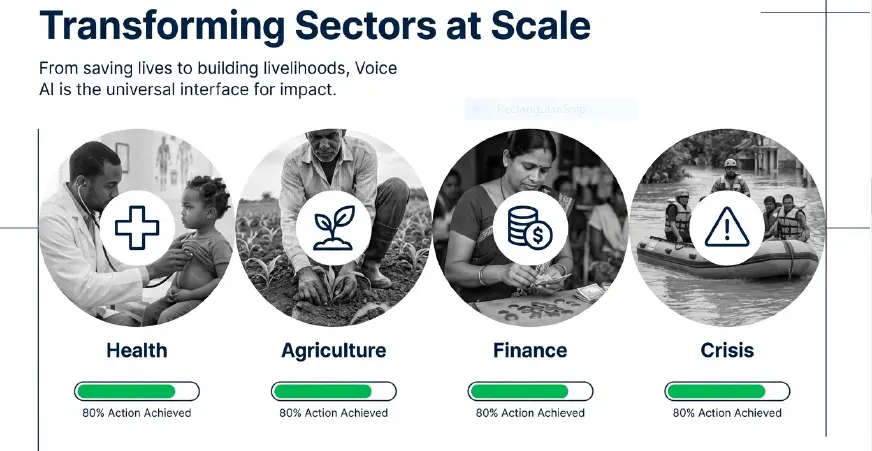
Healthcare and Public Health
An AI voice agent helps in improving the adherence to medications, appointments, follow-ups after treatments, and preventive health awareness. This enables NGOs to attain better health outcomes while using less resources.
Agriculture and Livelihoods
Farmers receive weather and pest alerts, market price updates, and scheme eligibility guidance. Voice AI empowers women farmers and smallholders by delivering actionable insights in local dialects.
Financial Inclusion and Microfinance
Voice AI can facilitate empathetic repayment reminders, financial literacy, and voice-based KYC. Firms achieve a 30%+ improvement in repayment time, all thanks to the power of trust and understanding.
Education and Skill Development
AI Voice Agents facilitate enrollment campaigns, attendance reminders, and parent engagement initiatives. This ultimately enhances parental and child retention rates.
Crisis Response and Disaster Management
During floods, heatwaves, or pandemics, voice AI can send mass alerts, handle thousands of inbound calls, and collect real-time needs data. Manual systems cannot match this speed or scale.
Donor Engagement and Operational Efficiency
Voice-Based Donor Engagement
Personalized thank-you calls and impact updates using audio media engender an emotional connection as opposed to email blasts. This fosters retention and donor relationships.
Cost Reduction and Resource Optimization
NGOs achieve “95% reduction in outreach costs, 70 to 80 percent automation of routine communications, and 30 to 50 percent reduction in operational overhead.”
Ethics, Trust, and Responsible AI Deployment
AI voice agents must be deployed responsibly.
Data Privacy and Compliance
Modern systems support PII redaction, encryption, and compliance with GDPR and healthcare regulations.
Human-in-the-Loop Design
Sensitive conversations are escalated to trained humans. AI supports—not replaces—human judgment.
Accuracy and Guardrails
Responses are generated from verified knowledge bases, preventing misinformation.
Implementation Roadmap for NGOs
Pilot simple use cases (reminders, helplines)
Start with low-risk applications to test the effectiveness of real-life scenarios, gathering quick feedback from a small beneficiary group. This builds confidence and identifies tweaks before broader rollout, typically achieving measurable results within weeks without major investments.
Train the system with FAQs and workflows
Upload common questions and operational processes to customize the AI, keeping its answers accurate and compliant with the policies of the NGOs. This section requires a low level of technical knowledge, as the emphasis is on the accuracy of the content to build trust with the AI users and make the AI highly reliable from the beginning. (52 words)
Integrate CRM and databases
Interfaces the voice AI with existing tools to facilitate smooth data exchange and utilization in real time. In essence, this step eliminates the need to create and update reports, thereby freeing the employees to concentrate on productive activities. (53 words)
Scale across regions and languages
Scale deployment through the addition of new dialects and geographies, depending on pilot success, and take advantage of cloud scalability for cost-effective scaling up. Track metrics such as engagement rates, thus refining while being inclusive without a corresponding rise in resources or complexity. (51 words)
Conclusion: Why AI Voice Agents Are the Future of Last-Mile Impact
The future of social impact is not app-first or text-first—it is voice-first. AI Voice Agents for the Last Mile offer something rare: inclusion without literacy, scale without burnout, trust without coercion, and impact without excessive cost. For NGOs operating in complex, resource-constrained environments, voice AI is not a luxury—it is a necessity. Organizations that adopt voice-first systems today will define the next decade of inclusive, scalable social change.