
Why Real Estate Agents Need a Real Estate CRM
In the competitive real estate industry today, agents cannot double-check properties or keep track of clients with a spreadsheet, diary, or by making manual calls. Buyers and sellers want instant feedback from their agents. Therefore, it would be imperative to use a Real Estate CRM (Customer Relationship Management) to fulfill these demands.
A Real Estate CRM offers many advantages to an agent, including the ability to automate follow-up calls and track what communicates with whom, so they will be able to turn around transactions at faster rates than ever before. A Real Estate CRM can help a single agent, a brokerage with many agents, or a growing team of agents run their business more effectively by improving production rates, satisfaction levels for the clients they represent, and ultimately, the bottom line.
In this article, we’ll outline 10 game-changing reasons for real estate agents to use a Real Estate CRM and why it has become a software solution that every modern agent should have.
1. Centralized Lead Management
Centralized Lead Management is one of the key features of a Real Estate CRM. With a Real Estate CRM, you have a single platform to manage all of your leads, including those from:
Web site forms, Social media, Property Portals, Referral programs, and Walk-ins
A Real Estate CRM allows agents to manage their leads more effectively because they NO longer have to manage multiple tools for lead management. They can:
Track each lead from first contact to the closing of a deal.
Access a complete “picture” of the lead (what source did the lead come from, what have they said through interactions, etc.).
Ensure that there is NO duplicate or lost leads.
By having all leads organized in a structured manner, this will ensure that NO business opportunity is missed and will also increase your overall lead conversion rate.
2. Increased Speed of Follow-Up and Improved Response Time
When it comes to real estate sales, speed is essential. Studies have found that real estate agents who respond to inquiries within minutes are significantly more likely to convert those inquiries into actual sales. By utilizing a Real Estate CRM, agencies can automate their follow-up reminders and send instant responses to leads via email or via SMS or WhatsApp.
Automation provides:
Immediate acknowledgement to leads as they enter the system
Agents never forget to follow up with leads, and leads never have to wait for an agent to call them back
Significantly decreased response times to leads
A greater degree of trust and engagement from leads, and greater probabilities of closing deals.
3. Better Client Relation Management
Success in Real Estate requires long-term relationships with Clients, so having a Real Estate CRM that contains a Client’s full profile (including preferences, budget, location preferences, etc.) and communications history helps to build a successful Real Estate career for agents.
Using a CRM allows agents to:
Personalize their conversations.
Provide property recommendations by matching them to the Client’s Profile.
Establish trust and loyalty with the Client.
Satisfied Clients tend to return and refer others, thus allowing the agent to continue growing their business through Client referrals.
4. Automated Marketing Campaign
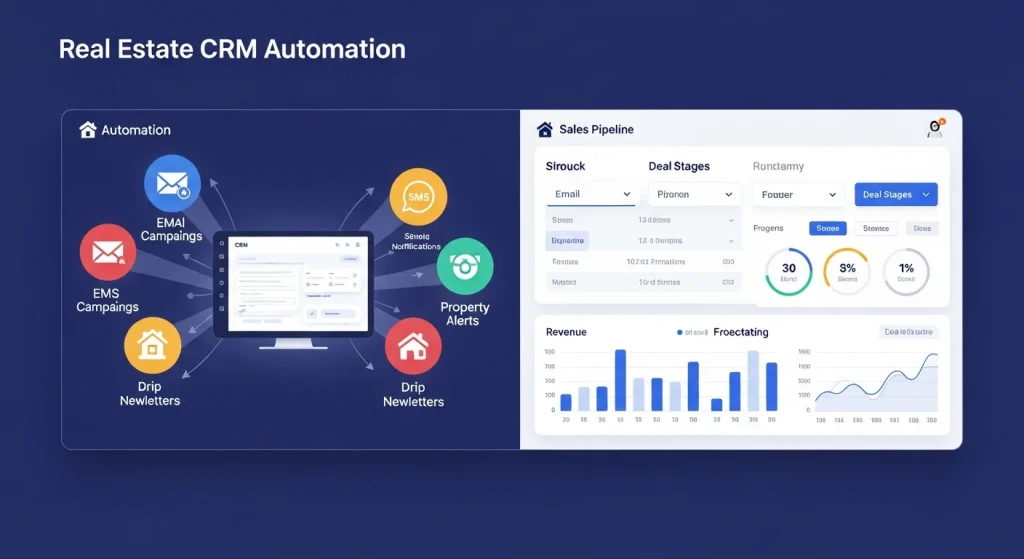
Marketing is time-consuming, but with the use of CRM Software, agents can automate their marketing. Agents can set up Email Campaigns, Property Alerts, and Drip & Newsletters without any manual work involved.
The Benefits of Automated Marketing for Agents are:
Provides Agents with Automated Property Recommendations
Provides Agents with a Scheduled Email & SMS Campaign
Provides Agents with Targeted Communications based on Buyer Behaviour
Automation of Marketing not only saves Agents time, but also keeps Branding Consistent.
5.Improvements in keeping track of deals and pipelines
The tracking of several deals at the same time without a suitable system can be daunting, therefore, a real estate CRM provides a graphical representation of the pipeline that allows for agents to see the status of all their deals.
A Real estate CRM allows agents to:
Monitor in real-time the progress of each of their deals.
Identify stalled opportunities.
Elevate their forecasting of revenue.
This transparency allows agents to effectively prioritize their efforts and close deals quickly.
6.Improvements in productivity and time management.
By streamlining repetitive tasks such as data entry, setting reminders, and following up, a Real estate CRM enables agents to use their time more effectively.
Instead of spending time on administrative duties, agents can concentrate on:
Showing properties.
Meeting with clients.
Negotiations and closings.
Using time in a more effective manner will allow agents to be more productive and experience less stressed.
7. Accurate Reporting and Insights
Data-driven decisions are crucial in real estate. A real estate CRM system provides detailed reports and analytics on leads, conversions, agent performance, and marketing effectiveness.
With real-time insights, agents can:
Understand which channels generate the best leads
Improve sales strategies
Measure ROI accurately
These insights help agents refine their approach and grow consistently.
8. Seamless Team Collaboration
For brokerages and teams, collaboration is key. A real estate CRM allows multiple agents to access shared data, update client information, and assign tasks efficiently.
Benefits include:
Better communication among team members
No data duplication
Clear accountability
This ensures smoother operations and a better client experience.
9. Mobile Access for On-the-Go Agents
Real estate professionals are always on the move. Modern real estate CRM software offers mobile-friendly access so agents can manage leads and clients anytime, anywhere.
Using a mobile CRM, agents can:
Respond to leads instantly
Update notes after meetings
Access property details on the go
This flexibility gives agents a competitive edge in fast-paced markets
10. Scalability and Long-Term Business Growth
As your business grows, managing more leads and clients becomes challenging. A real estate CRM scales with your business, allowing you to add more users, automate workflows, and integrate third-party tools.
With a CRM in place:
Growth becomes structured and manageable
Processes remain consistent
Long-term success is sustainable
A CRM is not just a tool—it’s an investment in future growth.
Conclusion
In today’s digital-first real estate landscape, using a real estate CRM is no longer optional—it’s essential. From lead management and follow-ups to marketing automation and analytics, a CRM empowers agents to work smarter, close deals faster, and build lasting client relationships.
Whether you are a new agent or an experienced broker, adopting the right real estate CRM will help you stay competitive, increase efficiency, and unlock new growth opportunities. If you want to scale your real estate business and deliver exceptional client experiences, investing in a powerful CRM is the smartest move you can make.
Frequently Asked Questions (Faqs)
Q1.What is a real estate CRM and how does it work?
A real estate CRM is software designed to help agents and brokers manage leads, track client interactions, automate follow-ups, and organize property transactions. It centralizes customer data, schedules reminders, and streamlines communication, helping agents close deals faster and build long-term relationships.
Q2.Why do real estate agents need a CRM?
Real estate agents need a real estate CRM to avoid missed follow-ups, manage multiple leads efficiently, and maintain consistent communication with buyers and sellers. A CRM improves productivity, enhances client experience, and increases conversion rates by automating repetitive tasks.
Q3.How does a real estate CRM help with lead management?
A real estate CRM software captures leads from multiple sources such as websites, social media, property portals, and referrals. It organizes leads in one place, tracks their status, and sends automated follow-ups, ensuring no lead is lost or forgotten.
Q4.Can a real estate CRM improve sales and conversions?
Yes, a CRM for real estate agents significantly improves sales by enabling faster response times, personalized communication, and timely follow-ups. Automated reminders and lead nurturing workflows help agents convert more prospects into paying clients.