
24/7 Healthcare Call Answering: Complete Automation Guide
Healthcare emergencies operate outside of business hours. Patient inquiries come at midnight. Concerned parents call on weekends. Employed individuals schedule appointments in the evenings. However, most healthcare organizations provide phone accessibility only during restricted business hours, leading to frustration, anxiety, and missed opportunities. 24/7 healthcare call answering addresses this basic incongruity between patient needs and facility availability.
The conventional after-hours system, including voicemail, answering services, and on-call personnel, is substandard for patient satisfaction and generates operational headaches. Contemporary AI voice bot automation in healthcare technology allows for real 24/7 service with immediate response, complete scheduling functionality, and proper emergency escalation without requiring additional staff.
This in-depth resource outlines the importance of 24/7 healthcare call answering as a necessity, the current cost of after-hours calls to healthcare facilities, how AI voice bot automation offers a complete solution, and actual outcomes from healthcare facilities operating 24/7.
The After-Hours Healthcare Communication Problem
Healthcare needs don’t pause outside 9-5. Patient health concerns, questions, and service needs occur continuously. Traditional healthcare communication systems fail to match this reality.
When Healthcare Calls Actually Occur
Analysis of call patterns across healthcare facilities reveals:
- 25-35% of total daily calls occur outside standard business hours
- Peak evening call times: 6-9 PM as working adults return home
- Weekend call volume: 40-50% of weekday volume
- Holiday periods: Significant call volume when facilities traditionally closed
Patients calling during these times with traditional systems encounter voicemail, creating delays, anxiety, and often calls to competitors offering better accessibility.
Why After-Hours Accessibility Matters
Patient Anxiety and Health Outcomes
Health-related issues that cause anxiety at 11 PM cannot be postponed until the next morning for many patients. Parents with children who are sick need information at that moment. Patients with symptoms that cause concern need to be evaluated. Answering healthcare calls 24/7 gives patients reassurance or the necessary escalation at the most critical moment.
Working Patient Convenience
Patients with traditional schedules have difficulty calling within business hours without affecting their work. Evening and weekend call times correspond when patients are available. Facilities providing only business-hour accessibility require patients to decide between work and healthcare access
Competitive Differentiation
With the increasing adoption of AI voice bot in healthcare by more healthcare facilities, the expectations of patients also increase. Healthcare facilities that have only business hours accessibility will be at a competitive disadvantage. Patients will increasingly demand an instant response, just like in other service sectors.
Emergency vs. Non-Urgent Triage
Some of the calls that are made outside of working hours are emergencies that require immediate attention. Others are inquiries and scheduling. Voicemail does not have the ability to distinguish between the two. Healthcare voice bot has the ability to perform triage. Emergencies are handled immediately, while others are handled automatically.
The Cost of Limited Availability
Facilities lacking 24/7 healthcare call answering experience multiple costs:
Lost Patient Acquisition
Prospective patients searching for providers may call multiple facilities. First facility to provide a helpful response often gets the patient. If your facility sends calls to voicemail after hours while competitors respond immediately with AI voice bot in healthcare, you are losing patient acquisition opportunities.
Analysis of after-hours calls shows substantial percentages of new patient inquiries. Each missed inquiry represents lost patient lifetime value.
Increased Patient Anxiety
Anxious patients leaving messages regarding their symptoms or health issues feel more anxious while waiting for a callback. This affects patient satisfaction even before any medical interaction has taken place.
24/7 healthcare call answering
provides immediate response reducing anxiety. For non-emergency concerns, instant information and reassurance prevents unnecessary emergency room visits. For emergencies, immediate escalation ensures faster appropriate care
Emergency Mismanagement
Life-threatening situations buried in morning voicemail backlog represent serious quality and liability risks. While most patients experiencing true emergencies call 911, some call their healthcare provider first.
Healthcare voice bot AI
programmed for emergency triage identifies alarming symptoms and calls immediately to on-call professionals or refers to emergency care. This is done instantly, not after hours when messages are retrieved.
Staff Burnout
Physicians interrupted at home for routine inquiries that could be automated experience burnout and resentment. Conventional after-hours care systems generate an expectation that physicians, nurses, or administrators are always on call.
AI voice in healthcare
handles routine after-hours calls automatically, escalating only cases requiring medical judgment. On-call staff handle appropriate volume of truly necessary consultations rather than fielding endless routine calls.
Negative Online Reviews
Reviews often include comments about accessibility issues: “impossible to reach after hours,” “only voicemail on weekends,” “can’t schedule unless you call during their narrow hours.” These reviews negatively impact online reputation and will discourage potential patients.
Facilities that use 24/7 healthcare call answering see reviews change to positive comments about accessibility: “I can call anytime,” “got my question answered at 10 PM,” “so convenient to schedule on weekends.”
Why Traditional After-Hours Solutions Fail
Healthcare facilities have attempted various approaches to provide after-hours access. All have significant limitations.
Voicemail (Documenting Problems, Not Solving Them)
Voicemail systems record messages but do not offer any actual service. Patients experience communication breakdown—they cannot connect with anyone—and have to wait for hours or days for return calls.
Voicemail systems generate administrative work: staff members spend the first hours of every day responding to messages. Many messages involve phone tag: patient unavailable when staff returns call, leaves new message, and so on.
Research indicates high percentages of healthcare voicemails never receive return calls because of message ambiguity or administrative error.
24/7 healthcare call answering with AI voice bot in healthcare eliminates voicemail for most calls.
Traditional Answering Services (Limited Capability)
After-hours answering services use operators who answer calls and leave messages. Although more personal than voicemail, answering services have these limitations and cannot:
Access your appointment system to schedule patients
Offer facility or provider-specific information
Answer medical inquiries
Verify insurance
Process prescription refill requests
Conduct emergency triage protocols
The operator leaves messages for on-call personnel, who must then call patients back. The patient still doesn’t receive immediate care. The cost of answering services is an ongoing expense with little benefit.
Healthcare voice bot AI offers full functionality—actual service, not just message leaving—at the same cost or less.
On-Call Staff Coverage (Expensive and Unsustainable)
Some hospitals have their doctors, nurses, or administrators carry phones outside of work hours to respond to patient calls. This method is very problematic:
Work-life balance of employees greatly affected
Cannot access scheduling or other systems from home
Interactions not documented in a consistent manner
Overtime or on-call pay is very costly
High turnover and burnout
Most calls to on-call personnel are not medical in nature: appointments, directions, hours of operation, billing inquiries. Disrupting busy medical staff for non-medical calls is a waste of highly trained talent.
AI voice bot in healthcare can automatically respond to non-medical calls, referring only appropriate cases to on-call personnel.
Call Forwarding to Mobile Phones (Unprofessional and Incomplete)
The practice of forwarding calls to after-hours lines to staff mobile phones gives the impression of availability rather than capability. Staff members who respond to their personal phones cannot:
Access facility systems
Schedule appointments
Retrieve patient information
Give full answers
Record interactions accurately
Patients receive ad-hoc answers instead of consistent professional service. Staff members receive constant interruptions. This practice seems unprofessional compared to a 24/7 healthcare call answering system.
How AI Voice Bot Enables True 24/7 Healthcare Operation
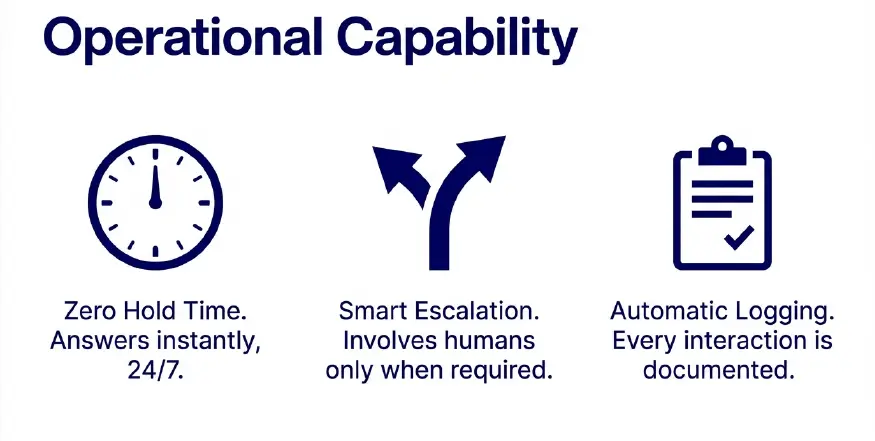
Healthcare voice bot overcomes all traditional after-hours solution limitations by providing continuous, full-capability service.
Continuous Availability Without Human Limitations
AI voice bot in healthcare systems never sleeps, never takes a break, never has a holiday, never comes in sick. The system works the same at 3 AM on Christmas as it does at 10 AM on Tuesday.
Calls from patients at any time are answered immediately, usually in one ring. No hold music. No “your call is important to us” announcements. No voicemail. Immediate human-like dialogue from the start of service interaction.
The system’s continuous operation corresponds to patient expectations shaped by 24/7 digital services in other sectors, such as banking, air transport, shopping, and entertainment. The healthcare industry is increasingly expected to conform to these expectations.
Full Functionality After Hours, Not Just Message-Taking
24/7 healthcare call answering with AI voice bot in healthcare enables full service capability:
Appointment Scheduling: Patients schedule, reschedule, or cancel appointments at any time. System accesses actual provider schedules, provides available times, confirms appointments, sends confirmations—entire transaction automated.
Information Provision: Directions, parking, hours, provider information, insurance acceptance, preparation instructions—all provided immediately without human intervention.
Prescription Refills: Refill requests captured with required information, automatically processed into pharmacy system, coordination automated. Patients don’t have to wait until morning to start refilling.
Symptom Assessment: For patients calling with symptoms, healthcare voice bot prompts questions based on established protocols to evaluate urgency. Emergencies are escalated immediately. Non-urgent symptoms are provided guidance or appointment scheduling.
Emergency Escalation: Actual emergencies are connected immediately to on-call providers or 911 as needed. System identifies high-risk symptom patterns and responds immediately.
The full service capability means patients receive actual service after hours, not just answering messages requiring callbacks.
Unlimited Capacity During Any Time Period
Conventional systems have issues with handling multiple calls. Only a maximum of three calls can be handled by three employees. If ten patients call at the same time at 8 AM, then seven are left to wait or receive voicemail.
AI voice bot in healthcare can handle an unlimited number of calls simultaneously without any degradation of quality. Whether it is one patient or one hundred patients calling at 2 AM, all receive instant answer and service.
There is no “busy signal” issue at all. 24/7 healthcare call answering means every call answered, every time, regardless of volume.
Consistent Quality Around the Clock
Human performance is variable: alertness in the morning vs. end-of-shift fatigue, experienced personnel vs. new employees, good days vs. stressful days. Healthcare voice bot performance is the same 24/7/365.
The same accurate information is provided to every patient, same professional tone, same efficient service.
After-Hours Scenarios AI Voice Bot Handles
24/7 healthcare call answering systems address full range of after-hours patient needs
Midnight Appointment Booking
Working professional remembers at 11:30 PM that she needs dermatology follow-up scheduled. Calling immediately while it’s on her mind:
Patient: “I need to schedule a follow-up with Dr. Martinez.”
Voice Bot: “I can help with that. May I have your name and date of birth?” [Verification proceeds]
Voice Bot: “I have availability with Dr. Martinez next Wednesday at 3 PM or Thursday at 10 AM. Which works better?”
Patient: “Thursday at 10.”
Voice Bot: “Perfect! You’re scheduled for Thursday at 10 AM. You’ll receive a text confirmation shortly.”
Complete appointment booked in under two minutes at midnight. Patient satisfied. No staff required.
Healthcare voice bot captured appointment that otherwise would have gone to voicemail, possibly never scheduled.
Weekend Prescription Refill
Saturday morning, patient realizes needed medication running low before Monday:
Patient: “I need to refill my blood pressure medication.”
Voice Bot: “I can help with that. May I have your name and date of birth?” [Verification proceeds]
Voice Bot: “I see you have lisinopril on file. Which pharmacy would you like the refill sent to?”
Patient: “CVS on Main Street.”
Voice Bot: “I’ll process that refill request to CVS on Main Street. It should be ready for pickup this afternoon.”
24/7 healthcare call answering processes refill immediately. Pharmacy receives request automatically. Patient gets medication without waiting until Monday.
2 AM Symptom Assessment
Anxious patient experiencing concerning symptoms calls at 2 AM:
Patient: “I’m having chest discomfort and I’m worried.”
Voice Bot: “I understand your concern. I’m going to ask you some important questions. Are you experiencing severe chest pain right now?”
Patient: “It’s uncomfortable, not severe pain.”
Voice Bot: “Is the discomfort spreading to your arm, jaw, or back?”
Patient: “No, just my chest.”
Voice Bot: “Are you having difficulty breathing or shortness of breath?”
Patient: “Maybe a little.”
Voice Bot: “Based on your symptoms, I’m connecting you immediately to our on-call nurse. Please stay on the line.”
Healthcare voice bot recognizes potentially serious symptoms and escalates instantly to clinical staff for assessment. Appropriate triage happens immediately, not after hours of worry or morning callback.
For truly emergent symptoms, system would direct immediately to 911 while notifying on-call provider. For clearly non-urgent symptoms, system provides reassurance and schedules next-available appointment.
Holiday Information Request
Thanks giving evening, new patient needs facility information:
Patient: “I have an appointment next week but I lost the address and I don’t know where to park.”
Voice Bot: “I can help you with that. May I have your name?” [Verification proceeds]
Voice Bot: “Your appointment is at our downtown location, 123 Medical Plaza. I’ll text you the address and a map link. For parking, we have a patient lot behind the building. You’ll receive free validated parking with your appointment.”
Patient: “Perfect, thank you!”
Simple information request handled instantly on holiday when traditional office would be closed and voicemail unhelpful.
Emergency Handling After Hours
24/7 healthcare call answering must handle emergencies appropriately—arguably the most critical after-hours scenario.
Protocol-Based Emergency Screening
The AI voice bot in healthcare systems follows evidence-based screening protocols for symptom evaluation. When patients report alarming symptoms, the system asks follow-up questions to evaluate the symptoms’ severity and urgency.
Life-Threatening Symptoms: Severe chest pain, breathing difficulties, severe bleeding, altered mental awareness, severe allergic reactions—system identifies these symptoms immediately and calls emergency services.
Urgent But Not Life-Threatening: Moderate symptoms needing immediate medical evaluation but not requiring 911. System refers to on-call provider immediately for phone consultation or to emergency room.
Non-Urgent Symptoms: Common symptoms not needing immediate care. Healthcare voice bot offers relevant advice, arranges next available appointment, and provides home care advice when necessary.
Immediate Escalation Capabilities
For emergencies, 24/7 healthcare call answering systems act instantly:
- Direct connection to 911 for life-threatening situations
- Immediate transfer to on-call physician for urgent assessment
- Notification to on-call provider with patient information and presenting complaint
- Documentation of emergency interaction for continuity of care
Response time measured in seconds, not hours. This responsiveness potentially impacts patient outcomes in critical situations.
Integration with On-Call Systems
Healthcare voice bot integrates with on-call scheduling:
- Knows which providers are on-call for different specialties
- Routes appropriately based on patient needs and provider coverage
- Provides provider with patient information, chief complaint, and urgency assessment
- Documents all interactions for morning review
On-call providers receive well-triaged calls with necessary context, rather than fielding every random patient call regardless of urgency.
Benefits of 24/7 Healthcare Call Answering
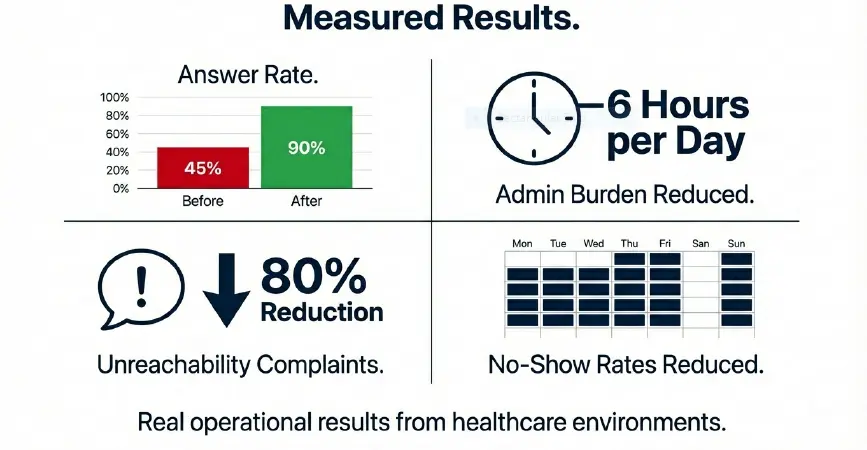
Facilities implementing continuous availability through AI voice bot in healthcare experience multiple operational and strategic benefits:
Capture After-Hours Appointment Volume
Analysis has consistently shown that 25-35% of appointment requests are made after hours. 24/7 healthcare call answering addresses this lost volume of business.
Patients making calls in the evenings and on weekends will schedule appointments immediately, rather than leaving voicemails that are often forgotten or never returned. This directly correlates to more appointments and more revenue.
Convenience of after-hours scheduling also serves to enhance patient satisfaction, making it more likely that the appointment will be kept and future care utilized.
Improved Patient Satisfaction and Experience
Patient satisfaction scores for accessibility improve significantly after the implementation of 24/7 healthcare call answering. Some specific patient satisfaction survey questions that improve include:
“I can reach the facility when I need to”
“My calls are answered promptly”
“It’s easy to schedule appointments”
“The facility is responsive to my needs”
Patient satisfaction scores for overall experience typically improve by 30-40% after the implementation of healthcare voice bot.
Reduced Emergency Department Utilization
Patients with questions outside of business hours who cannot get hold of their physician resort to visits to the emergency department. AI voice bot in healthcare offering immediate assessment and advice cuts down on unnecessary visits to the ED.
Regarding non-urgent issues, the system offers reassurance and proper scheduling follow-through. Regarding urgent issues, the system enables proper level of care—urgent care, next-day appointment, or ED as indicated.
This is beneficial to the facility, as it cuts down on ED usage, and to the patient, as it avoids costly and time-consuming ED visits for non-urgent issues.
Decreased Staff Burnout
The traditional methods of after-hours care, such as on-call schedules, weekend coverage, and evening shifts, are major contributors to burnout among healthcare staff. The 24/7 answering of healthcare calls through healthcare voice bot eliminates the need for after-hours coverage.
Healthcare staff are able to maintain work-life boundaries. Only appropriate calls are answered by on-call providers, not scheduling and information calls. Administrative staff work regular hours without after-hours responsibilities.
Competitive Market Advantage
With the growing demand for immediate access from patients, facilities that provide 24/7 healthcare call answering services stand out in the competitive market. Marketing campaigns emphasizing “24/7 appointment scheduling” and “always available patient support” appeal to today’s patients.
Accessibility is cited as a positive aspect in online reviews. Search engine optimization is enhanced by positive review content. Patient acquisition increases with convenience as a deciding factor.
Pioneers in AI voice bot in healthcare for continuous availability achieve long-term competitive advantage as patient demands change permanently to always-available access.
Enhanced Operational Data
24/7 healthcare call answering systems generate comprehensive data about after-hours call patterns:
- Volume by day of week and time of day
- Types of calls (appointments, questions, emergencies)
- Seasonal patterns
- Demographics of after-hours callers
This data informs strategic decisions about services, marketing, and operations impossible to gather with voicemail-only after-hours approach.
Multi-Time Zone and Geographic Considerations
Healthcare organizations operating across multiple time zones or serving geographically distributed patients benefit especially from 24/7 healthcare call answering.
Multi-Location Healthcare Systems
Large healthcare systems with facilities in different time zones face complexity: business hours vary by location, patient needs span time zones, centralized call centers may not operate continuously.
AI voice bot in healthcare provides unified continuous coverage across all locations and time zones. Patients calling any facility any time get consistent instant service. System routes appropriately based on location and need.
International Patient Populations
The facilities catering to international patients or travelers have time zone issues. International patients abroad have to communicate during their local daytime, which could be facility nighttime.
Healthcare voice bot AI supporting 24/7 healthcare call answering is easily adaptable to international patients. Scheduling, inquiries, issues with prescriptions—everything is taken care of irrespective of the location or time zone.
Rural and Underserved Areas
Rural healthcare facilities often struggle with limited staffing making after-hours coverage especially challenging. AI voice bot in healthcare levels the playing field, enabling small rural clinics to offer same continuous accessibility as large urban systems. This improves healthcare access equity and patient outcomes in underserved areas.
The Future: Continuous Availability as Standard Expectation
Patient expectations around healthcare accessibility are permanently shifting. The question is no longer whether to offer 24/7 healthcare call answering but how quickly to implement before competitive and reputational damage accumulates.
Rising Patient Expectations
Patients compare healthcare access to other service industries:
- Banking: 24/7 account access, instant customer service
- Retail: Round-the-clock online shopping, anytime support
- Transportation: Immediate booking, instant confirmation
- Entertainment: Always-on streaming and access
Healthcare continuing to operate on business-hours-only model increasingly seems anachronistic and patient-unfriendly. 24/7 healthcare call answering meets modern service expectations.
Generational Preferences
The younger demographics of patients, Millennials and Gen Z, demand instant digital access as a minimum standard. They have never experienced a world where service is not available 24/7. Healthcare organizations targeting these demographics must provide constant access or risk alienating their patients.
With these demographics comprising an increasingly larger share of the patient base, constant access becomes a necessity rather than a choice.
Technology Making It Possible
Healthcare technology voice bot AI has matured to support true 24/7 healthcare call answering at an affordable price and quality. What was difficult or expensive even five years ago is now standard implementation.
The technology will become standard and less expensive, and eventually, every facility will provide continuous availability. The first movers will have competitive advantages during the transition period.
Getting Started with 24/7 Healthcare Call Answering
If your facility is currently providing business-hours-only accessibility, the following immediate benefits can be achieved by incorporating 24/7 healthcare call answering using AI voice bot in healthcare:
Assess After-Hours Volume: Analyze the volume of after-hours voicemails, the burden of callbacks, and lost appointment opportunities. Assess the current effect of limited availability.
Define Service Scope: Decide which after-hours calls are to be automatically processed versus which calls are to be escalated to on-call personnel. Establish emergency response plans.
Select Technology Platform: Research and identify healthcare voice bot AI platforms that are intended for continuous healthcare operations. Assess the capabilities of integration, emergency response, and compliance tools.
Plan Deployment: Collaborate with the chosen vendor on integrating the EMR systems, call flow design, emergency response plans, and staff training for escalation procedures.
Monitor and Optimize: Monitor after-hours call volume, type, resolution rates, and patient satisfaction. Continuously improve system performance.
Schedule a demo to witness AI voice bot in healthcare responding to real after-hours calls such as appointments, emergencies, and general inquiries, and discover how 24/7 healthcare call answering can revolutionize the accessibility of your healthcare facility.