
Student Retention Software: How Voice AI Stops Dropouts Before They Happen
Student retention software powered by Voice bot prevents dropouts by detecting early warning signs before students disengage.
It continuously monitors attendance, LMS activity, performance, and financial signals in real time.
When risk appears, Voice bot initiates immediate, personalized outreach and connects students to the right support.
The result is higher retention, lower dropout rates, improved student success, and strong ROI for institutions.
Why Students Don't Drop Out Suddenly
The Truth About Student Dropout
Students do not wake up one morning and decide to drop out of college. They drift away. They miss a class, then another. They do not respond to a few emails. They fall behind in their work. By the time the staff realizes that something is amiss, the student has already checked out in his or her mind. They are just waiting for the opportune moment to leave.
The Warning Signs of Student Dropout
The signs are there before the students actually drop out. They stop accessing the learning management system. They miss several classes in a row. They do not turn in their assignments. They do not answer emails from their advisors. They have outstanding balances or problems with financial aid. They post alarming messages on the discussion board. These are all signals that something is wrong, but no one is paying attention until it is too late.
Why Early Detection Matters for Student Retention
The earlier the intervention, the better. A student who has missed two classes can be turned around with a simple conversation. A student who has missed eight classes and failed three assignments is much harder to turn around. Most of the dropout prevention happens too late because the current system is based on monthly reports. By the time a staff member gets a report and follows up, weeks have passed, and the student has already checked out mentally.
The Cost of Student Dropout
When students withdraw, it is a loss for everyone. The student loses their investment in tuition and time, as well as the future earnings that could have been generated with a degree. The college loses tuition revenue for the years the student would have attended. Taxpayers lose if the student was receiving public funding. Society loses a potential skilled professional. Perhaps most importantly, students experience emotional fallout such as feelings of failure, loss of confidence, and hesitation to return to higher education. Prevention is not simply about dollars; it is about changing life paths.
Problems with Traditional Student Retention
Student Retention Depends on Manual Reports
Most colleges have retention systems that provide weekly or monthly reports of students who may be at risk. The reports are reviewed, and the decision to contact the students is made. The issue is the timing involved before the report is run, reviewed, and someone contacts the student. By the time this is done, weeks have gone by since the student exhibited signs of being at risk. During this time, a small issue has turned into a big issue, and the student’s motivation to stay has dwindled.
Staff Can't Monitor Every Student
The advising staff is drowning in huge caseloads. An advisor may have to track the progress of hundreds of students. It is physically impossible to check on all students, observe the slightest changes in their engagement levels, and contact all those who may be struggling. The staff members are left to deal with only the most apparent emergencies while the students with warning signs go unnoticed until it is too late.
Late Intervention in Student Retention Efforts
The traditional methods of retention occur too late in the process. A student has to fail several assignments, miss several classes, or ask for help before anything can be done. At this point, the student is already well behind in their studies and has probably already mentally checked out of school. Early intervention, such as contacting the student after the first or second missed class, rather than the eighth, would eliminate most dropouts, but the traditional system is not capable of this.
One-Size-Fits-All Student Retention Approaches
The common method of retention outreach is the same for all students: a generic email about support services or a request to meet with an advisor. However, students struggle for different reasons. Some struggle with financial issues. Some struggle with academic issues. Some struggle with personal or family issues. And some simply feel disconnected and lonely. A generic email does not address the issues, so it does not motivate struggling students to get back on track.
No Follow-Up on Student Retention Outreach
When the staff member sends a retention outreach email or a voicemail, there is no systematic follow-through if the student does not respond. The attempt is recorded, but the student remains drifting away. To retain a student, there needs to be persistent yet respectful follow-through, such as trying different methods of communication, different times of the day, and different offers of help until the student either re-engages or refuses help. Manual processes do not lend themselves to this kind of persistent follow-through.
What Is AI-Powered Student Retention Software
Understanding Student Retention Software with Voice Bot
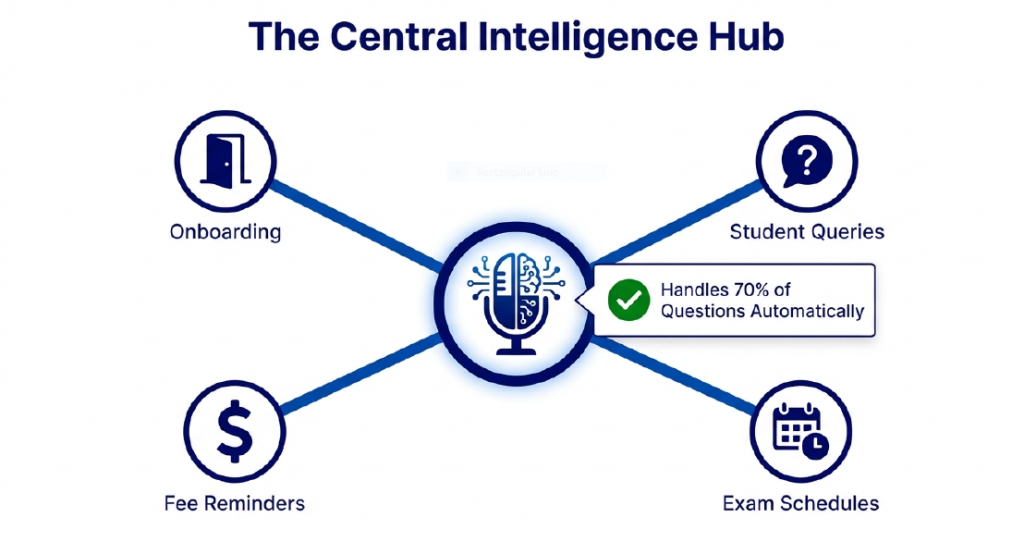
The student retention software using Voice Bot tracks student engagement on all college systems and automatically starts proactive outreach when it finds signs of trouble. Rather than waiting weeks for reports, the system finds students who are struggling in hours and contacts them immediately with personalized support. This turns retention from a crisis management function into a prevention tool that catches problems before students quit.
How AI Student Retention Software Is Different
The traditional method of retention involves the generation of a list of students at risk, which are then contacted by staff. AI-powered student retention software eliminates the waiting time associated with reporting and contacts students the moment warning signs are detected. It would take a human advisor longer to review reports, which are done once a week, compared to Voice Bot, which continuously monitors students and can start conversations hours after detecting worrying patterns.
What Voice AI Does for Student Retention
Voice Bot tracks various data sources such as learning management system usage, attendance, assignment submittals, grade distributions, payment status, and library or tutoring room usage. When it detects red flags such as a student not attending several classes or not performing well in assignments, it automatically reaches out to them through phone calls, texts, or emails. The AI engages in personalized conversations with students to find out what is going wrong, provides them with specific support options, sets up meetings with advisors or tutors, and notifies human staff members when human intervention is needed.
Key Features of Student Retention Software
Contemporary student retention systems have many advanced features. Real-time tracking implies that the system monitors student activity all the time, instead of providing reports at set intervals. Predictive analysis picks students who are likely to withdraw before they even notice that they are struggling, based on what the system has learned from past data. Automated communication starts contacting the student immediately when it detects a problem, instead of waiting for a staff member’s availability. Tailored communication deals with each student’s individual problem, instead of sending them generic messages. Multi-channel communication attempts to contact the student through phone calls, texts, emails, and notifications on the campus app, depending on the student’s preference. Intelligent escalation allows human advisors to take over difficult cases with full knowledge of what the student has been sharing. Continuous learning implies that the system learns from its outcomes and improves its predictions and interventions.
Why This Transforms Student Retention
The paradigm shift is from crisis management to prevention. Rather than asking “which students are failing and need crisis intervention,” the question becomes “which students are exhibiting early warning signs and could use a supportive check-in.” This is when problems are still small and easy to solve before students have psychologically checked out of the institution. The end result is a much higher retention rate with far less staff time invested because prevention is always easier than intervention.
How Voice Bot Student Retention Works
AI-Powered Student Retention in Action
Let me show you exactly how student retention software prevents dropouts.
Continuous Monitoring for Student Retention
Voice Bot keeps track of data from your college systems. It includes monitoring when students log into the learning management system, whether they are attending classes, whether they are turning in assignments on time, how they are performing on tests, whether they are using support services such as tutoring or the library, and whether they are paying their fees on time. The system identifies patterns that suggest a student is struggling, such as when they are logging in less often, missing classes, turning in assignments late or not at all, or failing tests.
Early Warning Detection
When the system identifies warning patterns, it alerts the student for proactive contact. For instance, if a student who usually logs in on a daily basis has not accessed the system for five days, that is a warning. When a student has not attended three classes within two weeks, that is a cause for action. If students who have been submitting assignments on time start submitting them late or not at all, the system alerts the student.
Immediate Proactive Outreach
As soon as the warning signs are identified, Voice Bot establishes communication with the student. The software places calls to the student during the time when he or she is most likely to be available, sends text messages if the calls are not answered, and then follows up with emails. The communication is customized depending on the information that the software has about the situation of the student, as opposed to a standard message that is sent to all students who are at risk.
The Student Retention Conversation
When Voice Bot reaches the student, it has a real conversation to grasp what is happening. The AI may say, “Hi Sarah, this is State University. I noticed that you missed Chemistry class a couple of times this week. Is everything okay?” The student can freely explain the situation. If the student is struggling in academics, confused about the concepts, having personal issues, financial issues, or feeling overwhelmed, the AI will listen to them and react accordingly based on what they are saying.
Providing Immediate Help and Resources
From what the student has said, Voice Bot offers immediate support that is relevant to the situation. If the student is confused about their studies, the AI arranges tutoring sessions and delivers study materials. If they are overwhelmed, it arranges a meeting with an academic advisor. If they are struggling financially, it sets them up with financial aid advisors. If they are expressing personal or emotional issues, it refers them to counseling services with the necessary level of urgency. The point is that the support is offered immediately in the conversation.
Smart Escalation to Human Staff
When a situation calls for human judgment, empathy with complex issues, or specialized knowledge, Voice Bot will automatically connect the student with the right staff member. The human has the full context of what the student has shared, so the student doesn’t have to tell their story twice. For instance, if a student is sharing a problem of emotional distress, Voice Bot will connect the student directly to the counseling department with the context of what was shared.
Follow-Up and Outcome Tracking
Voice Bot is not just one call and then forget the student. The system has a follow-up conversation to make sure that the student actually showed up for the tutoring session, met with the advisor, or resolved their issue. If the student does not show up for their support, Voice Bot follows up with them to see what barriers there are and provide alternatives. Everything that happens is automatically tracked, providing information on what actually works to retain students.
Real Student Retention Success Stories
State College Cuts Dropout Rate Significantly
Prior to using AI-driven student retention software, the first-year dropout rate at State College was what could be expected for colleges of their kind—roughly one in five students failed to return for the sophomore year. They chose to use Voice Bot, which tracks student activity and initiates proactive calls when warning signs emerge. It didn’t take a whole semester to notice a difference. Students who received proactive calls to address early warning signs were significantly more likely to re-engage than those who received generic emails. By the end of the year, their dropout rate had fallen dramatically. Thousands of proactive outreach calls were made during the year, scheduling hundreds of tutoring sessions, connecting dozens of students with counselors, and notifying advisors of students who required specialized attention. Most telling, however, was the fact that far more students who exhibited warning signs remained enrolled compared to years past when those same warning signs resulted in dropout.
Community College Prevents Financial Dropouts
A community college discovered that many of their dropouts were actually related to financial problems, not academic ones. Students would have problems with payment, be embarrassed to reach out to anyone, and just quit school. They began using student retention software that tracks payment status and makes immediate contact when problems arise. Voice Bot makes calls to students the same day a payment fails, discusses options such as payment plans or emergency assistance, and puts them through to financial aid counselors immediately. The results were staggering—the number of students who dropped out due to unpaid balances was greatly reduced. Students were grateful for the assistance, rather than being left to fend for themselves when financial problems arose. Employees did not have to spend time tracking down students with unpaid balances since AI took care of the initial contact and only referred those who needed special handling.
University Supports At-Risk STEM Students
A university observed that students enrolled in challenging STEM courses exhibited warning signs of impending dropout early on—missing one or two classes was often a harbinger of future dropout. They began using retention software to track STEM students and initiate contact based on early warning signs of dropout. Voice Bot reaches out to students who miss even a single class in calculus or chemistry to see if they are having trouble with the concepts and immediately sets up tutoring if necessary. The AI also automatically contacts students before big exams to make sure they are ready and provides access to study resources if necessary. This led to a significant decrease in dropout rates in STEM courses, especially among freshmen who tend to have difficulty adjusting to the rigors of technical education. Faculty members noticed that students were taking advantage of tutoring services at a much higher rate because the hurdle of having to ask for help themselves was eliminated; help came to them automatically.
Financial Impact of Better Student Retention
Understanding the Revenue Loss from Student Dropout
Each student who drops out means a significant loss of revenue for the college. It takes four years to complete an undergraduate degree, which means that each student is a source of multiple years of tuition revenue. If a first-year student drops out, the college will lose not only one year of tuition revenue but also three more years that the student would have paid. For colleges that have thousands of students enrolled, even a slight improvement in the retention rate means millions of dollars in saved tuition revenue. The business case for student retention software is simple: it pays for itself by preventing a few students from dropping out.
Beyond Direct Revenue: Hidden Benefits of Student Retention
The financial effects also include more than tuition. Improved retention enhances the reputation of the institution, ensuring recruitment is more effective. Students retained contribute to the alumni base, which is a source of financial support for many years or decades. Improved graduation rates enhance rankings and accreditation, ensuring the institution attracts better students and staff. Improved retention means more accurate projections of enrollment, ensuring better planning for facilities and staff. The institution also saves recruitment costs for students who would have dropped out.
Cost Comparison: Prevention vs. Recruitment
Think about the economics of retention versus recruitment. Recruiting a new student costs several thousand dollars in marketing and admissions staff time. Keeping a student from leaving costs a fraction of that, primarily the cost of the retention software subscription that tracks thousands of students at once. In other words, it is much more economical to retain the students you already have than it is to recruit new students to replace those you are losing. This is why progressive institutions are pouring money into retention efforts—the payback is immediate.
Staff Efficiency Gains from Student Retention Software
The AI-driven retention software also provides substantial staff time savings. Advisors and student success professionals no longer have to spend hours poring over reports to find at-risk students. They do not have to spend days trying to reach students who fail to respond to emails or voicemails. Instead, AI systems take care of initial contact, initial problem identification, and basic resource connection, while staff professionals concentrate on difficult cases that actually require human judgment. This means that institutions can serve more students with the same staff or serve students better who actually need specialized attention. Either way, the ROI on staff time alone often pays for the software.
Student Retention Technology and Integration
What Student Retention Software Connects To
Good student retention software will integrate with a variety of college systems to give a full view of student engagement. It will integrate with your learning management system to track login activity, assignment turns, quiz results, and discussion board activity. It will integrate with your student information system to track attendance, grades, enrollment status, and demographics. It will access financial systems to determine if payment problems exist that could be a barrier to enrollment. It will integrate with your CRM to record all interactions and work with other communications to students. Some systems will even integrate with campus card systems to determine if students are visiting dining halls, libraries, or recreation centers.
How Student Retention Software Monitoring Works
The system is constantly extracting information from integrated sources, usually updating multiple times a day or even in real-time. It compares each student’s current activity with their past behavior and with the characteristics of successful students. Machine learning algorithms find patterns that can predict the likelihood of dropping out based on your institution’s specific historical data. When concerning patterns are detected, whether sudden or gradual, the system alerts the students for intervention. The beauty of automation is that this comprehensive monitoring is done for all students at once, identifying students who would inevitably fall through the cracks of manual monitoring processes.
Student Retention Software Security and Privacy
Student retention software is developed with robust privacy and security protocols since it handles confidential academic information. It adheres to FERPA guidelines on student privacy. All data communications are encrypted. The software uses role-based access, which means it can only access the data required for its purpose. It maintains an audit trail of all data accesses and activities. Communications with students are kept confidential, and data is shared with authorized personnel only as per student consent and institutional policies. Students can usually opt out of automated communication if they wish to, although most students welcome the proactive support.
Implementation Timeline for Student Retention Software
The pace of implementing retention software is much quicker than that of other IT projects. The first week is spent identifying the systems that need to be integrated and learning about the risk factors specific to your institution. The second week is about the technical integration in which the vendor hooks into your learning management system, student information system, and other systems of relevance. The third week is about configuration in which you decide what patterns to trigger outreach on, what messages to send, and how to escalate various scenarios. The fourth week is about testing with a small group of students to make sure that everything is working as it should. By the fifth and sixth weeks, you are running at full capacity, monitoring all students.
Student Retention Software Cost Structure
Retention software typically uses subscription pricing based on the number of students monitored. Initial implementation includes setup fees to configure the system and integrate it with your specific platforms. Annual licensing covers the software, ongoing support, system updates, and continuous monitoring. Some providers charge per intervention or per retained student, aligning their incentives with your outcomes. Most institutions find that even if the software only prevents a small number of dropouts, the preserved tuition revenue exceeds the total cost by a substantial margin. The investment typically pays for itself within a single semester, with ongoing returns throughout subsequent years.
Getting Started with Student Retention Software
Understand Your Current Student Retention Challenge
The retention software usually operates on a subscription model that depends on the number of students being tracked. The initial cost of implementation involves setup costs to set up the system and interface it with your particular platforms. The annual licensing fee will take care of the software, support, system updates, and continuous monitoring. Some companies may charge per intervention or per retained student, which will align their interests with yours. It is likely that even if the software prevents only a few students from dropping out, the saved tuition revenue will be significantly more than the total cost.
Calculate Your Retention Problem Cost
Quantify your retention problem. Multiply the number of students who do not graduate each year by the tuition revenue they would have brought in if they had remained in school and graduated. This is a direct loss of revenue. Add the cost of staff time spent on manual retention processes—analyzing reports, making phone calls, sending emails, holding meetings with students at risk of not graduating. Factor in the cost of recruiting new students to replace those who do not graduate. Add these numbers together to see the total annual cost of substandard retention. Even a small increase in graduation rates will yield returns that pay for retention software many times over.
Start with a Focused Pilot Program
Instead of rolling out retention software solutions institution-wide without testing, begin with a pilot project. Identify a population of students with serious retention issues—perhaps first-year students, students in a particular program, or students with certain types of financial aid. Track this pilot population with AI-based retention software while continuing traditional methods with a control group. Conduct the pilot project for a full semester. Compare outcomes in terms of retention rates, student satisfaction, staff effort, and cost-effectiveness. A successful pilot, usually demonstrating a positive retention outcome with positive student feedback and lower staff effort, can give you the confidence to implement institution-wide.
Select the Right Student Retention Software Provider
Select a vendor with proven experience in higher education. Make sure they can interface with your specific learning management system, student information system, and other systems you are using. Check that their philosophy of outreach and intervention is compatible with your institutional culture and values. Ask for specific case studies from similar institutions that have actually improved retention. Arrange to talk with existing customers about their experience with implementation, support, and results. Make sure they meet all the necessary compliance and security standards for working with sensitive student information. The vendor becomes a long-term partner in improving student success, not just a software supplier.
Prepare Your Campus for Student Retention Software
To successfully implement, it is essential to have buy-in from multiple stakeholders. Help faculty see that the system is for the benefit of their students’ success without adding to their workload. Demonstrate to advisors and student success professionals how the system automates routine follow-up so they can focus on difficult situations that require their expertise. Use student concerns about privacy to explain how the system safeguards their information while proactively assisting them. Develop protocols for how the system is to escalate different scenarios to the appropriate staff members. Determine what kinds of student problems need to be addressed immediately by a human versus what can be handled by the AI system on its own. When all stakeholders know what their role is in the AI-assisted retention process, implementation becomes seamless.
Launch and Optimize Your Student Retention System
In the early weeks following the launch, it is important to observe the system’s activity. This will enable you to see which strategies are most successful in re-engaging students. You can listen to recordings of conversations between the AI system and students to see where improvements can be made. You can also monitor the speed at which staff respond when the system refers cases to human handling. Feedback from students and staff will help you understand the experience they have had. Based on what you have discovered, you can make changes to the system’s trigger levels, messages, strategies, and escalation rules.
Frequently Asked Questions (Faqs)
Q1: What is student retention software?
Student retention software is a technology that assists colleges in retaining students by identifying students who are at risk of not attending the college and taking preventive measures before they withdraw from the college. The latest AI-based student retention software is always tracking the engagement of students with the college systems, including attendance, assignment submissions, grades, and logins, among other factors. Once the software identifies that students are exhibiting warning signs such as unattended classes and poor performance, it automatically triggers proactive communication with the students through phone calls, text messages, or emails. Voice AI technology enables personalized conversations with students to determine the issues they are facing and immediately connects them with the relevant support services such as tutoring, advising, counseling, or financial aid.
Q2: How does AI student retention software prevent dropouts?
AI systems also work to prevent dropouts by detecting them early and acting on them immediately. Conventional systems work on reports that are manually checked by staff, and as such, weeks may go by before a struggling student is contacted. By this time, the student would have already fallen considerably behind and made up their minds to leave the institution. AI-powered retention software tracks all students constantly and identifies potential warning signs in a matter of hours rather than weeks. If a student has missed a few classes or shown signs of waning interest, the software makes contact with them on the same day. This allows problems to be identified while they are still small and easily remedied—a student who has missed two classes can be turned around with just one supportive conversation, but a student who has missed ten classes is much more difficult to salvage.
Q3: Will students be upset about AI monitoring their activity?
Most students will respond well to proactive support if it is offered in the right way. The trick is in the framing: students do not want to feel like they are being watched, but they do want to feel like they are being supported. When a student is not attending classes and Voice AI follows up with a phone call to check in and see if they are doing all right, most students will respond well because the institution cares enough to notice them. Students who are struggling often feel like they are alone and do not know how to reach out for help, so having help come to them is a big plus. Institutions should be open with students about using technology to help with student success, but they should also be clear about protecting privacy. Students can usually opt out if they do not want to receive automated calls. Usually, student satisfaction will increase with retention software because students feel like they are being supported and will not fall through the cracks if they are struggling.
Q4: What happens to advisors and student success staff?
The role of staff changes but is still necessary in AI-assisted retention systems. Today, advisors are spending a lot of time manually analyzing reports to find students at risk, making phone calls and sending emails that are frequently ignored, and addressing a large number of questions that do not actually require their expertise. With AI handling continuous monitoring, initial contact, routine resource connection, and follow-up, advisors can devote their specialized knowledge to cases that actually require human judgment. They spend time with students dealing with difficult academic choices, personal emergencies, mental health issues, or special circumstances that require tailored solutions. In most cases, institutions will require the same number of advisors but will be able to serve more students effectively because they are not tied up with administrative work. Staff members are also more satisfied with their jobs because they are engaged in relationship-building work rather than monitoring and following up with unresponsive students.
Q5: How quickly does student retention software show results?
Most institutions see measurable improvements within a single semester. Early indicators appear within weeks—you’ll notice students responding to outreach, attending tutoring sessions they were automatically scheduled for, and re-engaging with coursework after receiving proactive support. By semester’s end, you can compare retention rates for students who received AI-powered interventions versus those who didn’t, typically showing meaningful differences. Full impact becomes clear after a complete academic year when you can measure first-year to second-year retention improvement. Most institutions report that retention rates improve by a significant percentage, which translates to dozens or hundreds of additional retained students depending on institutional size. The financial return typically becomes positive within the first semester as preserved tuition revenue exceeds the software investment, with compounding benefits in subsequent years.
Final Thought: Student Retention Is Revenue Protection
Colleges invest enormous resources recruiting students, but many institutions pay insufficient attention to keeping those students enrolled through graduation. The financial and human cost of student dropout is staggering—students lose their investment and future opportunities, while institutions lose years of tuition revenue and damage their reputation with every student who leaves.
The challenge is that traditional retention approaches can’t scale effectively. Human advisors can’t monitor hundreds of students continuously, notice subtle warning signs immediately, and reach out instantly when problems emerge. By the time manual systems identify struggling students, intervention often comes too late.
AI-powered student retention software solves this scaling problem. It monitors every student continuously, detects problems within hours rather than weeks, initiates immediate personalized outreach, provides instant connections to support resources, and ensures no struggling student slips through the cracks unnoticed. This transforms retention from an impossible manual task into an automated system that catches problems early when they’re still easily solvable.
The institutions that thrive will be those that don’t just focus on enrollment numbers but optimize the complete student journey from admission through graduation. Student retention software is the foundation that ensures enrolled students stay, succeed, and complete their degrees.