
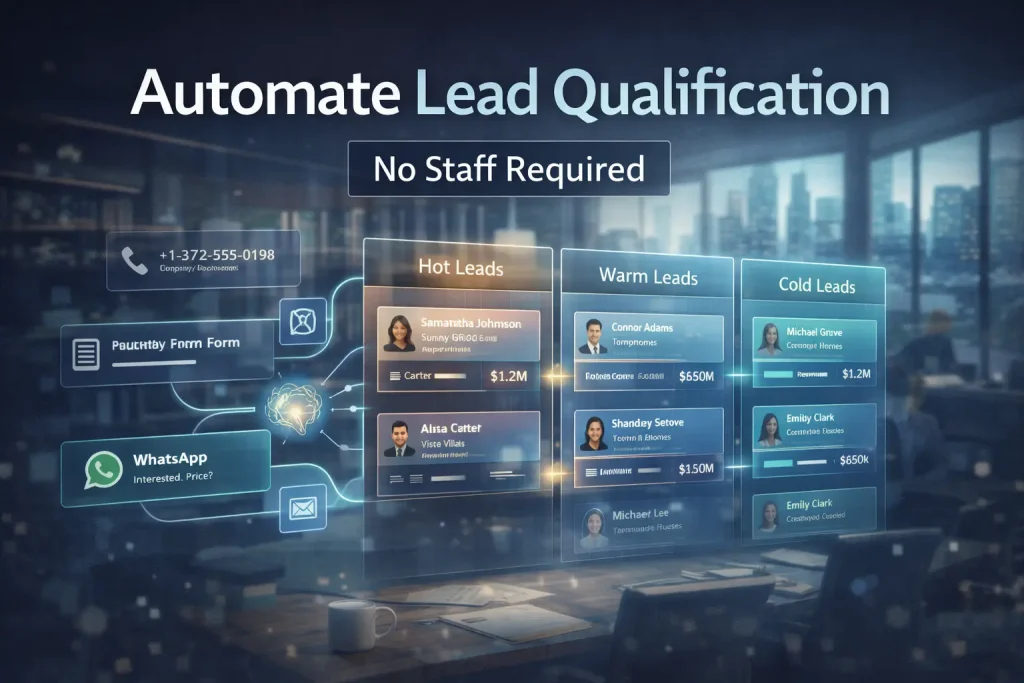
How to Automate Lead Qualification in Real Estate (Without Hiring More Staff)
lead qualification calls in the backgroundYou receive 80 new real estate leads for the month. That’s fantastic, right? Not exactly. You spend the entire week dialing each new lead, asking questions, and trying to determine who is serious. After 10 hours of non-stop phone calls, you find that only 20 of the 80 new leads are ready to buy or sell. The remaining 60 are just window shopping, not yet ready, or can’t afford properties within your price range.
This occurs every month for thousands of real estate agents. It’s one of the most time-consuming activities in the industry. You don’t know which new leads are worth pursuing until you’ve spent considerable time qualifying them.
The best part is that you no longer
Have to perform lead qualification manually. You can now automate lead qualification for real estate using AI voice bot technology without hiring more personnel.
The most successful real estate agents have already solved this problem. They use automated lead qualification systems before they even make a single phone call. They save 15+ hours of their time every week. They increase conversion rates by 30%. And they do it all without hiring virtual assistants or receptionists.
This guide shows you exactly how to automate lead qualification in your real estate business within 30 days.
What Lead Qualification Actually Means
Before we discuss automation, let’s define what lead qualification actually is in the real estate industry.
Lead qualification is the act of evaluating whether an individual has the ability and willingness to finalize a real estate transaction within a reasonable period of time.
An unqualified lead may be:
- Browsing without any intention of purchasing
- Working with a budget that doesn’t align with your properties
- Planning to move in a year or more
- Already working with another agent
- A qualified lead will have:
- A set timeline for moving forward
- The ability to finalize a transaction
- Active interest in areas you work in
- A legitimate need for agent services
The conventional method is a waste of your time.
Most agents qualify leads manually. A lead will come from your website or from your phone. When you have some time, you call back. You introduce yourself, ask questions, find out their timeline and budget, attempt to set up a meeting. This process takes 15 to 30 minutes per lead if you consider dialing, leaving voicemails, calling back, and actually talking.
Here's the rub
Only 20% to 30% of your leads are actually qualified. This means 70% to 80% of your time spent qualifying leads is spent on leads that will never be clients.
For an agent with 80 leads a month and 20 minutes per lead, that’s 27 hours of work. About 21 of those hours are spent on leads that will never become clients. At $100 an hour for your time, that’s $2,100 a month wasted, $25,200 a year.
Automation turns this model on its head completely.
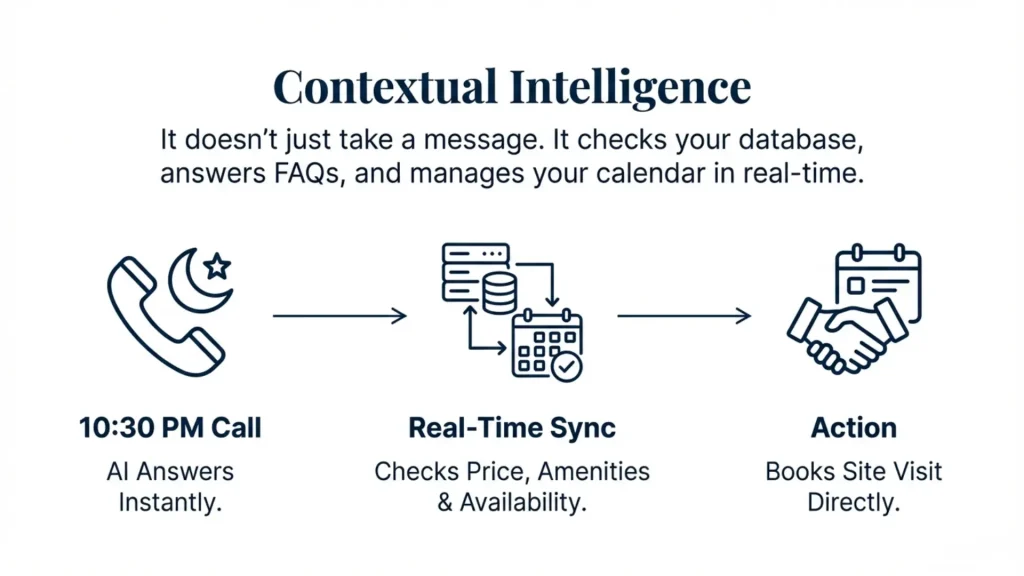
When you automate lead qualification in the real estate industry, for example, the system will qualify all leads before any of your time is invested in the lead. Rather than finding out that a lead is not qualified after speaking with them, automation allows you to find out automatically and only presents qualified leads to you.
The 5 Essential Questions Every System Must Ask
Lead qualification is all about asking the right questions. Below are the five essential questions that are the basis of any good lead qualification process.
Question 1: What Type of Transaction?
The first question is about whether the person wants to buy, sell, or rent property. This may seem like an obvious question, but it is a very important one. Many real estate agents specialize in either buying or selling. Others do not handle rentals at all.
Question 2: What's Your Budget Range?
Budget qualification is critical because it will give you an idea of whether there is any hope of a match. If your budget maxes out at $300,000 and your average listing price is $800,000, then neither of you should be wasting each other’s time. A good automated system will ask this question comfortably: “What price range are you considering?”
Question 3: What's Your Timeline?
Real estate is a timing business. A person who needs to locate a home in 30 days because their lease is up is a hot lead that requires immediate attention. A person who is considering buying in the next year or two is a cooler lead that requires nurturing but not immediate action.
Question 4: Are You Pre-Approved or Paying Cash?
This question will help you distinguish between serious buyers and people who are just browsing. Obtaining mortgage pre-approval is not a trivial process—it takes real work. People who have done this work are serious buyers. For cash buyers, this will confirm that they have the resources and can act quickly.
Question 5: Which Locations Interest You?
Knowing location preferences verifies they are looking in the areas where you actually work and have knowledge. It also shows priorities and lifestyle choices. A person looking for suburban family neighborhoods has entirely different requirements than a person looking for downtown condos
How AI Voice Agents Handle Qualification
Understanding how AI voice bot assistants actually qualify leads helps you understand why this technology has been so successful.
The dialogue begins seamlessly.
When a prospective client calls, the AI responds in two rings. The greeting is natural and conversational: “Thank you for calling. This is the office of Premier Real Estate. I’m here to help answer questions about our properties. Who am I speaking with today?”
Real conversations occur, not scripts
The AI employs natural language processing to comprehend what people actually say, not just key words. If a person says, “Hi, I’m calling about the three-bedroom house I saw online,” the AI comprehends they have introduced themselves, stated interest in a specific property, and stated buying intent.
The AI can answer specifically: “That’s a beautiful property with lots of natural light and an updated kitchen. Are you looking to buy or interested in renting?”
Property knowledge adds credibility.
Contemporary AI systems are programmed with information about all your current listings. This enables intelligent, specific discussions about properties, not general information-gathering. Discussions feel informative, not like interrogations.
Qualification questions flow naturally
.As the conversation progresses, the AI systematically goes through key questions while keeping the conversation natural. After determining that someone wants to buy, the AI could say: “That’s great. Have you considered your budget for this purchase?”
Based on their answer, the AI automatically recognizes whether this corresponds to the property they inquired about. If there is a good fit, the conversation proceeds. If not, the AI tactfully points this out: “The property you inquired about is listed for $450,000, which is a bit higher than your budget. However, we have several great properties within your budget that might be just right. Would you like me to set up a time to discuss those options?”
Everything gets captured automatically
During the conversation, the AI is doing all of the following at the same time: transcribing what is being said, pulling out the highlights, calculating the lead score, and determining what the next moves are. By the end of the conversation, your CRM has a full profile: name, contact information, property preferences, budget, timeline, financing status, location preferences.
The lead will also receive a lead score. Perhaps this is a 95 out of 100, which is a very hot lead that needs to be contacted immediately. Perhaps it is a 45 out of 100, which is someone for a long-term nurture series.
Real Results from Automated Lead Qualification
Now, let’s examine what happens when real estate agents actually implement the automation of lead qualification
Solo Luxury Agent Results
A high-end agent in a large city was producing 60 leads per month from her online marketing, networking, and website. However, she was only converting 5% of those leads into actual clients—three per month. The issue wasn’t a lack of quality. Her former clients gave her five-star ratings. She simply couldn’t handle the number of leads.She set up an AI voice bot solution that concentrated on lead qualification and appointment setting. The installation took approximately two hours to set up
Results showed up immediately
In the first month, her lead-to-appointment conversion rate increased from 5% to 14%. Instead of meeting three people a month, she was speaking with eight or nine qualified leads. In the third month, her conversion rate peaked at 18%.
But what mattered most was the quality of the appointments. Since the AI system had already determined budget, timeline, and preferences before scheduling, she knew exactly what to expect from each meeting. She wasn’t wasting time on unqualified leads—she was diving right into meaningful conversations with people who were ready to take the next step.
She also found an unexpected silver lining. The AI system answered calls in the evenings and on weekends. In six months, 35% of qualified leads came from calls outside regular business hours—that is, calls she would have never received before. This added one or two more deals a month, or about $28,000 in additional commission. With the system costing $500 a month, her ROI was 5,500%.
Mid-Sized Brokerage Results
A brokerage with six agents was handling 120 leads monthly. The managing broker noticed constant friction about lead distribution. Some agents felt they were getting lower quality leads. Response times were inconsistent. There was no systematic qualification, so agents spent huge amounts of time chasing leads that never converted.
She implemented an AI voice bot system to handle initial qualification before leads got assigned to agents. She programmed it to ask standard qualification questions plus property type preferences and neighborhood interests. This allowed automatic routing of qualified leads to whichever agent had most expertise in that property type or neighborhood.
Results transformed the entire operation
Within month one, they discovered they’d actually been receiving closer to 200 leads monthly rather than 120—they’d been missing 80 leads every month because calls came in when nobody was available.
The automated qualification and routing solved lead distribution problems. Instead of manual distribution, the system automatically routed each qualified lead to the most appropriate agent based on expertise and capacity. Conversion rates increased across the entire team because each agent only worked with leads matching their specific expertise.
Time savings were equally impressive. Agents had previously spent a combined 50 hours weekly on initial qualification calls. After implementing AI, that dropped to virtually zero. Those 50 hours got redirected toward actual client service, showings, negotiations, and closings. Overall team productivity increased 22%. In dollar terms, the brokerage closed an average of four additional transactions monthly—roughly $150,000 in additional monthly revenue.
International Developer Results
A luxury developer specializing in villa sales struggled with international buyers calling at all hours. Inquiry volume was highest between 8 PM and midnight, when international buyers researched properties during their business hours. The sales team of four agents couldn’t realistically staff phones 24 hours daily, missing significant international inquiries.
The director implemented an AI voice bot system specifically for after-hours inquiries. The AI got programmed with detailed information about all villa projects: floor plans, pricing, payment plans, completion timelines. It handled calls in both English and Arabic, covering the vast majority of their client base.
Over four months, approximately 70% of total inquiries came during after-hours when AI handled calls. Of these after-hours inquiries, the AI successfully qualified about 30% as serious prospects based on budget alignment, timeline, and financing status. These qualified leads got automatically scheduled for follow-up calls with human agents the next business day, with all qualification information already in their CRM.
The conversion rate on AI-qualified after-hours leads was actually slightly higher than leads handled by human agents during business hours. The AI did a more consistent qualification job because it asked the same questions the same way every time.
The after-hours AI system generated approximately 15 qualified leads monthly that would have been completely missed otherwise. With a 22% conversion rate and $35,000 average commission per villa sale, this translated to roughly three additional sales monthly—about $1.2 million in additional revenue. The monthly system cost was $650.
Integrating with Your Existing CRM
One of the biggest concerns about automated lead qualification is whether it works with existing technology, particularly CRM systems.
Most major CRMs offer straightforward integration
Popular real estate CRM systems—Salesforce, HubSpot, Follow Up Boss, kvCORE, BoomTown, LionDesk—all offer API access. This is how external systems securely connect to your CRM and exchange information.Setting up typically takes less than 15 minutes. You log into your CRM, generate an API key (essentially a secure password for system integrations), and enter that key into the AI platform. No technical expertise required beyond following simple instructions.
Data flows both ways
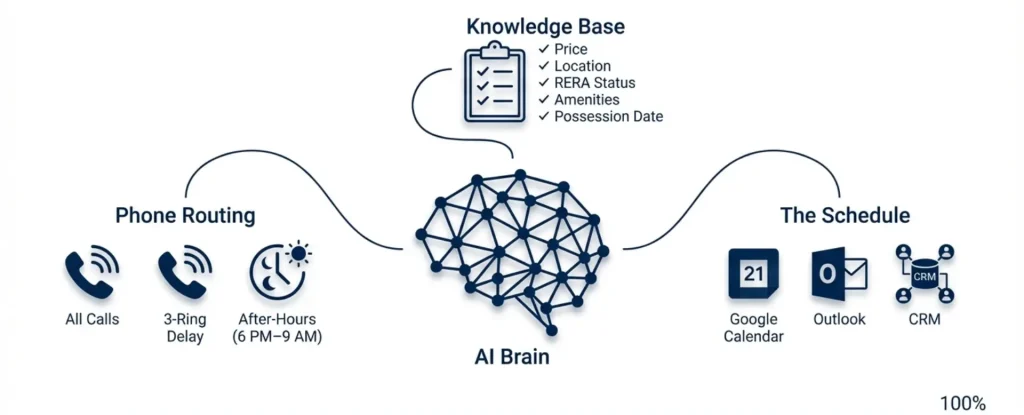
Once integrated, the AI system can read information from your CRM and write new information into it. On the reading side, the AI can access your current property list and details, allowing informed conversations about specific listings. It can see calendar availability if you grant access, enabling direct appointment booking without double-booking.
On the writing side—even more important—the AI automatically creates or updates lead records in your CRM after every conversation. Information synced typically includes: full name, phone number, email address if collected, conversation date and time, complete transcript, answers to all qualification questions, assigned lead score, recommended next action, and any scheduled appointments.
All this information appears in your CRM as if a human assistant manually entered it, immediately available for review and action.
Alternative solutions exist for uncommon systems.
For agents using less common CRMs or even spreadsheets, solutions exist through platforms like Zapier or Make. These integration tools act as translators between different software systems, allowing AI voice bot platforms to send information to virtually any system with an API or web-based data acceptance.
Integration preserves existing workflows
The practical impact is that automation doesn’t require changing how you work or learning new systems. When you open your CRM in the morning, you’ll see new qualified leads with all information already entered and organized. You can continue using whatever workflow you’re comfortable with—automation simply ensures leads in your system are higher quality and more thoroughly qualified.
30-Day Implementation Plan
Here’s a realistic timeline to go from current manual processes to fully automated lead qualification within 30 days.
Week 1: Preparation and Platform Selection
Document your current lead qualification process in detail. Write out every question you currently ask leads, what answers you’re looking for, and how you decide whether a lead is qualified. This formalizes what might be an intuitive process and ensures the automated system matches your actual business criteria.
Research and select an AI voice bot platform. Look for platforms specializing in real estate, offering integration with your specific CRM, providing natural-sounding voices in needed languages, and having transparent pricing with no long-term contracts. Schedule demonstrations with two or three different platforms to compare capabilities.
Week 2: Setup and Configuration
Most AI voice bot platforms offer guided onboarding where a specialist walks you through setup via video call. During setup, you’ll enter qualification criteria documented in week one, configure CRM connection, record current property listing information, set appointment availability, and customize conversational flow to match your style and brand voice.Initial setup typically takes two to four hours across one or two sessions. At week two’s end, you’ll have a fully configured system technically ready to take calls.
Week 3: Testing and Pilot Phase
This is a critical step many agents skip but shouldn’t. Instead of routing all leads through AI immediately, start with just 20% to 30% through automated qualification while handling the rest manually. This allows direct comparison to see whether automation actually improves qualification and conversion rates.Listen to several conversation recordings. Read through transcripts. Review assigned lead scores. Look at information entered into your CRM. This gives you a chance to spot issues, refine qualification questions, adjust conversational flow, or make improvements before rolling out to all leads.
Week 4: Full Implementation or Refinement
Make the decision to expand the system to all leads or make additional adjustments based on week three learnings. If results showed clear improvement in qualification quality, conversion rates, and time savings, confidently route all future leads through automation.
If you encountered issues or didn’t see expected results, spend additional time diagnosing problems. Perhaps qualification questions need rephrasing to be more conversational. Perhaps lead scoring criteria are too strict or lenient. Perhaps there are technical CRM integration issues needing resolution.
By week four’s end, you should have a fully operational lead qualification system handling all inbound calls, qualifying every lead consistently, booking appointments with qualified prospects directly onto your calendar, and entering all relevant information into your CRM automatically.
Total time investment
Eight to twelve hours across four weeks. This is remarkably small considering ongoing time savings of 15 to 20 hours weekly that most agents experience once fully operational.
Common Mistakes to Avoid
Learning from others’ mistakes can save significant time and frustration.
Mistake 1: Over-Qualifying Leads
Some agents set criteria too strict, configuring systems to only pass through leads meeting every single ideal criterion. This filters out leads slightly outside ideal parameters who could still become excellent clients with right guidance.
Better approach: Use qualification to score and prioritize leads rather than completely filtering anyone not meeting every criterion. Let AI flag leads as hot, warm, or cold. You decide how much attention each category deserves based on current capacity and business needs.
Mistake 2: No Human Backup System
Despite AI sophistication, situations still require human touch. Maybe a lead asks complex legal questions. Maybe they’re speaking with a heavy accent the AI struggles understanding. Maybe they simply prefer speaking with a human agent.
Your AI system should always offer leads the option to transfer to a human agent or schedule a callback. Set up call forwarding so when leads request human assistance, AI can transfer them directly.
Mistake 3: Neglecting Warm Leads
Automated qualification excels at identifying hot leads requiring immediate contact, but equally excels at identifying warm leads with genuine interest who aren’t ready to act immediately. Many agents focus all attention on hot leads while letting warm leads sit untouched.These warm leads represent significant future value. They’ve expressed interest, been qualified as potentially good fits, and simply need time and nurturing. Your automated system should include follow-up sequences for warm leads, sending helpful information, market updates, new listing alerts, or valuable content over time.
Mistake 4: Not Tracking Performance Metrics
If you don’t establish baseline measurements before implementing automation, you can’t prove whether the system actually works. Before routing any leads through AI qualification, document current numbers: average response time, percentage of leads successfully contacted, percentage converting to appointments, overall lead-to-closing conversion rate, hours weekly spent on qualification.
Once automation runs, track these same metrics weekly for at least three months. This data clearly shows whether automation improves your business. If results aren’t expected, it helps identify specifically where adjustments are needed.
Take Action on Automated Lead Qualification
Lead qualification represents one of the most significant time drains in real estate, but it’s also one of the most easily automated processes.Agents consistently outperforming competitors aren’t necessarily working harder or spending more on lead generation. They’re working smarter by using automation to handle repetitive, time-consuming tasks so they can focus energy on high-value activities requiring human expertise.
The value proposition is straightforward
You capture more leads because systems never miss calls. You qualify leads more consistently because systems ask same questions the same way every time. You respond faster because systems work instantly without delay. You save enormous time because you only personally engage with leads already pre-qualified and ready for your attention.
For most agents, the decision to automate lead qualification comes down to simple cost-benefit analysis. If you’re currently handling more than 40 leads monthly, spending more than $2,000 monthly on lead generation, or finding you simply don’t have time to properly follow up with all leads, the math almost certainly favors automation.Typical cost of $400 to $600 monthly for AI voice bot systems gets recouped by converting just one additional lead—which most agents accomplish within first 30 days after implementation.
The question isn’t whether automated lead qualification is effective. Data from thousands of real estate professionals proves it works. The real question is whether you’ll be an early adopter gaining competitive advantage by implementing before local competitors, or whether you’ll wait until automation becomes standard practice and you’re forced to implement just to keep up.
Start Qualifying Leads Automatically Today
Ready to see how automated lead qualification would work in your specific real estate business?
Download our free “Lead Qualification Checklist” that walks through exactly what questions to ask, what answers to look for, and how to score leads effectively. Get your complete implementation guide with qualification question templates, CRM integration instructions, and ROI calculator.
The technology is ready. Your leads are waiting. The only question is: will you automate lead qualification before your competitors do?
Most major CRMs offer straightforward integration
One of the biggest concerns about automated lead qualification is whether it works with existing technology, particularly CRM systems.
Frequently Asked Questions (Faqs)
Q1.How does automated lead qualification work in real estate?
Automated lead qualification uses AI voice bot technology to answer incoming calls, ask qualifying questions, and determine if a lead is ready to buy or sell. The system asks about budget, timeline, location preferences, and financing status. Based on responses, it assigns a lead score and either books an appointment with qualified prospects or adds them to nurture sequences. All information gets automatically entered into your CRM without any manual work.
Q2.What questions should I ask to qualify real estate leads?
The five essential lead qualification questions are: (1) Are you looking to buy, sell, or rent? (2) What’s your budget range? (3) What’s your timeline for moving forward? (4) Are you pre-approved for financing or paying cash? (5) Which locations interest you? These questions help determine if someone is ready, willing, and able to complete a transaction. Your automated system should ask these questions in a natural, conversational way during every call.
Q3.How much does it cost to automate lead qualification?
Most AI voice bot systems for real estate lead qualification cost between $300 and $600 per month, depending on call volume and features. This is significantly less expensive than hiring a virtual assistant ($800-$1,500 monthly) and provides 24/7 coverage instead of limited hours. The typical agent recoups this investment by converting just one additional lead per month. Most see positive ROI within 30 to 60 days after implementation.
Q4.Will automated lead qualification work with my CRM?
Yes, modern AI voice bot platforms integrate with all major real estate CRM systems including Salesforce, HubSpot, Follow Up Boss, kvCORE, BoomTown, and LionDesk. Integration typically takes less than 15 minutes through API connections. The system automatically writes lead information, conversation transcripts, qualification scores, and appointments directly into your existing CRM. For less common systems, integration tools like Zapier provide connectivity.
Q5.How long does it take to set up automated lead qualification?
Full implementation typically takes 30 days following a structured plan. Week one involves documenting your qualification criteria and selecting a platform. Week two is setup and configuration (2-4 hours). Week three is testing with a small percentage of leads. Week four is full implementation or refinement. Total time investment from you is approximately 8 to 12 hours spread across the month. Once running, the system requires minimal ongoing maintenance.
Q6.Can AI really qualify leads as well as a human agent?
AI voice bot systems often qualify leads more consistently than humans because they ask the same questions in the same way every single time. They never skip questions, forget to record information, or make assumptions. Case studies show that AI-qualified leads actually convert at slightly higher rates than manually qualified leads because the qualification process is more thorough and consistent. However, the AI always offers callers the option to speak with a human agent when needed.