
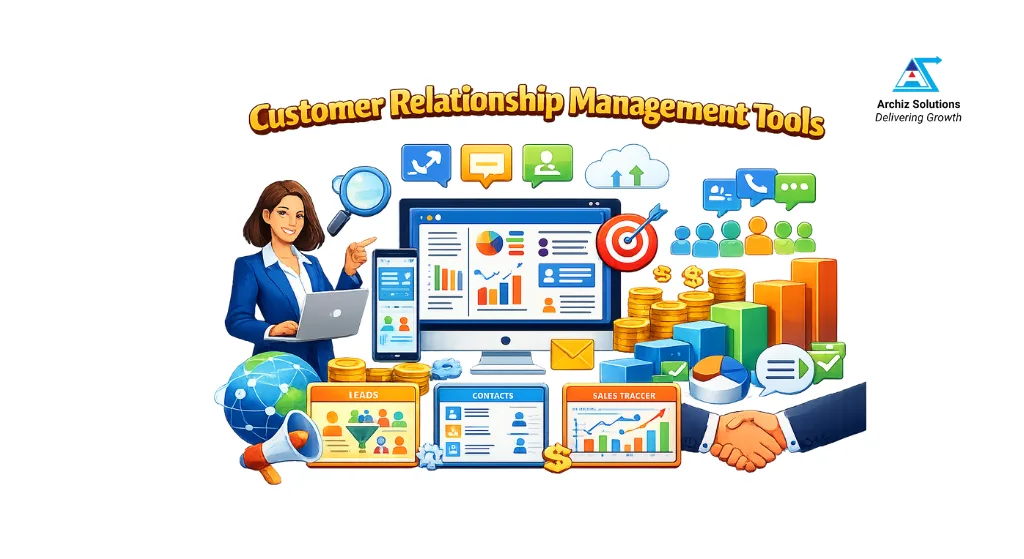
Customer Relationship Management Tools
In today’s competitive market, businesses need a structured way to manage customer interactions and sales processes. Customer relationship management tools help organizations centralize customer data, track communication, automate tasks, and build long-term relationships. By using the right CRM tools, businesses can improve efficiency, boost sales performance, and deliver a better customer experience.
Modern customer relationship management tools are designed to support sales, marketing, and customer service teams by providing real-time insights and automation that drive business growth.
Today’s often include an automated digital assistant— a smart CRM assistant that automates tasks like lead scoring, follow-ups, and real-time insights so teams can focus on strategic engagement.
What Are Customer Relationship Management Tools?
Customer relationship management tools are software solutions that help businesses store, organize, and analyze customer information across multiple touchpoints. These tools allow companies to manage leads, monitor sales pipelines, track customer interactions, and measure performance.

Key Features of Customer Relationship Management Tools
1. Centralized Customer Data
CRM tools store all customer details—contact information, interaction history, and purchase records—in one place. This enables teams to deliver personalized communication and maintain consistency across departments.
2. Lead and Opportunity Management
Customer relationship track leads from multiple channels such as websites, emails, calls, and social media. This ensures no lead is missed and helps sales teams focus on high-value opportunities.
3. Sales Automation
Automation features handle repetitive tasks like follow-ups, reminders, and status updates. This improves sales productivity and allows teams to focus on closing deals.
4. Reporting and Analytics
CRM tools provide real-time reports on sales performance, customer behavior, and pipeline progress. These insights help businesses make data-driven decisions and improve forecasting accuracy.
5. Improved Team Collaboration
With shared dashboards and activity logs, customer relationship improve collaboration between sales, marketing, and support teams.
Benefits of Using Customer Relationship Management Tools
Improved customer engagement and retention
Faster lead response and higher conversion rates
Better visibility into sales performance
Reduced manual work and operational costs
Enhanced customer satisfaction and loyalty
By implementing the right customer relationship businesses can strengthen relationships while increasing revenue and profitability.
Choosing the Right Customer Relationship Management Tools
When selecting CRM tools, businesses should consider:
Ease of use and scalability
Customization options
Integration with existing systems
Automation and reporting capabilities
Data security and support services
The right customer relationship management tools should adapt to your business needs and grow alongside your organization.
When these capabilities are part of an proactive CRM workflow engine — a self-optimising CRM system that anticipates tasks, triggers intelligent workflows, and adapts over time — the tools evolve from management systems into proactive growth engines.
Conclusion
Customer relationship management tools play a vital role in helping businesses manage customer interactions, streamline sales processes, and improve overall efficiency. By centralizing data, automating workflows, and providing actionable insights, these tools empower organizations to build stronger customer relationships and achieve long-term success.
Frequently Asked Questions (Faqs)
Q1.What are customer relationship management tools?
Customer relationship management tools are software solutions that help businesses manage customer data, track interactions, automate sales processes, and improve communication across sales, marketing, and support teams.
Q2.What are CRM tools with AI agent and voicebot features?
These are advanced customer management systems that use artificial intelligence and voice automation to handle queries, track interactions, and improve customer engagement.
Q3.How does an AI agent help businesses?
An AI agent can automate responses, qualify leads, manage support tickets, and provide 24/7 assistance without human intervention.
Q4.What is the role of a voicebot in customer service?
A voicebot interacts with customers through voice calls, answers common questions, routes calls, and reduces workload for support teams.
To effectively engage these highly profitable leads during midnight, the best way to do that is through the implementation of a Conversational AI Voicebot.
With the use of powerful algorithms that allow NLP capabilities to take place along with integration into your CRM, the AI Voicebot becomes your ultimate 24/7 Business Development Representative (BDR). They will never require overtime and they will not put your high net worth client on hold.
Whereas you human agent may be annoyed at you at midnight, the AI Voicebot will always have impeccable manners and professionalism.